
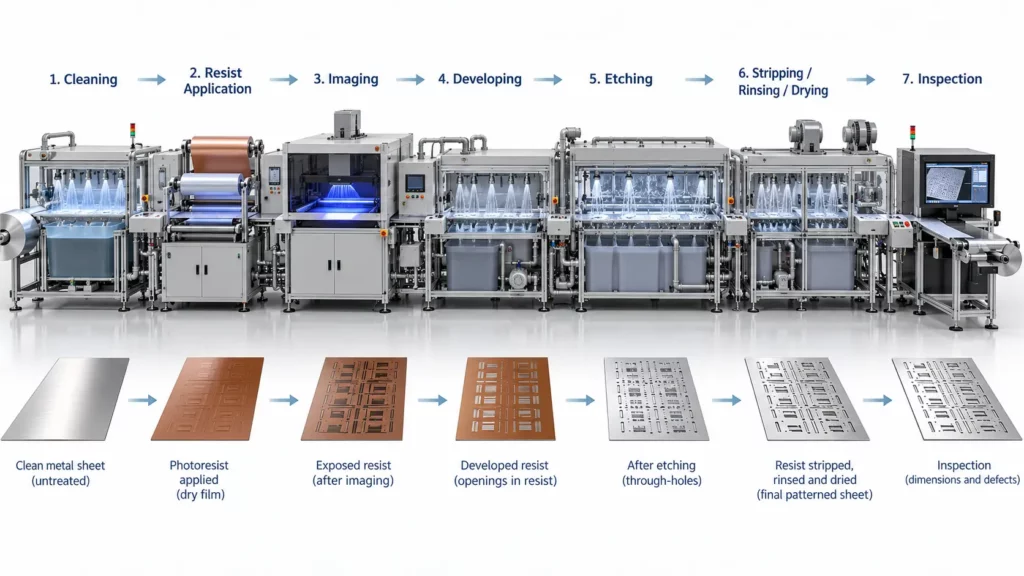
Chemical etching equipment for precision metal parts works as a linked production system. A typical photochemical etching line needs surface cleaning, resist application, imaging, developing, etching, stripping and inspection. Select the equipment from the part drawing, material and required output, then compare the full operating cost with outsourcing.
This guide covers wet processing of thin metal sheet and foil. Equipment used for photochemical machining is also often described as chemical milling equipment. Large structural chemical milling and semiconductor plasma etching require different equipment assessments.
If your project needs finished components, outsourced chemical etching services provide another route to evaluate before investing in a line.
Key takeaway: Specify each module against the same material, drawing and inspection requirements. Evaluate sample quality, repeatability, line capacity and running costs together. Compare in-house production and outsourcing using the cost of accepted parts delivered to the same requirements.
What Equipment Makes Up an Industrial Metal Etching Line?
Industrial etch line systems combine equipment that prepares the metal, defines the pattern, removes exposed material and verifies the result. Process stages include preparation, masking, etching, stripping and inspection. Some modules may be separate machines; others may form an integrated line.
| Process stage | Typical equipment | What to verify |
|---|---|---|
| Surface preparation | Cleaning, rinsing and drying equipment | Cleanliness, residues and surface condition |
| Resist application | Dry-film laminator or suitable coating system | Coverage and adhesion |
| Imaging | Exposure and alignment equipment | Pattern definition and registration |
| Developing | Developer and rinse modules | Complete openings without unwanted resist loss |
| Etching | Etching chamber and material-handling system | Feature dimensions and uniformity |
| Post-etch processing | Stripping, rinsing and drying equipment | Resist removal and cleanliness |
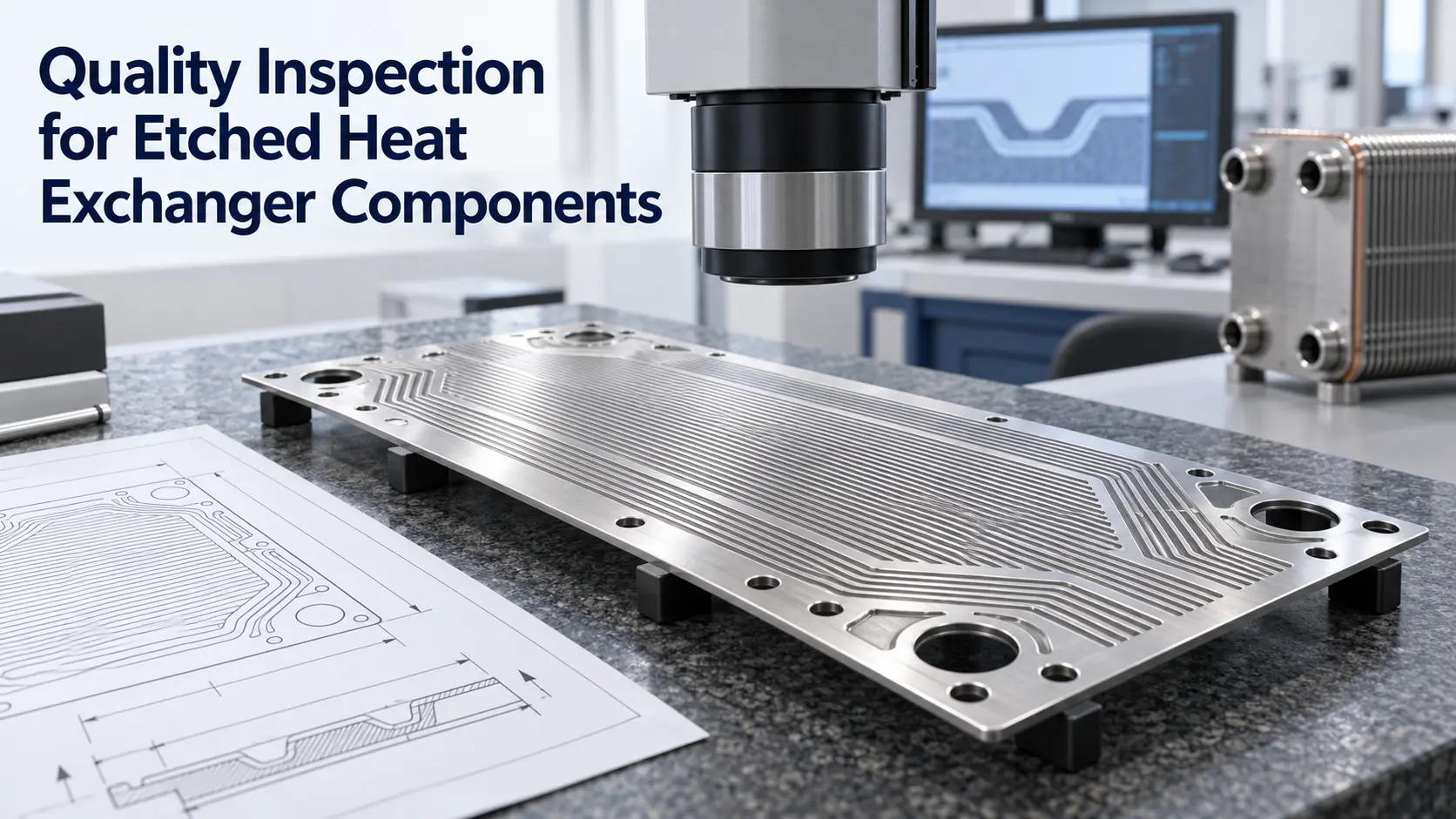
| Inspection | Optical measurement and suitable gauges | Drawing compliance and surface condition |
Cleaning and Surface Preparation
Cleaning prepares the metal for photoresist, the light-sensitive coating that protects selected areas during etching. Oil, particles or unsuitable surface conditions can interfere with adhesion and pattern quality.
Define the incoming material condition before choosing cleaning equipment. Check cleaning effectiveness, rinse quality and handling between preparation and resist application. Thin sheets also need support that limits creasing or transport damage.
Resist Application, Imaging and Developing
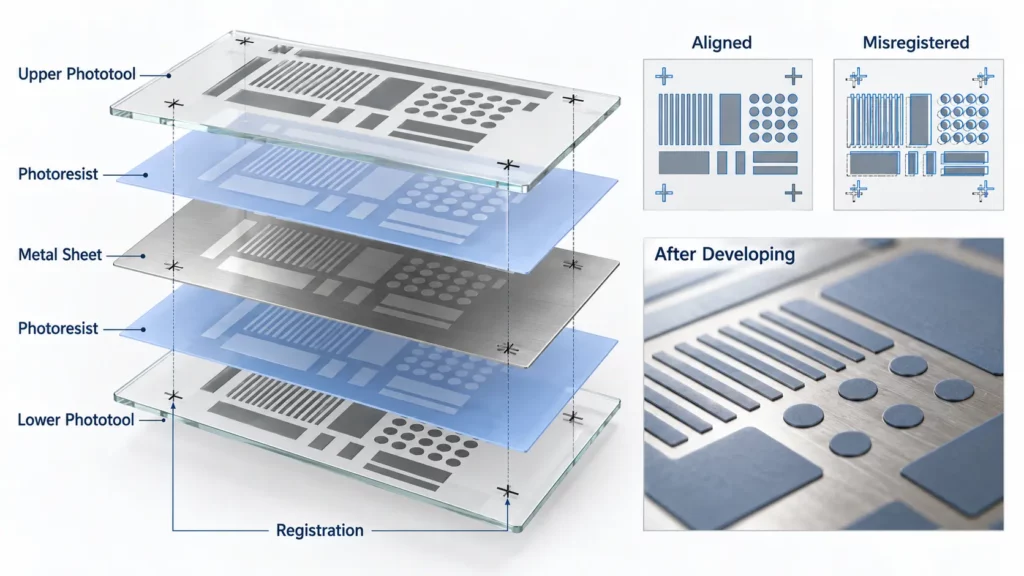
The resist system must suit the material, imaging method and etching chemistry. Exposure transfers the design into the resist, while developing opens the areas selected for metal removal.
For double-sided parts, confirm front-to-back registration. Evaluate resist adhesion, pattern integrity and developed openings before treating the etcher as the source of a dimensional problem.
Etching, Stripping, Rinsing and Inspection
The etching machine removes exposed metal according to the developed pattern. Stripping removes the remaining resist, followed by suitable cleaning and drying.
Inspection completes the production route. For an etched stencil or micro-hole plate, define how openings, positions and edge conditions will be checked. Select optical measurement, microscopes or gauges according to the feature size and tolerance.
Wet Etching Systems: Immersion, Spray and Conveyorized Equipment
Immersion and Spray Etching
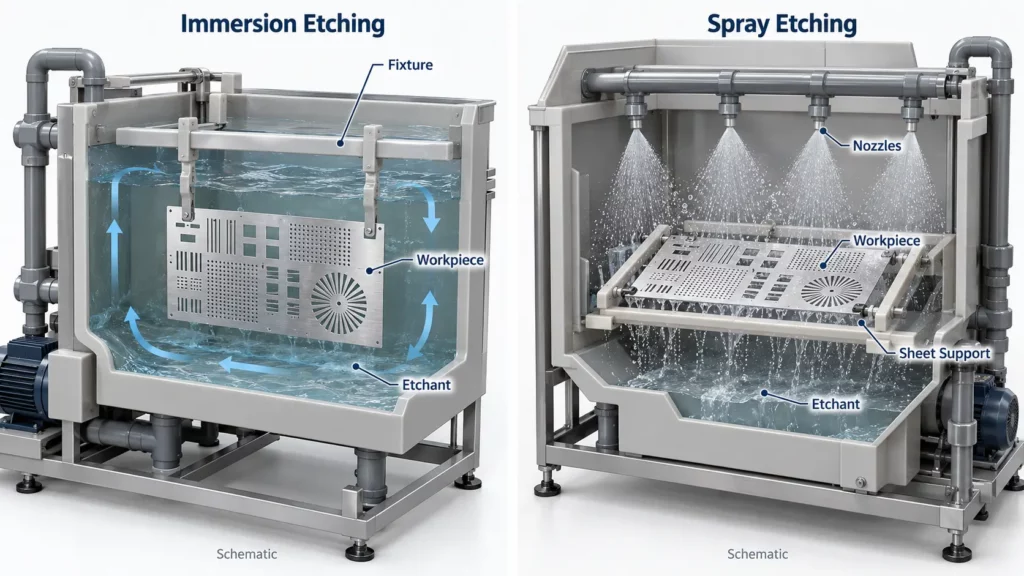
Immersion systems place the workpiece in an etchant bath. Spray systems deliver etchant through nozzles. Compare them against the actual material, geometry, exposed area, support requirements and desired uniformity.
For spray equipment, examine nozzle access, spray distribution and maintenance. For immersion equipment, examine solution movement, fixtures and loading. Either approach needs a validated process; the method alone does not establish achievable quality.
Batch, Conveyorized and Reel-to-Reel Configurations
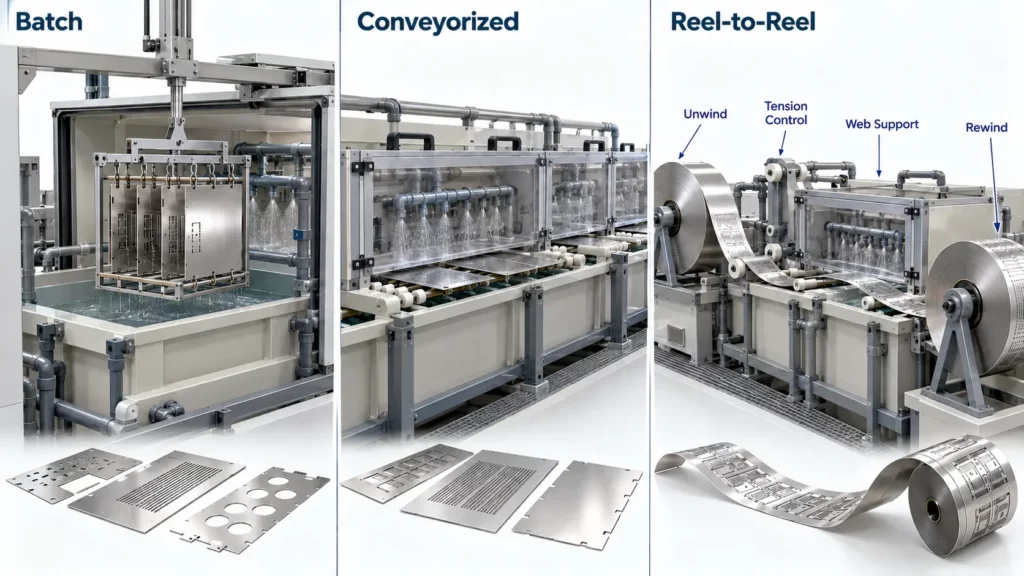
Batch and conveyorized configurations describe how work moves through production. They should be assessed separately from the choice between immersion and spray etching.
A conveyorized line may support repeat processing of sheet material. Reel-to-reel processing requires compatible coil stock, tension control and a suitable product layout. Verify transport and support using representative material, especially where etching changes its stiffness.
Automated Chemical Etching Lines and Equipment Integration
Module Integration and Production Bottlenecks
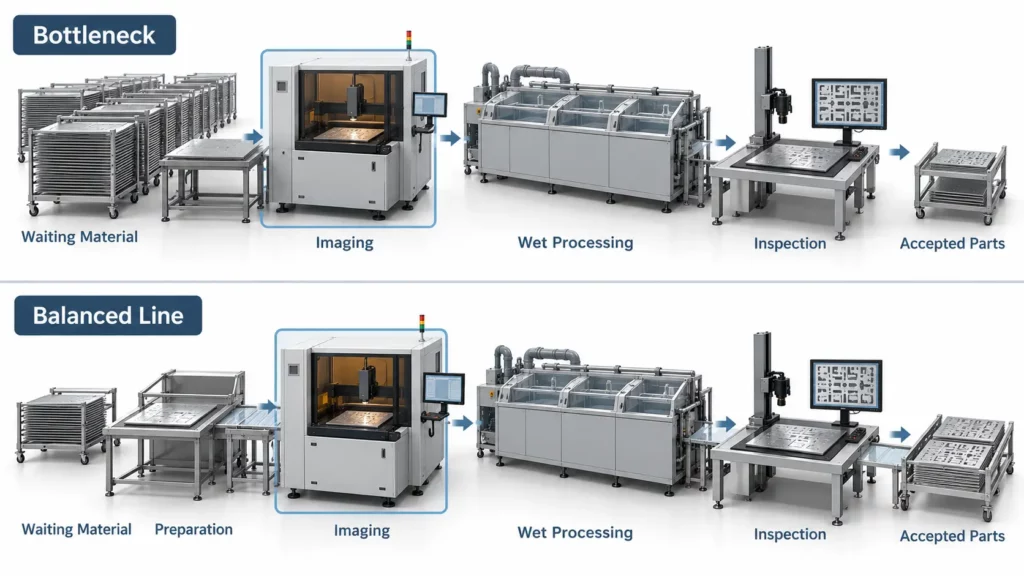
An automated chemical etching line must balance preparation, imaging, wet processing and inspection. A faster etcher provides limited benefit when another stage sets the production rate.
Before specifying automated etching equipment integration, map the flow from incoming metal to accepted parts. Identify transfer points, waiting time, product changes and inspection capacity. Confirm whether each module can handle the planned workload and whether future expansion is practical.
Ask how the system handles interrupted production. Define how partially processed material is identified and assessed before restarting.
Thin-Material Handling and Process Repeatability
Automation can reduce setup variation through recorded settings, process recipes and monitoring. Chemcut’s wet-processing equipment options include thin-material transport, recipe-driven operation and data collection.
Assess these features against a specific production need. For example, thin foil may require different support from a thicker sheet with the same outside dimensions.
Confirm how operators identify the active recipe, record changes and respond to alarms. Repeatability still requires material control, chemical management, maintenance and inspection.
How to Specify a Chemical Etching Machine for Metal
Material, Thickness and Sheet Size
Start with the exact material grade, thickness, sheet dimensions and surface condition. Define whether the design requires through-etching, partial-depth features or both.
For a chemical etching machine for stainless steel, a general material label is insufficient. Confirm the grade, selected chemistry and compatibility of wetted components, including tanks, pumps, seals and heaters.
Review photochemical etching materials and tolerances before setting equipment requirements. The machine must accommodate the intended process window and material format.
Fine Features, Tolerances and Etch Uniformity
List the dimensions that control fit, sealing, flow or electrical function. Identify critical openings, slots, narrow webs and feature positions instead of applying one tolerance to every dimension.
For example, specify the diameter and position of functional holes separately from a non-critical outside edge. For parts with both through-etched and depth-etched features, identify which surfaces and depths need measurement. These distinctions give the equipment trial clear acceptance criteria.
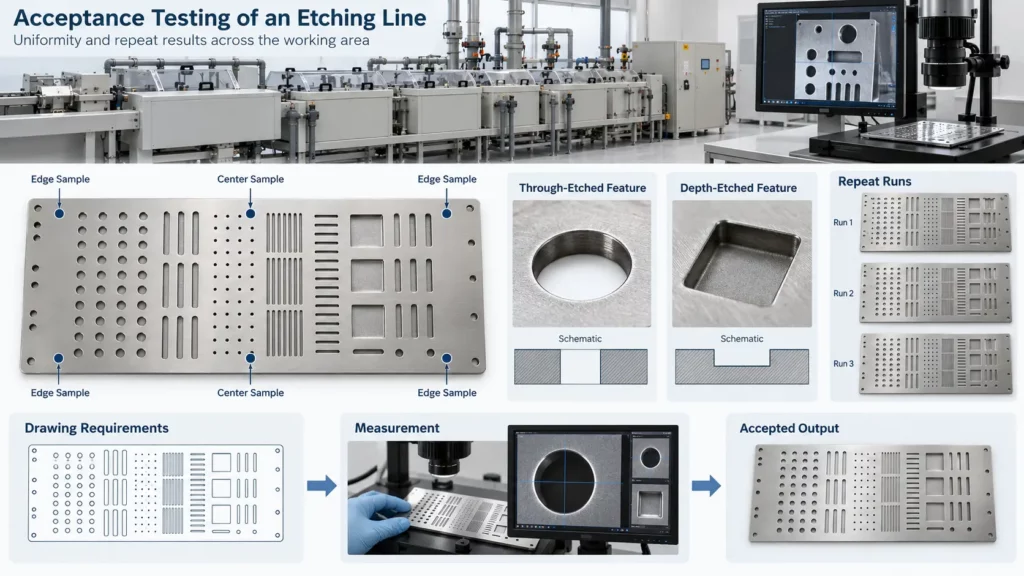
For fine chemical milling, equipment acceptance should include uniformity across the working area and repeat results. Image accuracy, registration, resist condition and etching controls all need evaluation.
A quoted minimum feature size becomes useful only when its material, thickness, geometry and inspection conditions are defined. The photo etching quality control guide can help to plan the supporting checks.
Throughput and Equipment Acceptance
Compare throughput using a representative drawing and an agreed acceptance standard. Conveyor speed does not directly state how many usable parts the line will produce.
A practical acceptance plan should cover:
- Customer material and the approved drawing revision.
- Critical dimensions and measurement methods.
- Samples from different locations across the sheet.
- Repeat runs under agreed operating conditions.
- Accepted output, setup time and product changes.
- Verification after installation at the operating site.
Record the results and any limits revealed by the trial. These provide a stronger purchasing basis than an isolated sample or brochure claim.
Chemical Control, Maintenance and Safety Requirements
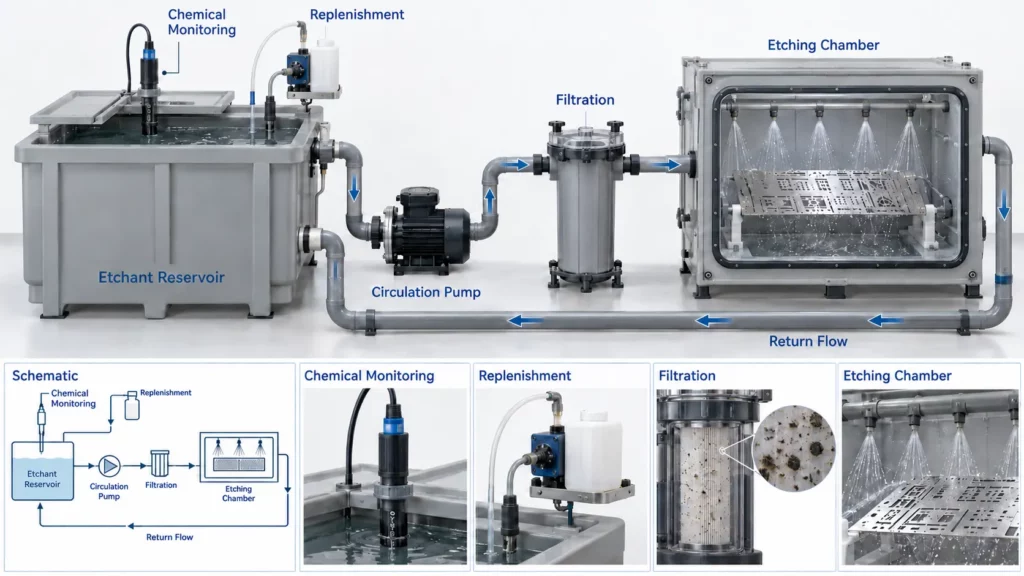
Filtration, Recirculation and Bath Management
Filtration removes suitable solid particles. Recirculation moves solution through the system. Chemical management maintains the bath within the validated operating conditions. These functions solve different problems.
Choose monitoring and replenishment methods for the actual chemistry. Regeneration is a process option to assess, rather than a standard feature required for every line.
Maintenance, Utilities and Waste Handling
Acid etching equipment requires a facility plan as well as a machine specification. Confirm utilities, ventilation, spill collection and applicable worker protection requirements. An industrial etching plant also needs space for material handling, chemical storage and maintenance access.
Ask the supplier to distinguish normal temperature control from protective functions such as over-temperature or low-level shutdown. Verify which functions are included and how they are tested.
Keep waste etchant, rinse water and stripping waste identifiable. Treatment or recovery must match their composition. Adjusting pH alone does not establish discharge compliance: U.S. metal-finishing effluent rules, for example, address specified metals separately from pH. Apply the requirements relevant to the actual facility and discharge route.
How to Evaluate an Etching Equipment Supplier
Confirm the Supplier’s Role and Product Scope
Establish whether the company manufactures equipment, distributes it, integrates systems or produces etched parts. Owning an etching line does not establish that a company sells production equipment.
Chemcut and Masteretch publish identifiable wet-processing machines and configurations. Use official product information to verify offered equipment, then assess suitability through a documented trial.
Compare Trial Results and Lifecycle Support
Request a written scope covering machines, controls, ancillary equipment and facility responsibilities. Confirm installation, commissioning, training, acceptance criteria and support arrangements.
Check access to replacement pumps, nozzles, filters and transport components. Clarify software support and responsibility for process development. Equipment support should cover the planned operating life, including product or chemistry changes where agreed.
In-House Chemical Etching vs. Outsourcing
Compare Total Cost per Accepted Part
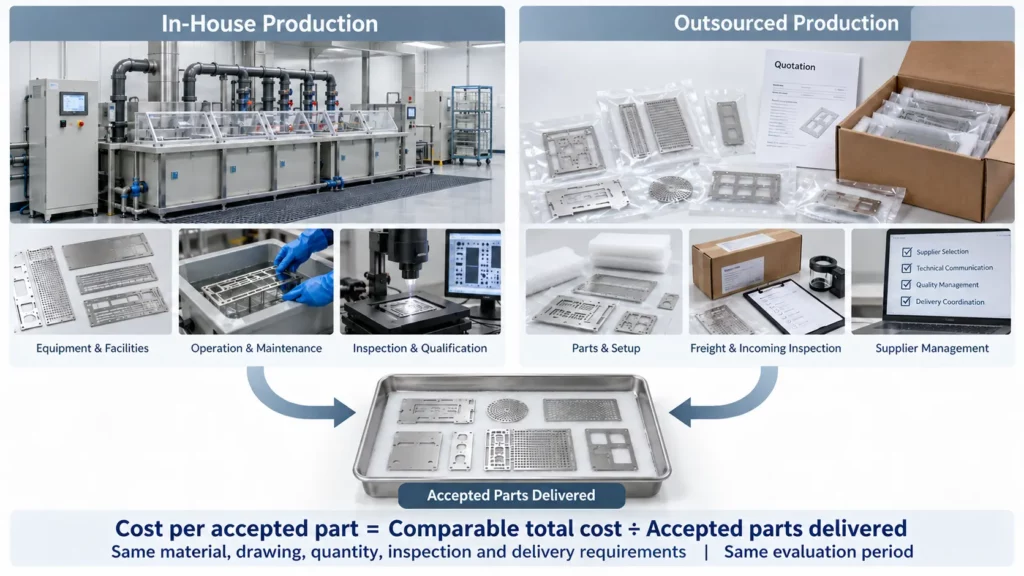
Compare both routes against the same material, drawing, quantity, inspection and delivery requirements. Use accepted parts delivered as the cost denominator.
| In-house production | Outsourced production |
|---|---|
| Annualized equipment and facility investment | Part price and initial tooling or setup charges |
| Labor, utilities, materials and process chemicals | Freight and incoming inspection |
| Maintenance, inspection, scrap and downtime | Supplier management and inventory costs |
| Process development and qualification | Sampling, qualification and change charges |
Include realistic utilization and product changes in the in-house estimate. A line operating below its planned workload spreads fixed costs across fewer accepted parts. For outsourced quotations, check what is included using the photochemical etching cost guide.
When In-House Production Deserves Evaluation
In-house production may suit stable, recurring demand where internal process control has clear value. It also requires staff who can manage chemistry, maintain equipment and verify part quality.
| Decision factor | Conditions supporting an in-house assessment | Conditions supporting an outsourcing assessment |
|---|---|---|
| Demand | Predictable repeat workload | Uncertain or intermittent orders |
| Product mix | A relatively consistent process range | Frequent material or design changes |
| Capabilities | Available process and quality staff | Skills need to be established |
| Facilities | Suitable operating infrastructure | Significant facility investment needed |
High volume strengthens the case for analysis, but it does not establish the investment result. Check accepted output, operating resources and the cost of interruptions.
When Outsourcing Fits the Project
Outsourcing may suit prototypes, uncertain demand or projects requiring several materials and secondary operations. Evaluate the supplier’s ability to meet the complete drawing and delivery requirements.
Use a chemical etching supplier checklist to review process capability, inspection, traceability and change control. Agree on ownership and handling of design files, tooling and relevant production records.
Keep the decision open to project stages. External prototypes can support design validation while the team evaluates whether a future in-house line is justified.
FAQs
What Is a Chemical Etching Machine Used For?
A chemical etching machine selectively removes exposed metal using an etchant. With the appropriate masking process, it can produce profiles, holes, slots or partial-depth features in metal parts.
Does One Etching Machine Provide a Complete Production Line?
An etcher handles the material-removal stage. Verify which cleaning, resist, imaging, developing, stripping, rinsing and inspection functions are included or need separate equipment.
Can PCB Etching Equipment Be Used for Standalone Metal Parts?
Some wet-processing equipment may be adaptable, but compatibility requires verification. Check material thickness, chemistry, transport, support and achievable quality using the intended metal part.
Does a Metal Etching Line Need a Process Gas Supply?
Gas or compressed-air requirements depend on the configuration, including handling and any chemical-regeneration system. Semiconductor plasma etching has different process-gas and vacuum requirements, which should not be assumed for a wet metal etching line.
Discuss Your Etched-Part Requirements
If you are evaluating outsourced production, share your drawing revision, material grade, thickness, quantities and critical tolerances with TMNetch. Include inspection, finishing and delivery requirements so the project can be assessed as a complete manufacturing request. Discuss your chemical etching project.