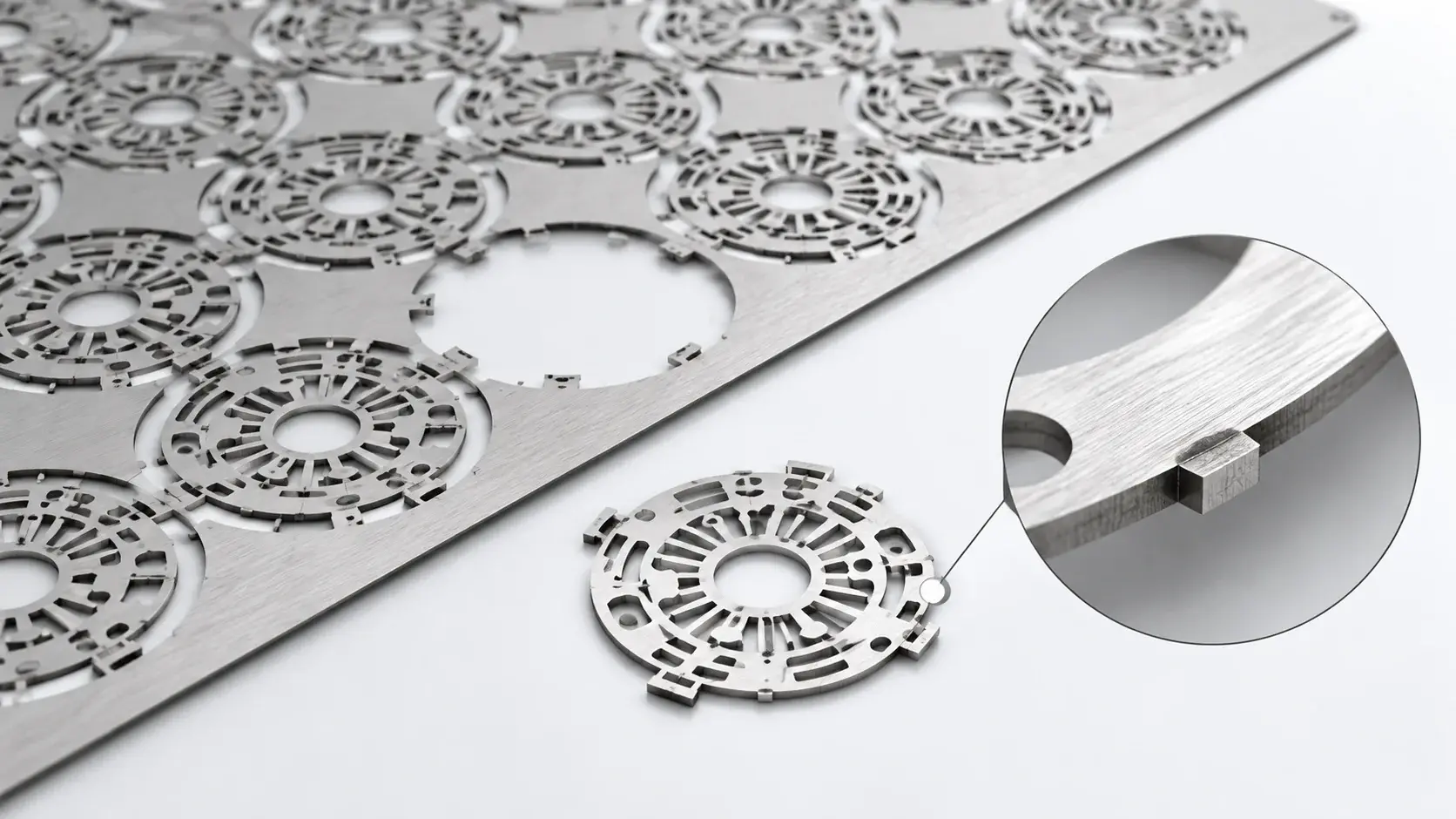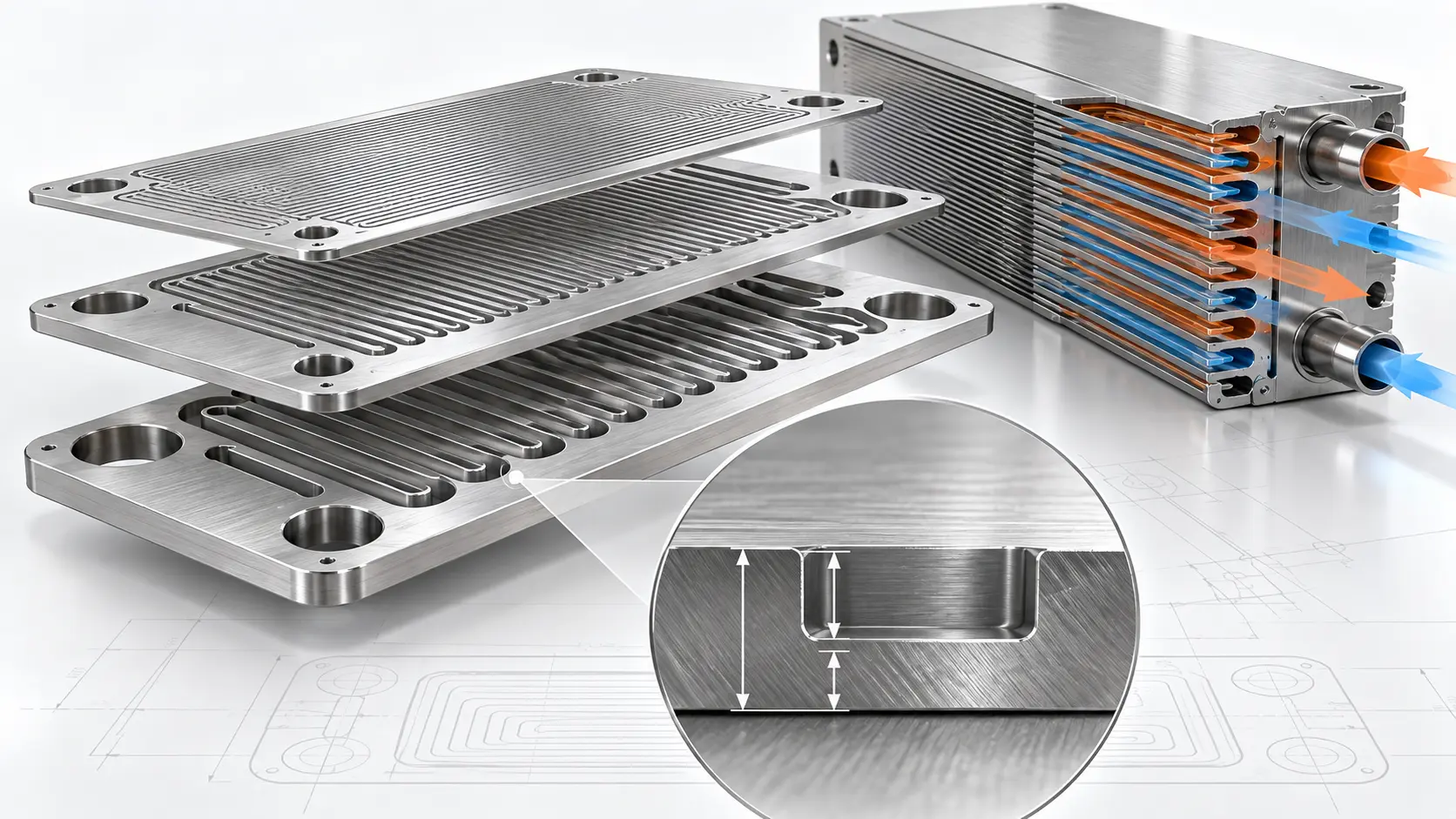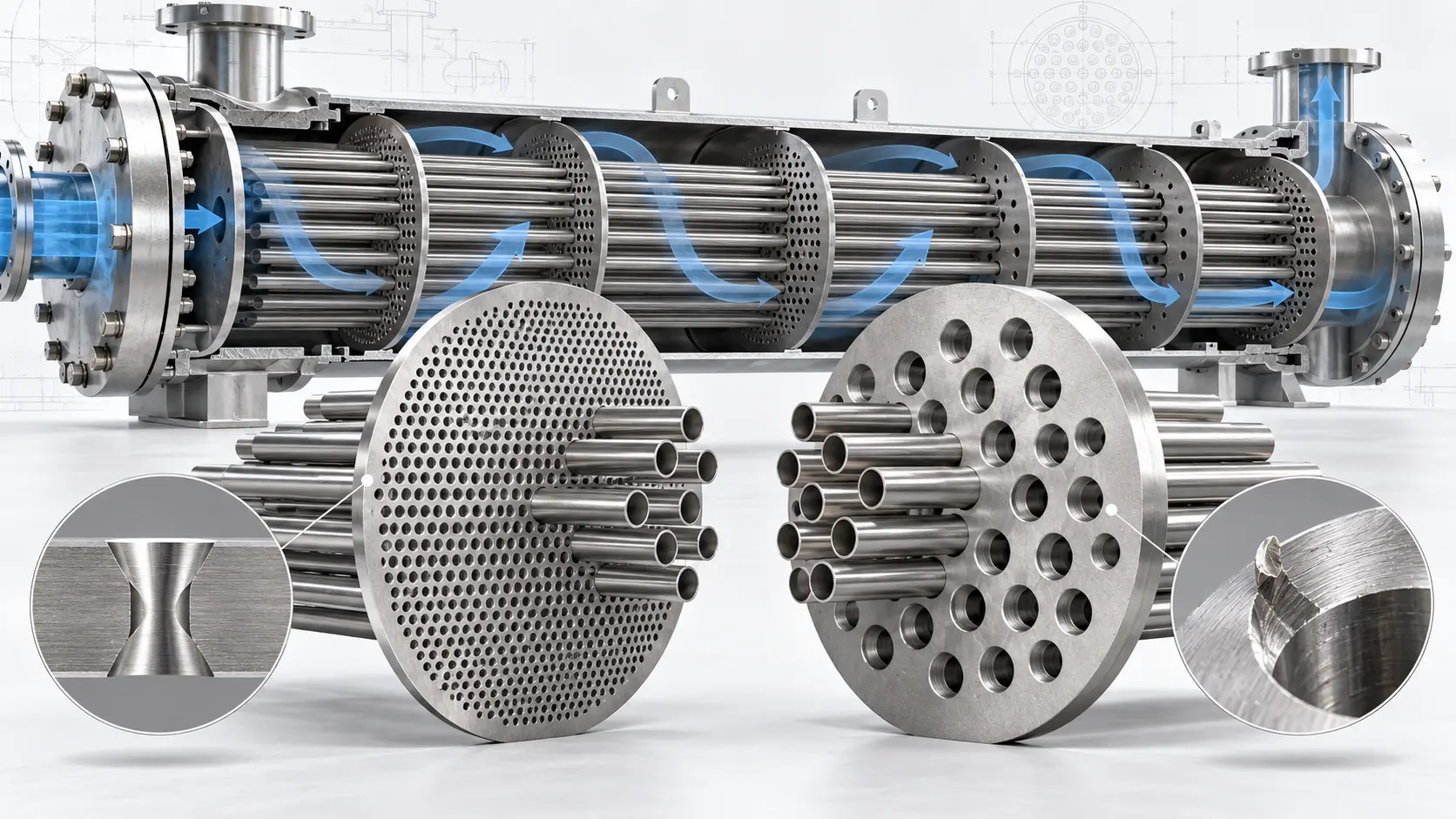

Chemical etching is often the best option for thin, flat metal parts with complex features, tight spacing and burr-free edges. It uses chemical action instead of cutting tools, hard dies or concentrated heat. This helps reduce mechanical stress, heat-affected zones and tooling costs.
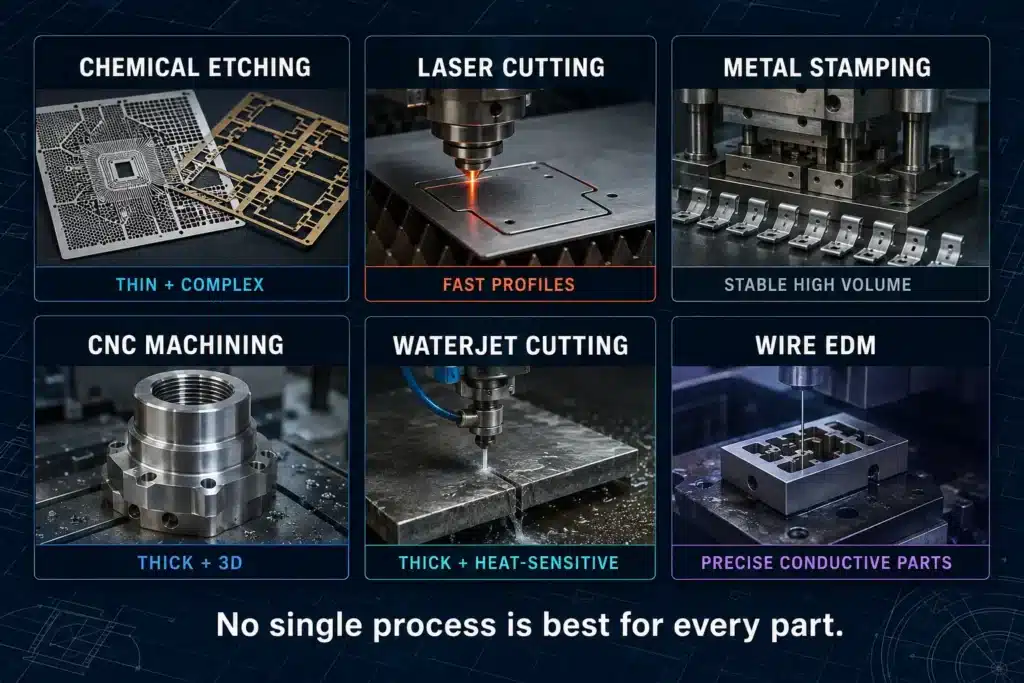
However, chemical etching is not the best process for every metal component. Laser cutting can be more practical for quick, simple profiles. Stamping becomes highly efficient at stable, very high production volumes. CNC machining is better for thick or three-dimensional parts, while waterjet and wire EDM address other material and geometry requirements.
The right process depends on the part design, material, thickness, tolerance, production volume and required secondary operations.
Quick Comparison: Which Metal Manufacturing Process Should You Choose?
| Process | Best suited for | Main advantages | Main considerations |
|---|---|---|---|
| Chemical etching | Thin, flat and complex precision metal parts | Burr-free edges, no concentrated heat, low-cost digital tooling and flexible design changes | Best results depend on material, thickness and feature geometry |
| Laser cutting | Fast production of simple or medium-complexity profiles | Flexible programming, quick setup and broad availability | Thermal cutting can create a heat-affected zone |
| Stamping | Stable, high-volume production | Very fast cycle times after tooling is complete | Hard tooling can be expensive and slow to change |
| CNC machining | Thick, three-dimensional or stepped components | High precision, controlled depths, threads, pockets and complex 3D geometry | Tool paths, fixtures and machining time affect cost |
| Waterjet cutting | Thick materials and heat-sensitive parts | No thermal heat-affected zone and broad material compatibility | Fine features and edge taper require evaluation |
| Wire EDM | Precise contours in conductive and hardened metals | High precision with low mechanical cutting force | Conductive materials only; cutting is generally sequential |
No single process wins in every category. A design review should consider the complete part rather than only the unit price.
What Is Chemical Etching?
Chemical etching, also called photochemical etching or photo etching, is a subtractive manufacturing process for producing precision sheet metal components.
The process normally includes these stages:
- Clean the metal sheet.
- Apply a light-sensitive photoresist.
- Transfer the component pattern to the resist.
- Develop the resist to expose selected metal areas.
- Remove the exposed metal with a controlled etchant.
- Strip the remaining resist and inspect the finished parts.
Because the design comes from digital artwork, chemical etching does not require a conventional stamping die. Multiple components and features can be processed across the same sheet.
Unlike laser cutting, chemical etching does not use a concentrated heat source. Unlike CNC machining, it does not remove material with a mechanical cutting tool.
For a detailed explanation, see the chemical etching process, applications and benefits.
Chemical Etching vs Traditional Sheet Metal Machining
“Traditional sheet metal machining” covers several different processes. It can include mechanical cutting, punching, stamping, milling and other tool-based operations.
These processes should not be treated as one single alternative. Each method has different strengths.
The most important differences are the way material is removed, the required tooling and the type of geometry each process can produce.
Material removal
Chemical etching removes selected metal through a controlled chemical reaction. Mechanical machining removes material through cutting force, while laser cutting uses concentrated thermal energy.
The removal method affects edge condition, residual stress, thermal influence and possible secondary finishing.
Tooling
Chemical etching uses digital artwork and photo tooling. Changes can often be made by updating the design data.
Stamping requires a physical die. CNC machining may require cutting tools, fixtures and programmed tool paths. Laser cutting and waterjet cutting also use digital files, but their cutting heads normally follow the component profile sequentially.
Part geometry
Chemical etching works best for thin, flat metal parts containing many openings, slots, fine details or repeated features.
CNC machining is more suitable when the design needs pockets, threads, steps, shoulders or other three-dimensional features. Stamping can also create formed features when the correct tooling is available.
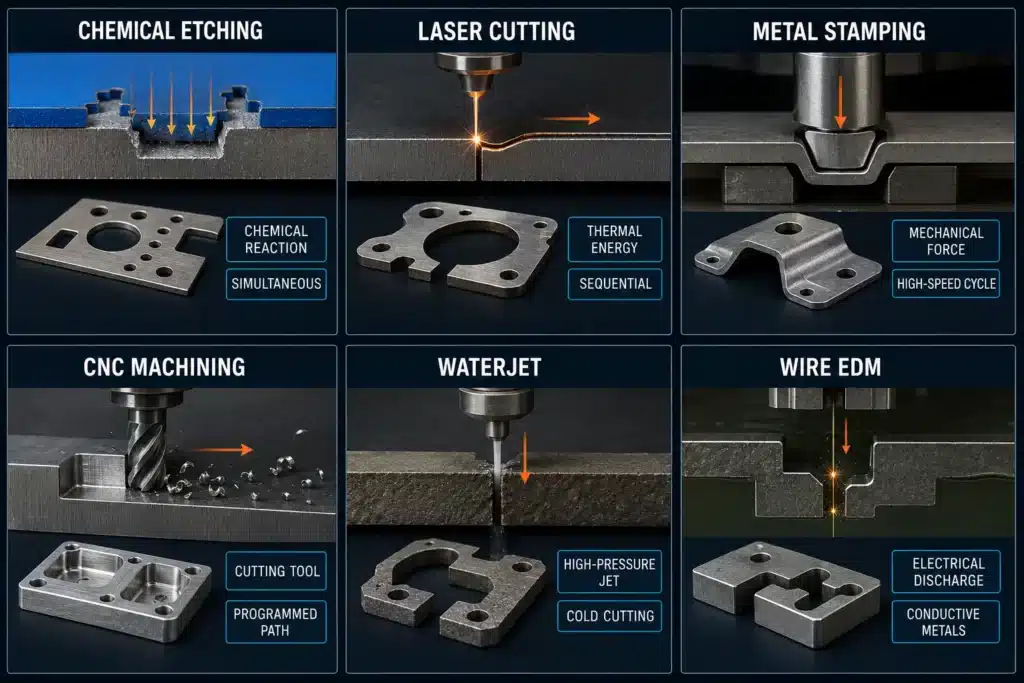
Chemical Etching vs Laser Cutting
- Process: Laser cutting uses a CNC-controlled, focused heat beam to cut along a programmed path. TWI classifies it as a mechanized thermal cutting process. Chemical etching removes exposed metal through a controlled chemical reaction.
- Edge quality: Chemical etching produces burr-free edges without a heat-affected zone. Laser cutting may cause localized thermal effects, although well-controlled systems can still achieve high-quality results.
- Design complexity: Laser cutting traces each feature individually, so additional holes and slots can increase processing time. Chemical etching processes multiple features simultaneously, making it efficient for dense patterns, meshes and grilles.
- Material thickness: Chemical etching is best suited to thin sheet metal and foil. Laser cutting is generally more practical for thicker sheets and simpler profiles.
- Best use cases: Choose chemical etching for thin, detailed parts with numerous repeated features or strict burr and thermal-distortion requirements. Choose laser cutting for thicker parts, simpler profiles and designs with fewer internal features.
For a more detailed comparison of process capabilities, tolerances, costs and applications, read our guide to Chemical Etching vs. Laser Cutting.
Chemical Etching vs Metal Stamping
Metal stamping uses a press and die to cut or form sheet metal. It is one of the fastest processes for producing stable designs at high volumes.
Precision stamping can produce close-tolerance components when the tooling and process are properly developed. A NIST manufacturing case study illustrates the use of precision stamping for close-tolerance metal parts.
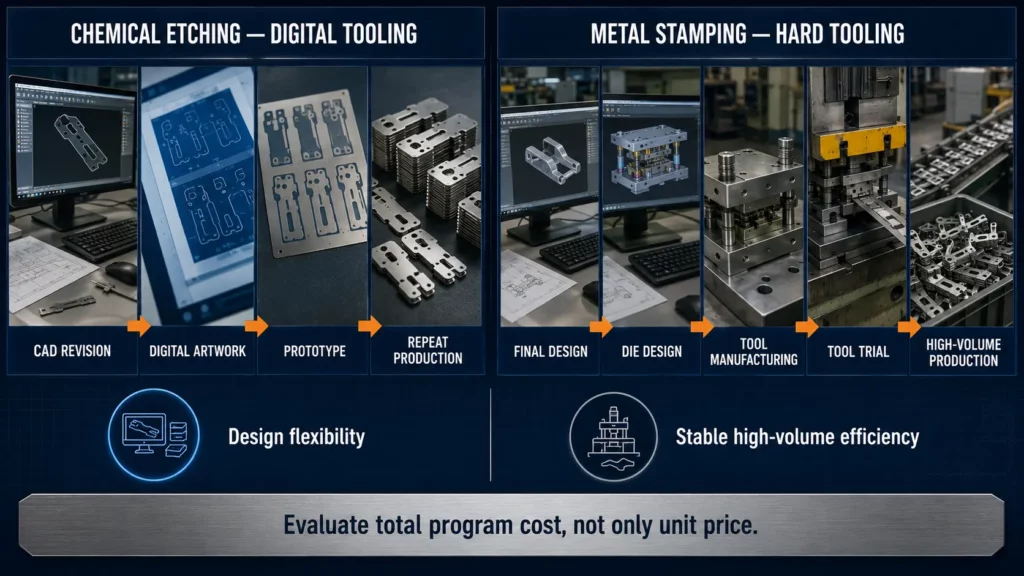
The main difference is the investment and commitment required for tooling.
Tooling cost
Stamping normally needs a dedicated die. The die must be designed, manufactured, tested and maintained.
Chemical etching uses digital photo tooling. This usually lowers the initial tooling barrier, especially when the part contains complex openings or when several design versions are under evaluation.
The total cost still depends on part size, material utilization, volume and inspection requirements.
Design changes
Changing an etched design often involves revising the digital artwork. Changing a stamped design may require modifying or replacing the die.
This makes chemical etching useful during prototyping, engineering validation and early production stages.
Production volume
Stamping can achieve very low unit costs once the design is stable and the production volume is high enough to justify the tooling.
Chemical etching can support prototypes and repeat production without the same hard-tool investment. It is often attractive when annual demand does not justify a progressive die or when the design may continue to change.
Burrs and mechanical stress
Punching and stamping apply mechanical force to the sheet. Depending on the material and tooling condition, the cut edge may contain rollover, shear zones, fracture zones or burrs.
Chemical etching does not apply a punching force. Properly controlled etched parts therefore have burr-free edges and low mechanical stress.
When to choose each process
Choose chemical etching for:
- Prototypes and design validation
- Complex thin metal parts
- Multiple design versions
- Burr-sensitive components
- Low-to-medium production volumes
- Products with frequent engineering changes
Choose stamping for:
- Stable designs
- Very high production volumes
- Parts that require forming during the press operation
- Programs that can justify dedicated tooling
- Components designed specifically for automated press production
Chemical Etching vs CNC Machining
CNC machining uses programmed cutting tools to remove material from a workpiece. Machining can produce flat and three-dimensional components with controlled depths, pockets, threads, shoulders and surface features.
NIST defines machining as the removal of material in the form of chips or swarf to produce the required geometry and tolerance. Its precision machining publication also shows how machine condition, tooling and process control influence accuracy.
CNC machining and chemical etching solve different design problems.
Two-dimensional vs three-dimensional geometry
Chemical etching is primarily a process for flat sheet and foil parts. It can produce through-features and, in some cases, controlled partial-depth features.
CNC machining is usually the better option for:
- Threads
- Deep pockets
- Steps and shoulders
- Three-dimensional surfaces
- Thick components
- Features requiring different controlled depths
Cutting tools and fixtures
CNC machining requires suitable cutting tools, workholding and tool paths. Very thin components can be difficult to clamp without distortion.
Chemical etching processes the sheet without direct cutting force. This is useful for thin, delicate parts that may bend or deform during conventional machining.
Complex two-dimensional patterns
CNC machining can produce complex profiles, but each hole, slot and contour requires machining time.
Chemical etching can process many two-dimensional features together. The advantage becomes more important when a sheet contains dense patterns or a large number of repeated openings.
Accuracy
Neither process is always more accurate.
CNC machining can achieve excellent precision when the machine, tooling, fixtures and inspection systems are suitable. Chemical etching can also achieve precise and repeatable results, but its tolerances depend strongly on material thickness, feature geometry and etching behavior.
Designers should avoid selecting a process from a general tolerance claim. The supplier should review the actual drawing and critical dimensions.
See the photochemical etching tolerance and design guide for factors that affect etched features.
When to choose each process
Choose chemical etching for thin, flat and highly detailed components.
Choose CNC machining for thick parts, 3D geometry, deep features, threads and components that require several controlled levels.
In some projects, the two processes can be combined. Chemical etching may create the flat profile before machining, forming or another secondary operation.
Chemical Etching vs Waterjet Cutting
Waterjet cutting uses a high-pressure stream of water. Abrasive particles can be added to cut metals and other hard materials.
Because waterjet is a cold-cutting process, it does not create a thermal heat-affected zone. It can also process a broad range of materials.
Waterjet cutting is often suitable for thicker material, large components and heat-sensitive applications. It can also cut materials that are difficult to process chemically.
Chemical etching is usually more suitable for thin metal parts with:
- Fine openings
- Narrow slots
- Dense patterns
- Large quantities of repeated features
- Strict burr requirements
- Small or delicate geometry
Waterjet kerf, edge taper and minimum feature size should be evaluated against the drawing. Chemical etching also has feature-size limits, so neither process should be selected without reviewing the material thickness and geometry.
Chemical Etching vs Wire EDM
Wire electrical discharge machining uses controlled electrical sparks between a wire electrode and a conductive workpiece. The process removes material without conventional cutting force.
EDM operates through electrical discharges in a dielectric fluid and is used in wire, sinker and hole-drilling configurations.
Wire EDM is well suited for precise contours in conductive materials. It can process hardened metals and thicker sections that may not be suitable for chemical etching.
Chemical etching offers a different advantage. It can produce many thin components and repeated features across a sheet without tracing every profile with a wire.
Choose wire EDM when:
- The material is electrically conductive
- The part is relatively thick
- Hardened material must be processed
- The design requires a highly controlled contour
- Production speed is less important than individual feature precision
Choose chemical etching when:
- The component is thin and flat
- The design contains many repeated features
- Burr-free edges are important
- Digital tooling flexibility is valuable
- Multiple parts can be arranged on one sheet
Key Advantages of Chemical Etching
- Burr-free edges: Chemical material removal avoids the conventional mechanical burrs created by punching, milling and other cutting processes.
- Low mechanical stress: No cutting force is applied to the metal, reducing the risk of deformation in thin or delicate components.
- No heat-affected zone: As a non-thermal process, chemical etching avoids localized heat distortion and laser-style heat-affected zones.
- Flexible digital tooling: Designs can be revised without producing a new hard die, supporting prototypes, product updates, multiple variants and low-volume production.
- Efficient complex-feature production: Holes, slots and external profiles are etched simultaneously. Feature-dense parts do not require proportionally longer cutting paths.
- Multiple designs per sheet: Compatible component designs can often share one production sheet, making the process useful for sample kits and related product families.
- Broad material compatibility: The process supports many engineering metals, including stainless steel, copper, nickel alloys, titanium and aluminum. See our photochemical etching materials guide for material-specific information.
Learn more about the chemical etching process, applications and benefits.
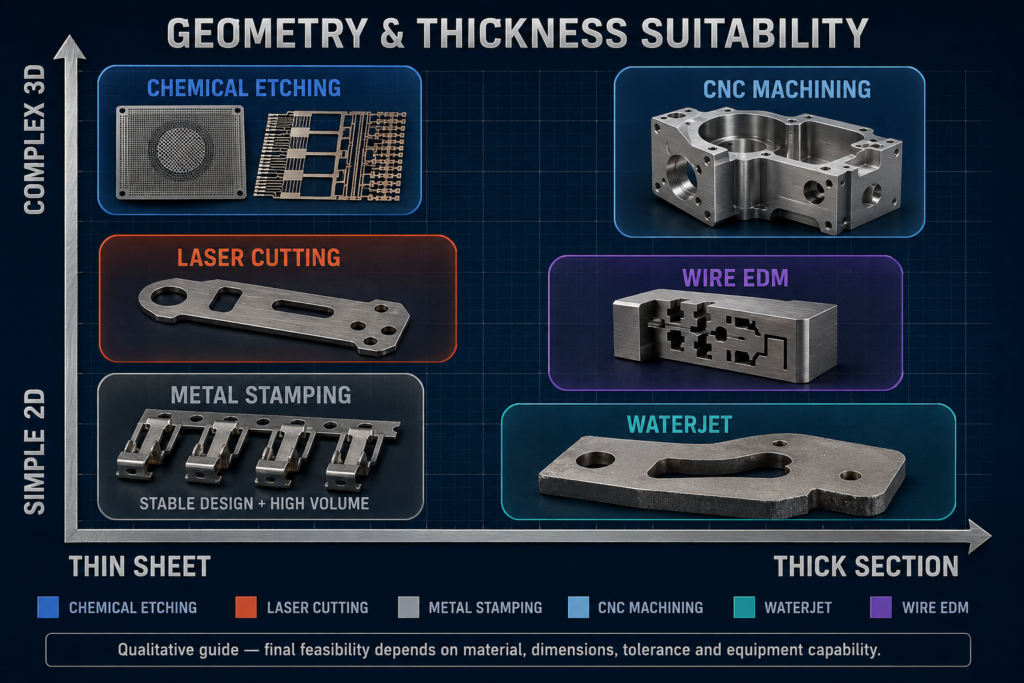
When Chemical Etching Is Not the Best Choice
- Thick components: Feature accuracy becomes harder to maintain as metal thickness increases. Laser cutting, waterjet, CNC machining or wire EDM may be more suitable.
- Complex 3D geometry: Chemical etching is not designed for threads, deep pockets, shoulders or complex three-dimensional surfaces.
- Very high, stable production volumes: Stamping may offer a lower unit cost when demand is high enough to justify hard-tooling investment.
- Deep partial-etch features: Chemical etching can create shallow recessed areas, but it does not offer the same depth control as CNC milling or sinker EDM.
- Very small features in thick metal: Undercut limits achievable hole sizes, slot widths and web dimensions. These limits depend on material thickness and process conditions.
Explore these constraints and their design implications in our detailed guide to the limitations of photochemical etching.
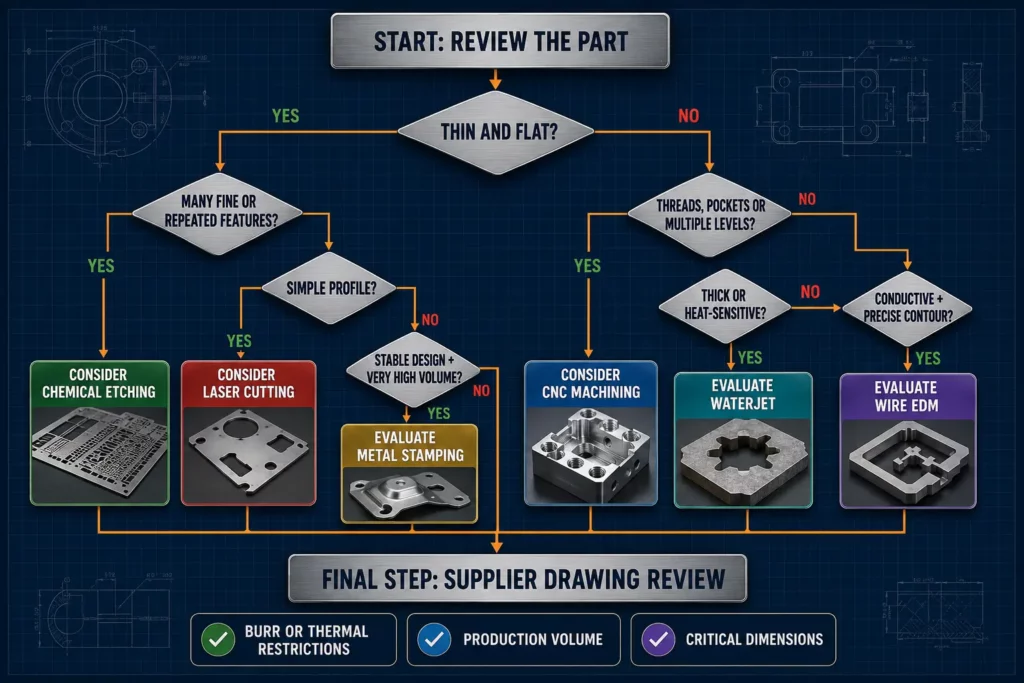
How to Select the Right Manufacturing Process
Use the following questions before choosing a process.
1. Is the part flat or three-dimensional?
A thin, flat component may suit chemical etching, laser cutting or stamping.
A part with deep pockets, threads or several height levels will normally require CNC machining, EDM, forming or a combined process.
2. How thick is the metal?
Thickness affects feature size, tolerance and processing options.
Do not evaluate the outside profile alone. Compare the smallest hole, slot, web and corner radius with the material thickness.
3. Are burrs or thermal effects acceptable?
Chemical etching can be useful when burrs, cutting force or heat-affected zones create functional risks.
Waterjet can also avoid thermal effects, while wire EDM offers low mechanical cutting force. The final choice depends on thickness and geometry.
4. How many features does the part contain?
Parts with hundreds of holes or repeated openings may favor chemical etching because the features are processed together.
Simple profiles may be faster and easier to source through laser or waterjet cutting.
5. Will the design change?
Digital photo tooling makes chemical etching suitable for evolving designs.
Hard stamping tools offer high production speed but are less flexible when dimensions or features change.
6. What is the expected production volume?
Consider total program cost, not only the first unit price.
Include:
- Tooling
- Setup
- Material utilization
- Production rate
- Inspection
- Deburring
- Finishing
- Design changes
- Tool maintenance
- Expected program life
7. Which dimensions are truly critical?
Not every dimension needs the tightest possible tolerance.
Mark critical-to-quality features on the drawing. This allows the manufacturer to recommend a practical process and avoid unnecessary cost.
Typical Applications for Chemical Etching
Chemical etching is commonly considered for thin precision components such as:
- EMI and RFI shielding parts
- Electrical contacts and lead frames
- Speaker and microphone grilles
- Fine filters, screens and meshes
- Encoder and code discs
- Shims, spacers and washers
- Battery and fuel-cell components
- Springs and flexible metal elements
- Medical and diagnostic components
- Aerospace and electronic assemblies
- Decorative and functional metal panels
The correct process still depends on the material, dimensions and performance requirements.
For aerospace-specific selection factors, see the comparison of photochemical etching, CNC machining and stamping for aerospace components.
Information to Include in Your RFQ
A complete request for quotation helps the manufacturer assess feasibility and recommend the right process.
Include the following information whenever possible:
- A dimensioned PDF drawing
- A DXF, DWG or other suitable two-dimensional design file
- Material grade
- Material temper or condition
- Sheet thickness
- Overall part dimensions
- Critical tolerances
- Minimum hole, slot and web dimensions
- Flatness requirements
- Surface finish requirements
- Burr and edge requirements
- Partial-etch or identification marks
- Required production quantity
- Prototype and annual volume estimates
- Secondary forming, plating or heat-treatment needs
- Cleaning and packaging requirements
- Inspection and documentation requirements
- Target delivery date
If some details are not yet fixed, identify them as open engineering decisions. This gives the supplier room to recommend a more manufacturable and cost-effective design.
Frequently Asked Questions
Is chemical etching better than laser cutting?
Chemical etching is often better for thin, complex parts with many features, burr-free edge requirements or sensitivity to thermal effects.
Laser cutting may be better for thicker sheet, simple profiles and jobs where fast access to local laser capacity is the main requirement.
Is chemical etching more accurate than CNC machining?
Not in every situation.
CNC machining can achieve excellent accuracy on thick and three-dimensional components. Chemical etching can produce precise thin, flat parts, but its achievable tolerance depends on material thickness, alloy and feature geometry.
Is chemical etching cheaper than stamping?
Chemical etching often has lower initial tooling costs and can be economical for prototypes, design changes and low-to-medium volumes.
Stamping may achieve a lower unit cost at very high volumes once the design is stable and the tooling investment is justified.
Does chemical etching leave burrs?
Chemical etching does not create the conventional mechanical burr caused by cutting or punching tools.
Edge profile and dimensional results still depend on material thickness, etching control and design geometry.
Can chemical etching process thick metal?
Chemical etching is mainly used for thin sheet and foil components. Thicker metal can sometimes be etched, but minimum features, tolerances and processing time become more restrictive.
A drawing review is necessary before confirming feasibility.
Can different parts be etched on the same sheet?
Yes. Different designs can often share a sheet when they use compatible materials, thicknesses and processing conditions.
This approach can be useful for prototypes, product families and engineering evaluation kits.
Does chemical etching change the metal hardness?
Chemical etching does not use concentrated thermal energy or mechanical cutting force, so it avoids the heat-affected zone and work-hardening mechanisms associated with some other processes.
However, material compatibility, surface condition and any required post-processing should still be validated for the application.
Conclusion
Chemical etching is a strong manufacturing option for thin, flat and complex metal parts. Its main advantages include burr-free edges, low mechanical stress, no concentrated heat source, flexible digital tooling and the ability to process many features across one sheet.
It is not a universal replacement for laser cutting, stamping, CNC machining, waterjet or wire EDM.
Laser cutting may suit quick and relatively simple profiles. Stamping is highly efficient for stable, very high volumes. CNC machining is better for thick and three-dimensional parts. Waterjet handles thick and heat-sensitive materials, while wire EDM produces precise contours in conductive metals.
The best decision comes from reviewing the complete drawing, including the material, thickness, smallest features, critical tolerances, production volume and secondary operations.
If you are deciding between chemical etching and another manufacturing process, contact TMNetch and submit your drawing for a technical feasibility review. The engineering team can evaluate the design and recommend a suitable manufacturing route.