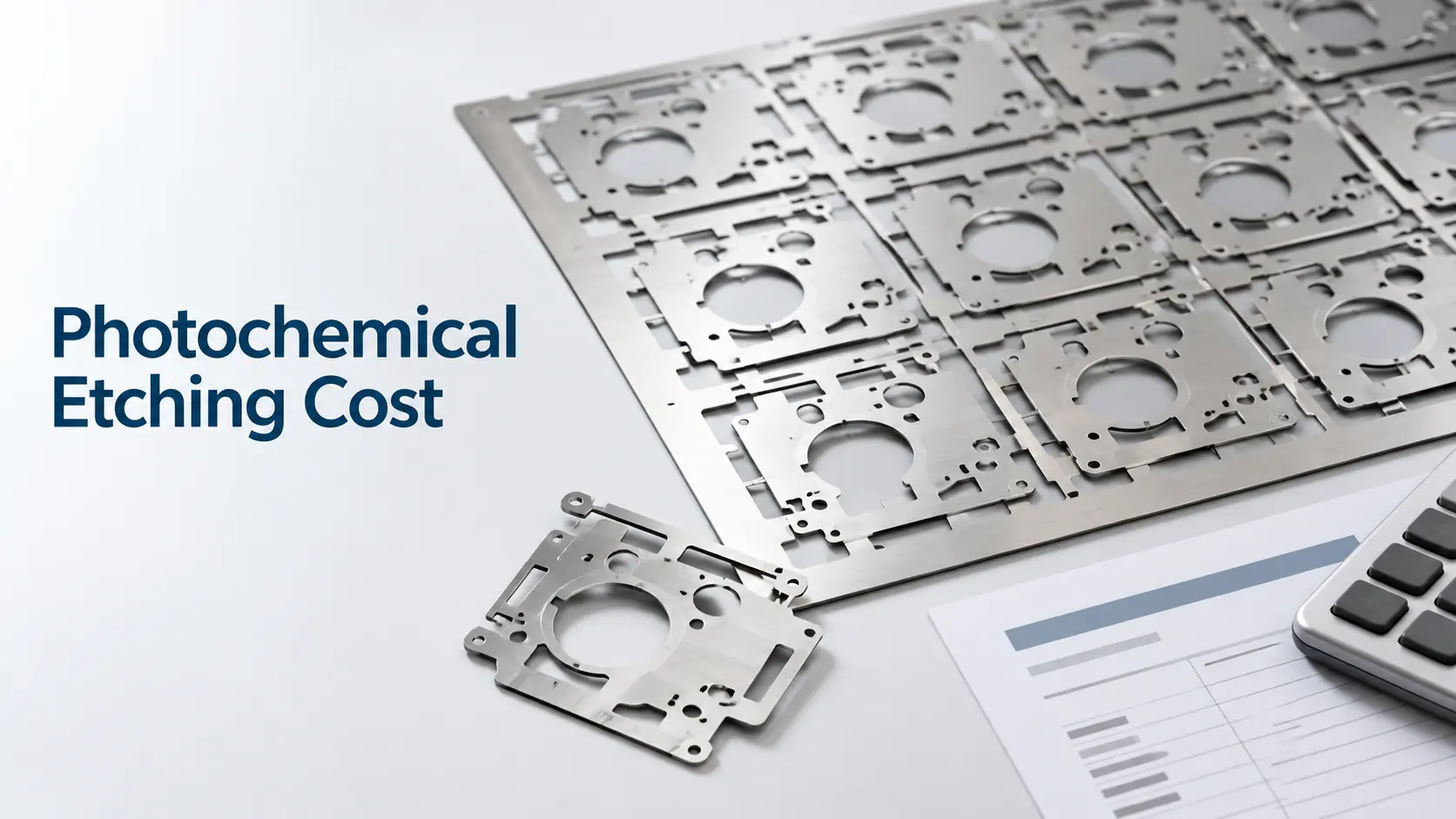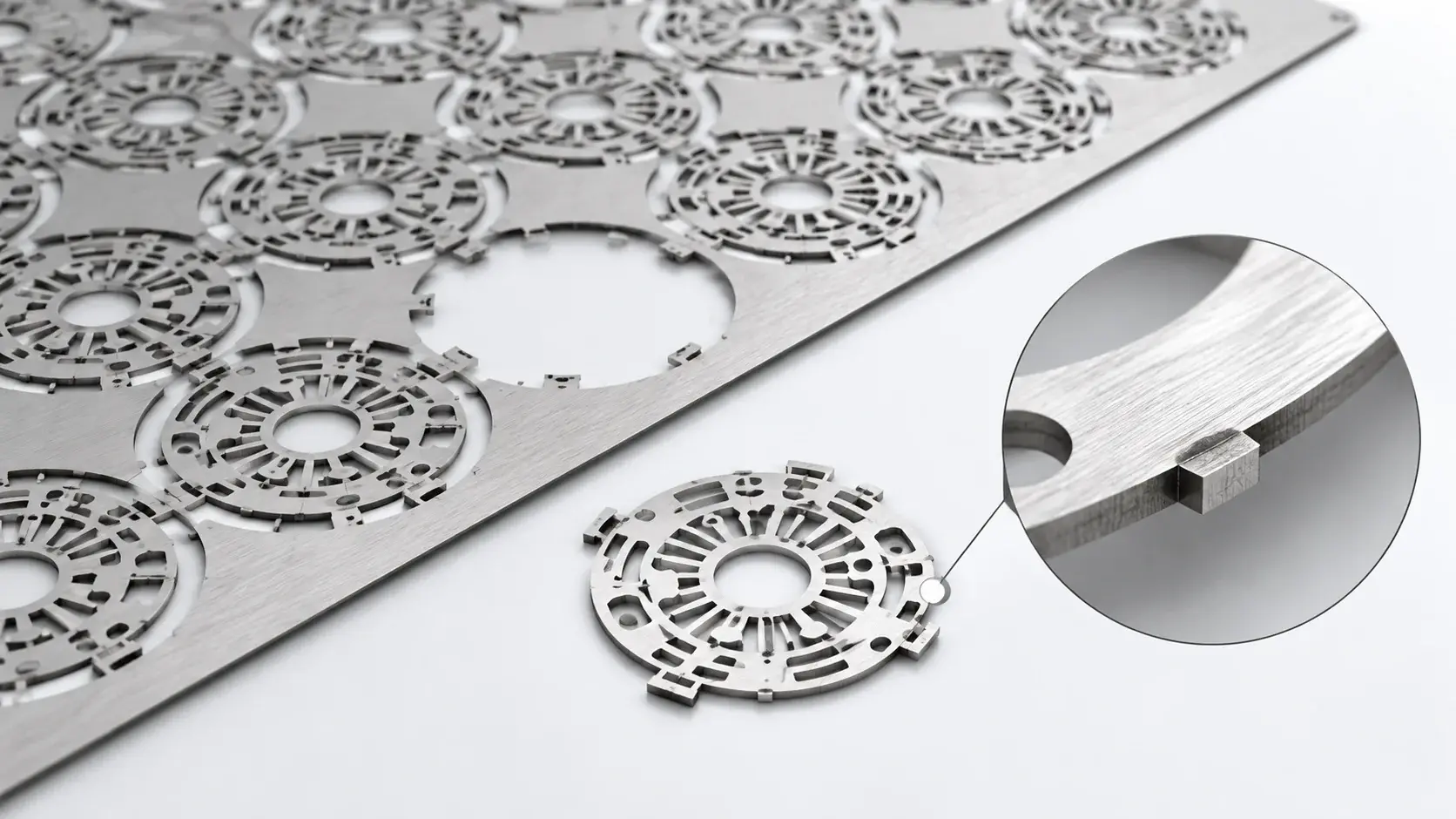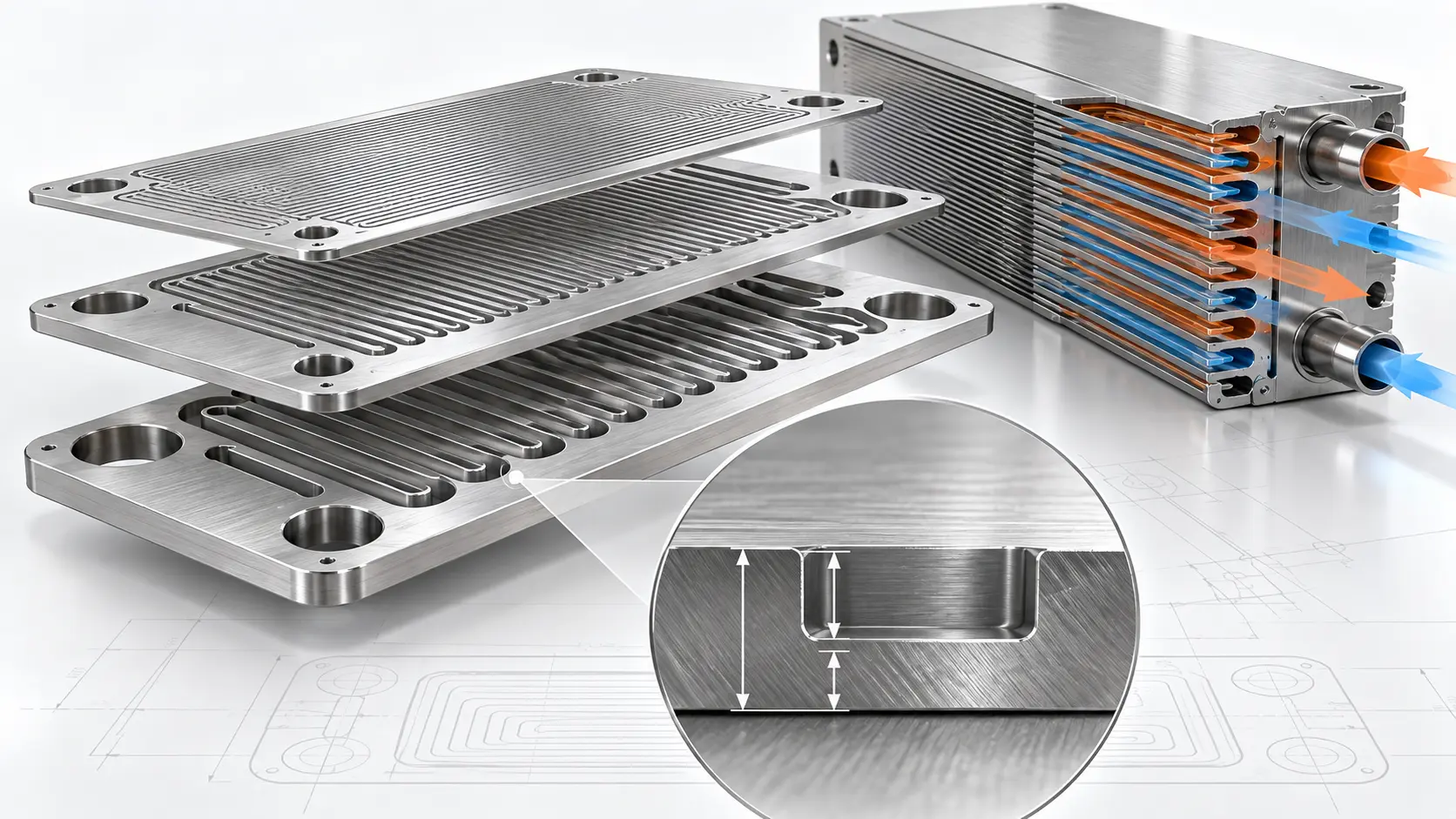

Photochemical etching materials are metals and alloys that can be shaped with photoresist, ultraviolet light, and controlled chemical etching. The process is mainly used with metal sheet, strip, and foil. Understanding the photochemical etching process helps engineers select suitable materials and designs. Common materials include stainless steel, copper, brass, phosphor bronze, beryllium copper, aluminum, titanium, nickel, and nickel alloys.
Each material has its own chemical composition, surface condition, strength, conductivity, and corrosion resistance. These properties affect how the metal responds during etching and where the finished part is commonly used. This guide explains the main types of photochemical etching materials, their basic properties, and their typical applications.
Key Takeaways
Photochemical etching works with many industrial metals and alloys in sheet, strip, or foil form.
Stainless steel, copper alloys, aluminum, titanium, and nickel alloys are common material groups.
Copper alloys include brass, phosphor bronze, beryllium copper, and nickel silver.
Each metal responds differently because of its alloy composition, thickness, temper, and surface condition.
Photo-etched materials are used for filters, contacts, shields, lead frames, bipolar plates, shims, and other precision parts.
A material that can be etched does not automatically support every thickness, feature size, or tolerance.
What Are Photochemical Etching Materials?
Photochemical etching materials are the metal substrates used to make photo-etched parts. A substrate is the sheet or foil that carries the photoresist pattern during manufacturing.
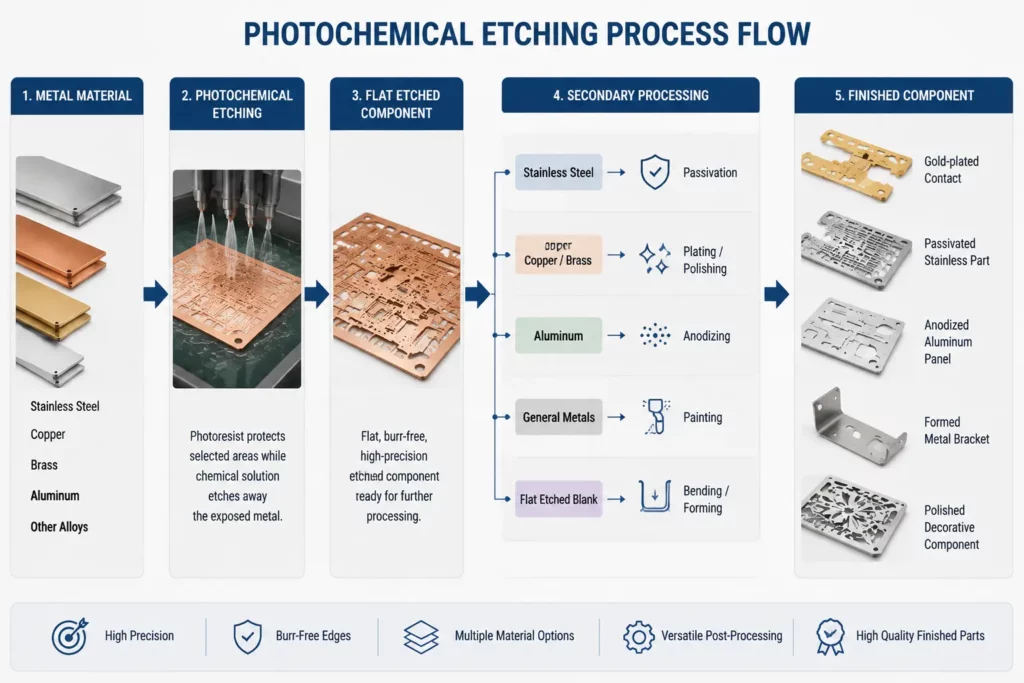
The photochemical etching process begins with a cleaned metal surface. A light-sensitive photoresist is applied, and ultraviolet light transfers the component pattern onto the resist. Controlled chemistry then removes the unprotected metal areas.
The material is different from the etchant. The material becomes the finished component, while the etchant is the chemical solution used to remove selected metal. Different metals need different process conditions because they do not react with etchants in the same way.
Photochemical etching is also called photo etching, photochemical machining, photo chemical machining, or PCM. For a complete explanation of the manufacturing method, read the main photochemical etching process and design guide.
Main Types of Photochemical Etching Materials
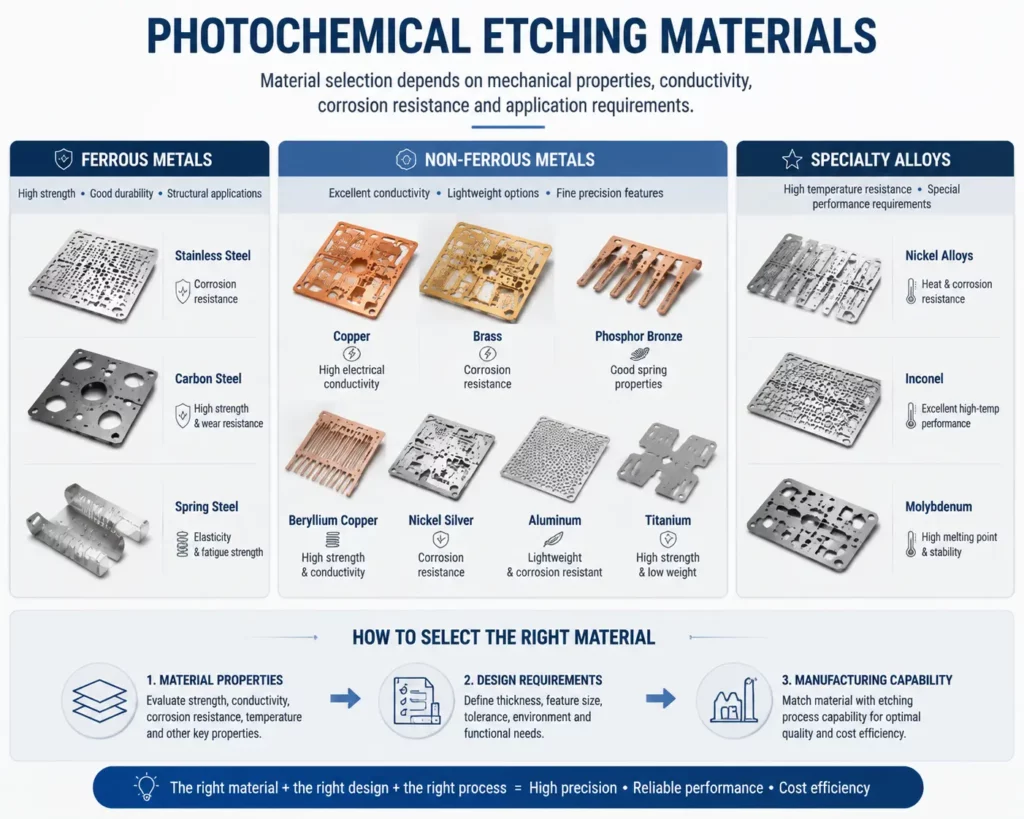
Photochemical etching materials can be grouped by their main metal content and basic properties. The three broad groups are ferrous metals, non-ferrous metals, and specialty alloys.
Ferrous Metals
Ferrous metals contain iron as their main element. Stainless steel, carbon steel, and spring steel belong to this broad group.
Iron-based alloys can provide strength, stiffness, wear resistance, or corrosion resistance. Their exact properties depend on the alloy grade, carbon content, chromium content, heat treatment, and temper.
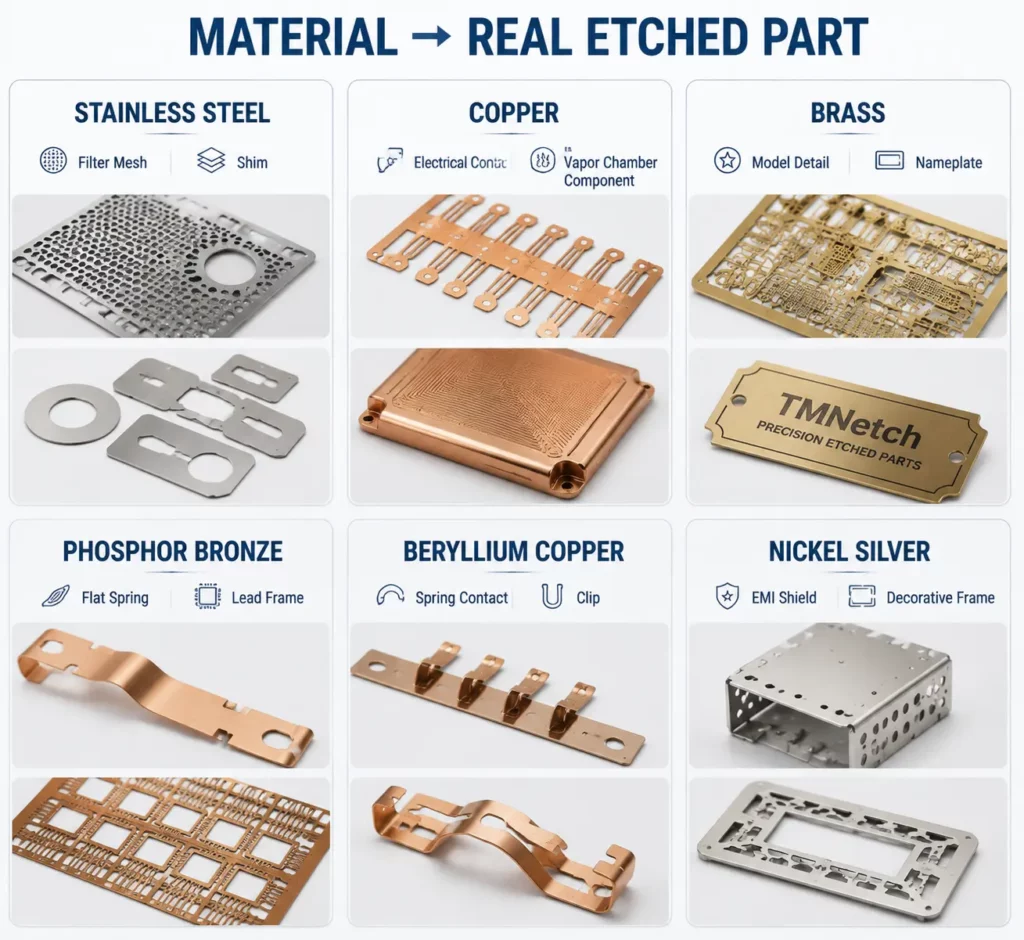
Stainless steel is the most visible ferrous material across TMNetch product pages. It is used for filters, shims, shields, encoder discs, speaker grilles, and other precision parts produced through stainless steel etching.
Non-Ferrous Metals
Non-ferrous metals do not use iron as their main element. This group includes copper, brass, bronze, aluminum, titanium, nickel, and many related alloys.
These materials cover a wide range of functions. Copper alloys can provide conductivity and spring behavior. Aluminum is known for low density, while titanium combines low weight with strength and corrosion resistance.
Specialty Alloys
Specialty alloys are produced for specific thermal, electrical, magnetic, mechanical, or chemical environments. Examples mentioned across TMNetch material content include Inconel and molybdenum.
These materials may need different surface preparation, chemistry, etching time, and inspection methods. The exact alloy grade matters because one alloy family can contain many different compositions.
Common Materials Used in Photochemical Etching and Their Applications
| Material | Key characteristics | Common photo-etched applications |
|---|---|---|
| Stainless steel | Strength, corrosion resistance, durability, and dimensional stability | Filters, shims, encoder discs, shields, speaker grilles, and bipolar plates |
| Copper | Excellent electrical and thermal conductivity | Electrical contacts, thermal components, channels, and vapor chamber parts |
| Brass | Copper-zinc alloy with good conductivity, machinability, and decorative appearance | Connectors, nameplates, model components, and decorative parts |
| Phosphor bronze | Spring properties, strength, wear resistance, and electrical conductivity | Flat springs, contacts, connectors, and lead frames |
| Beryllium copper | High strength, elasticity, fatigue resistance, and electrical conductivity | Spring contacts, clips, connectors, and lead frames |
| Nickel silver | Copper-nickel-zinc alloy with good forming properties and shielding performance | EMI/RFI shielding, contacts, frames, and decorative parts |
| Aluminum | Lightweight, corrosion resistance, and good thermal/electrical properties | Lightweight grilles, shields, panels, and decorative components |
| Titanium | High strength-to-weight ratio, corrosion resistance, and biocompatibility | Bipolar plates, aerospace parts, medical components, and corrosion-resistant components |
| Nickel and nickel alloys | Excellent corrosion resistance, heat resistance, and specialized performance properties | Electronic frames, shields, precision screens, and high-temperature components |
| Molybdenum | High-temperature stability, wear resistance, and specialized industrial performance | Specialist electronic components, thermal parts, and industrial components |
This table describes broad material families. Properties can change between grades, tempers, and product forms within the same family. Different applications may require additional review, such as EMI shielding components or bipolar plates.
Stainless Steel in Photochemical Etching
Chromium gives stainless steel a self-healing chromium-rich oxide passive layer, which provides corrosion resistance and helps make stainless steel one of the most widely used materials for precision thin-metal components. Grade selection is mostly a corrosion-vs-cost trade: 304 stainless steel is widely used for general corrosion-resistant applications, while 316/316L stainless steel contains molybdenum, improving resistance to chloride-containing and more aggressive environments (and is the grade used for bipolar plates), and 430 sits in the ferritic family with different magnetic behavior than either. For full grade specifications and application examples, see the stainless steel etching guide
Copper and Copper Alloys in Photochemical Etching
Copper alloys are the largest material family in photochemical etching, and the right choice inside the family depends on which property matters most for the part:
- Pure copper — highest conductivity in the family; the starting point for electrical contacts, thermal parts, and vapor chamber structures.
- Brass (C26000, C27000) — trades some conductivity for lower cost and a decorative metallic finish; common in connectors and nameplates.
- Phosphor bronze (C51000, C54400) — the spring-behavior choice; used wherever the part needs to flex and return to shape, such as contacts and custom lead frames.
- Beryllium copper (C17200) — conductivity plus the highest strength and elasticity in the family; used for spring contacts and clips that see repeated flexing.
- Nickel silver (C7521) — despite the name, no silver content; selected for EMI/RFI shielding and decorative parts where its color and forming behavior fit.
For full grade specifications, temper options, and application detail, see the copper etching guide and the custom lead frame guide.
Aluminum in Photochemical Etching
Aluminum is the low-density option in the material lineup — it trades some conductivity and strength for roughly a third the weight of copper or stainless steel, which is why it shows up in lightweight grilles, panels, and aerospace or automotive parts where weight is a design constraint. TMNetch’s aluminum grades span the 1000 series (high-purity, easiest to etch), 3000 series (aluminum-manganese, added strength), and 5000 series (aluminum-magnesium, better corrosion resistance) — 1100, 3003, 5052, 5083, and 5182 among the specific grades available. For full grade properties and finishing options, see the aluminum etching guide.
Titanium in Photochemical Etching
Titanium offers an excellent strength-to-weight ratio and corrosion resistance, making it suitable for aerospace, medical, chemical, and other demanding applications — the trade-off is that this same oxide layer means it doesn’t etch like stainless steel or copper, so process chemistry has to be matched to the specific grade. Commercially pure grades (Grade 1, Grade 2 — the ones typically used for fuel cell bipolar plates) and alloyed grades like Ti-6Al-4V have different compositions and mechanical properties, so the grade needs to be specified rather than just “titanium.” For full grade detail and process notes, see the titanium etching guide.
Nickel and Nickel Alloys in Photochemical Etching
“Nickel alloy” covers several distinct sub-families that don’t behave the same way or serve the same purpose:
- Pure nickel (Ni200) — general corrosion resistance for electronic, electrical, and battery applications.
- Nickel-iron alloys — including controlled-expansion grades such as Kovar and Alloy 42, selected for dimensional stability and matching the thermal expansion of glass or ceramic in hermetic electronic packages (see the lead frame CTE-matching section for how this applies to package design).
- Nickel-chromium alloys, including the Inconel family — heat and corrosion resistance for aerospace, chemical-processing, and high-temperature applications; suitability still depends on the specific grade.
- Nickel-titanium alloys — shape-memory and superelastic behavior for specialist medical and industrial parts.
For full grade specifications and application detail, see the nickel etching guide.
Other and Specialty Photochemical Etching Materials
Photochemical etching is not limited to the largest commercial metal groups. Specialty materials may also be processed when their grade, thickness, surface, and part design are suitable.
Molybdenum
Molybdenum is a refractory metal. Refractory metals retain useful properties at high temperatures and often have high melting points.
Molybdenum is used in electronics, thermal systems, lighting, and specialist industrial components. It behaves differently from copper, aluminum, or stainless steel, so it requires its own process conditions.
Inconel
Inconel is a family of nickel-chromium alloys. These alloys are known for performance in demanding heat and corrosion environments.
The term does not describe one fixed composition. An Inconel material must be identified by its exact grade before any manufacturing process is defined.
Other Specialty Alloys
The wider photochemical machining industry also works with other specialty metals and alloys. These can include magnetic alloys, controlled-expansion alloys, spring alloys, and precious-metal foils.
Specialty material names alone do not confirm manufacturing capability. The exact grade, product form, thickness, surface condition, and drawing determine whether a project can enter production.
What Material Characteristics Affect Photochemical Etching?
Two sheets that look similar can behave differently during etching. Several material characteristics influence the chemical reaction, photoresist performance, edge profile, and consistency of the finished part.
Alloy Composition
An alloy is a mixture of a base metal and one or more additional elements. These elements change the metal’s mechanical and chemical behavior.
For example, brass and phosphor bronze are both copper alloys, but zinc gives brass different properties from the tin and phosphorus used in phosphor bronze. The etching process must respond to the actual alloy rather than only the base metal name.
Material Thickness
Thickness determines how much metal must be removed to create a through-feature. A thicker sheet requires more material removal than a thin foil.
Thickness is also related to undercut, minimum feature size, and achievable tolerance. These relationships are explained in more detail in the main photochemical etching tolerances and design guide.
Temper and Hardness
Temper describes the mechanical condition created by processes such as cold working or heat treatment. A material grade may be available in soft, half-hard, full-hard, spring, or other temper conditions.
Temper affects bending, spring behavior, flatness, and later forming. It does not change the alloy name, but it can change how the finished part behaves.
Grain Structure
Metals are made from small crystalline regions called grains. Grain size and direction can vary with casting, rolling, heat treatment, and other material-processing steps.
Grain structure can influence surface appearance and edge consistency after material removal. It can also affect bending and spring behavior after etching.
Surface Condition
The metal surface may contain oil, oxides, scale, scratches, coatings, or rolling marks. These conditions can affect cleaning and photoresist adhesion.
Stainless steel, aluminum, titanium, and other metals also form natural oxide layers. Surface preparation must create a clean and consistent base for the imaging process.
Sheet and Foil Uniformity
Thickness uniformity and flatness matter across the full sheet. Local variation can affect large parts, dense hole patterns, or repeated components arranged across one panel.
The supplier may also need to consider rolling direction, coil set, and handling behavior when the material is very thin.
Can Every Metal Be Photochemically Etched?
Many commercially available metals and alloys can be photochemically etched. However, this does not mean that every material uses the same etchant, temperature, speed, or photoresist process.
A metal may be chemically etchable but still present limits for a particular part. Very thick material, very small openings, deep partial-etch features, unusual coatings, or inconsistent surfaces can change the result.
The exact grade also matters. “Stainless steel,” “titanium,” and “nickel alloy” each describe large material families rather than one fixed composition.
Specialty materials may need a sample test or engineering review before production. This confirms how the material responds and whether the required geometry can be produced consistently.
Photochemical Etching Materials and Secondary Finishes
Etching creates the part geometry, but some components receive further processing. The available finish depends on the base material and the part’s final use.
Common secondary processes listed across TMNetch pages include:
Plating
Passivation
Anodizing
Polishing
Painting
Bending and forming
Cleaning
Laser cutting
Custom packaging
Plating can add a metal layer for conductivity, solderability, corrosion resistance, or appearance. Passivation is commonly associated with stainless steel, while anodizing is widely used with aluminum.
Bending changes a flat etched blank into a formed part. Polishing and painting change the surface or appearance. These operations occur after or around the etching stage and require their own process controls.
Read the overview of one-stop chemical etching services for more information about etching and secondary operations.
Frequently Asked Questions
What materials are used in photochemical etching?
Common materials include stainless steel, copper, brass, phosphor bronze, beryllium copper, nickel silver, aluminum, titanium, nickel, and nickel alloys. Molybdenum, Inconel, and other specialty alloys may also be processed under suitable conditions.
Can stainless steel be photochemically etched?
Yes. TMNetch lists stainless steel grades such as 304, 316, and 430 across its service pages. Photo-etched stainless steel is used for filters, shims, encoder discs, shielding, speaker grilles, bipolar plates, and industrial parts.
Can copper and copper alloys be photo etched?
Yes. The copper family includes pure copper, brass, phosphor bronze, beryllium copper, and nickel silver. These materials are used for electrical contacts, thermal parts, lead frames, shielding, connectors, and springs.
Can aluminum be photochemically etched?
Yes. Aluminum and several aluminum alloy series can be photochemically etched. The alloy grade and surface condition influence the process. Common etched aluminum parts include lightweight grilles, shields, panels, and decorative components.
Can titanium be photochemically etched?
Yes. Titanium can be photochemically etched with material-specific surface preparation and process control. TMNetch lists titanium for bipolar plates, aerospace parts, medical parts, and other specialist components.
What is phosphor bronze used for in photo etching?
Phosphor bronze is used for flat springs, electrical contacts, connectors, and lead frames. It combines conductivity with strength and useful spring behavior. C51000 and C54400 are examples listed on TMNetch’s copper material content.
Are Inconel and molybdenum suitable for photochemical etching?
Both materials appear in photochemical etching applications. They are specialty materials, so the exact grade, thickness, surface, and part geometry require separate review. One set of process conditions does not apply to every grade.
Does material thickness affect photochemical etching?
Yes. Thickness changes how much metal must be removed and can affect undercut, minimum feature size, and tolerance. The relationship must be considered together with the material grade and geometry.
Are photochemical etching materials supplied as sheets or foils?
They can be supplied as sheet, strip, coil, or foil, depending on the material and thickness. The product form can affect flatness, handling, rolling direction, and production layout.
Final Thoughts
Photochemical etching works with a broad range of metals and alloys. Stainless steel, copper alloys, aluminum, titanium, and nickel materials are among the most common groups.
Each group contains many grades, tempers, thicknesses, and surface conditions. These differences explain why two metals can respond differently even when they belong to the same broad family.
Understanding the basic types, properties, and uses of photochemical etching materials creates a foundation for selecting materials, evaluating process limits, and choosing the right photo etching service for precision components.
To explore TMNetch’s manufacturing process and supported material services, visit the photo etching service page.