
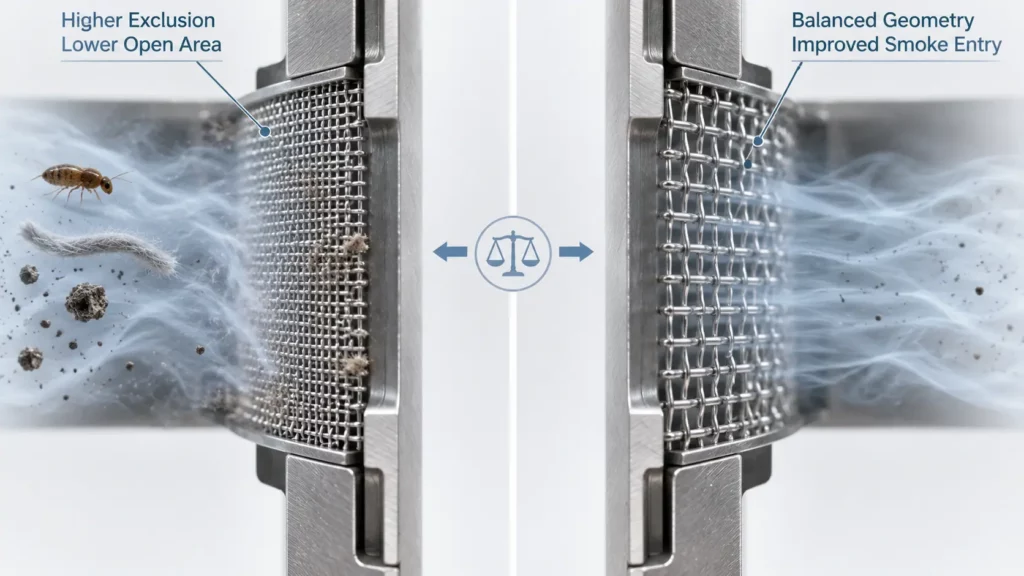
A smoke detector insect mesh protects the sensing chamber from insects, fibers, and larger contaminants. But it must also let smoke-laden air reach the sensor quickly enough for reliable detection.
This creates the main engineering challenge: the screen must block unwanted objects without becoming a barrier to smoke entry.
For smoke detector OEMs, aperture size is only part of the answer. Open area, material thickness, web width, chamber geometry, and manufacturing method all affect the final result.
Quick Answer
A smoke detector insect mesh protects the sensing chamber from insects, fibers, and larger contaminants while allowing smoke-laden air to enter with minimal restriction.
There is no universal best mesh hole size for smoke detectors. Engineers should evaluate five parameters together: aperture size, open area or pitch, material thickness, web width, and final mesh geometry.
For custom thin-metal screens, photo chemical etching is particularly useful when the design requires dense controlled apertures, integrated tabs or outer profiles, or rapid prototype changes. Final mesh geometry should always be validated as part of the complete smoke detector because smoke-entry performance depends on the housing, chamber, airflow, and sensing architecture.
What Does a Smoke Detector Insect Mesh Do?
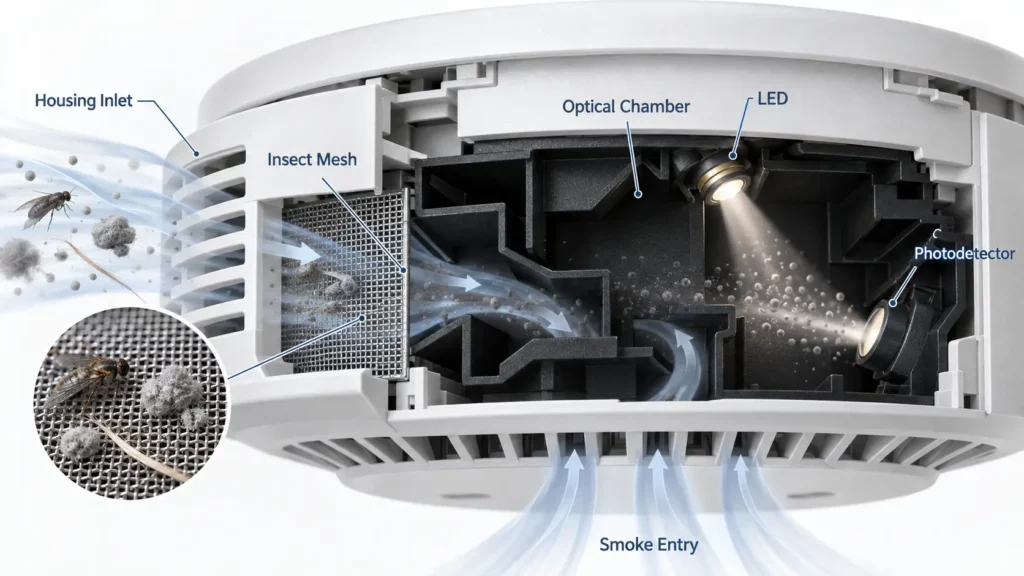
In a typical photoelectric smoke detector, outside air enters through the housing and moves toward an internal optical chamber. A protective mesh or insect screen may sit between these regions or form part of the chamber entrance.
Inside the chamber, an LED emits light into the sensing area. When smoke particles enter, they scatter some of that light toward a photosensitive receiver. This light-scattering principle is widely used in photoelectric smoke detection.
The U.S. National Institute of Standards and Technology, or NIST, describes how photoelectric detectors respond to light scattered by smoke particles. NIST: How Smoke Detectors Work
The insect mesh therefore sits in a critical position:
Ambient air → housing inlet → protective mesh → optical chamber → sensor
It helps keep insects, fibers, and larger debris away from sensitive areas. This matters because foreign particles can also disturb the optical environment.
NIST research on nuisance aerosols has shown that smoke detectors can respond to non-fire particles entering the sensing chamber. NIST research on nuisance aerosols
The mesh cannot eliminate every nuisance alarm. However, it provides an important physical barrier before larger contaminants reach the sensing chamber.、
The Core Trade-Off: Insect Protection vs. Smoke Entry
It may seem logical to make the openings as small as possible.
That is not always the best design.
Smaller openings can improve exclusion of insects and larger contaminants. But reducing aperture size or increasing the amount of solid metal can also reduce effective open area. A very restrictive screen may become more sensitive to dust accumulation and may slow the transport of smoke into the chamber.
Smoke-entry delay is a real detector-level issue.
NIST testing found that smoke outside a detector does not reach the internal sensing location instantly. Smoke must first move through the detector housing, and the resulting particulate entry lag depends strongly on flow velocity and detector geometry.
This means the mesh cannot be optimized in isolation.
Housing vents, mesh position, optical labyrinth geometry, chamber volume, detector orientation, and surrounding airflow can all influence how quickly smoke reaches the sensor.
European smoke detector standards reinforce this system-level view. BS EN 54-7:2018 specifies requirements, test methods, and performance criteria for point smoke detectors operating by scattered light, transmitted light, or ionization.
The important engineering lesson is not to copy one nominal mesh opening from a standard.
It is to design the screen so that it supports the complete detector’s required performance.
Five Parameters That Define a Smoke Detector Mesh
Aperture size receives most of the attention, but engineers should evaluate several parameters together.
Smoke Detector Mesh Design at a Glance
| Parameter | What It Controls | Main Trade-Off |
|---|---|---|
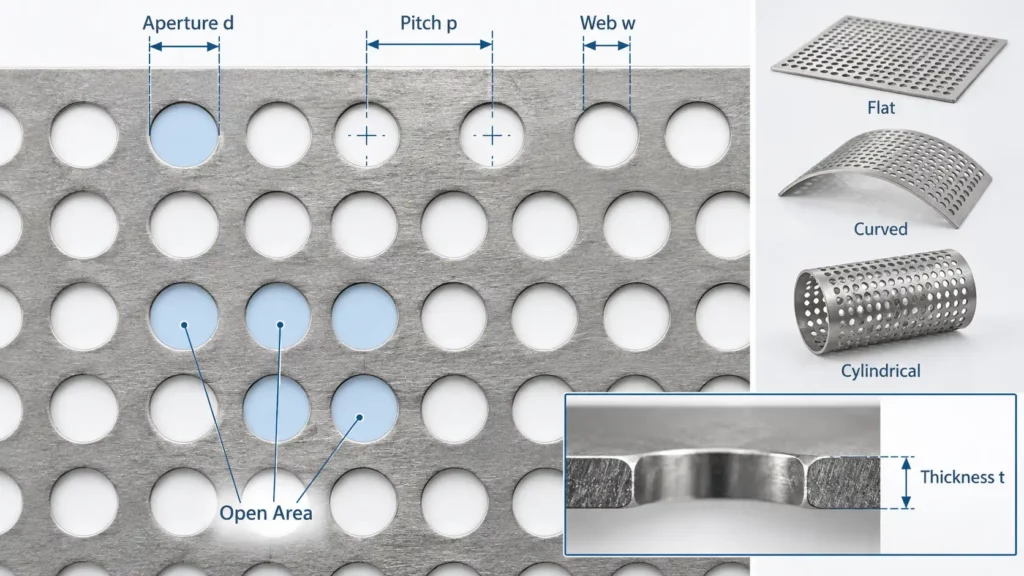
| Aperture size | Size of insects and contaminants that can physically pass | Smaller openings improve exclusion but may restrict smoke transport |
| Open area / pitch | Total flow area available for air and smoke | Higher open area improves transport but often requires narrower webs |
| Material thickness | Stiffness and achievable etched feature size | Thicker metal improves rigidity but makes very small through-features harder |
| Web width | Structural integrity between apertures | Narrow webs increase open area but reduce mechanical margin |
| Final geometry | Airflow path, assembly and chamber integration | Flat, curved and cylindrical screens behave differently after forming |
1. Aperture Size
Aperture size affects which foreign objects can physically pass through the screen.
However, there is no universal “best smoke detector mesh hole size.” A suitable opening depends on the detector architecture, mesh location, contamination environment, and target sensing performance.
This is why a drawing that only specifies:
0.30 mm holes
does not fully define the functional mesh.
The same hole diameter can produce very different results when pitch and material thickness change.
2. Open Area and Pitch
Open area describes how much of the screen remains available for air and smoke transport.
For round holes on a square pitch, a simplified theoretical open-area calculation is:
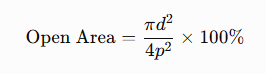
where (d) is the hole diameter and (p) is the center-to-center pitch.
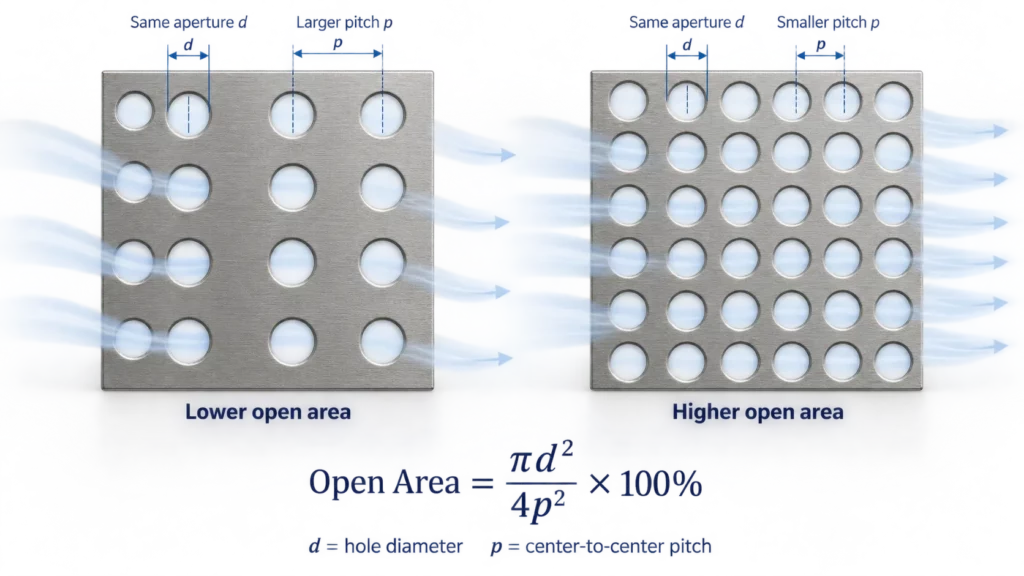
Consider two screens with identical 0.30 mm holes. If one design places those holes closer together, it can provide a higher total open area.
Therefore:
Hole size without pitch or open-area information is an incomplete specification.
For engineers comparing different perforated structures, TMNetch’s metal filter mesh guide provides additional background on etched mesh and screen structures.
3. Material Thickness
Thickness affects mechanical stiffness, forming behavior, and the size of features that can be produced reliably.
This becomes especially important with photo chemical etching.
During etching, exposed metal is removed vertically through the sheet and laterally at the feature edges. As material becomes thicker, producing very small through-holes becomes more demanding.
Published industry DFM guidelines illustrate this relationship. Precision Micro, for example, links minimum hole size and land width directly to material thickness.
These figures are useful engineering references, but they should not be treated as universal TMNetch production limits.
The correct approach is to confirm the final aperture-to-thickness ratio with the selected manufacturer.
For stainless steel designs, TMNetch’s stainless steel etching capabilities provide additional material and process information.、
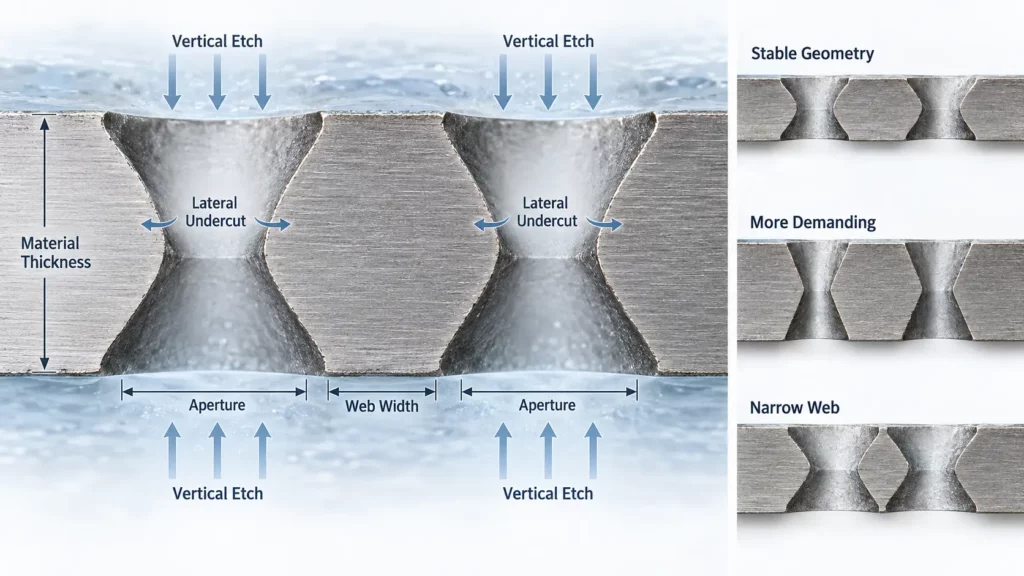
4. Web Width
The metal between neighboring apertures is commonly called the web, land, or bar width.
Reducing web width can increase open area. But if the remaining metal becomes too narrow, the screen may become more sensitive to distortion during processing, handling, forming, or assembly.
Industry photo-etching guidance also treats bar width as a thickness-dependent DFM parameter. VACCO, for example, notes that spacing between dense holes becomes an important design limitation as material thickness changes.
This creates another engineering balance:
Higher open area ↔ narrower webs ↔ lower structural margin
5. Pattern and Final Geometry
Not every smoke detector screen needs round holes arranged on a square grid.
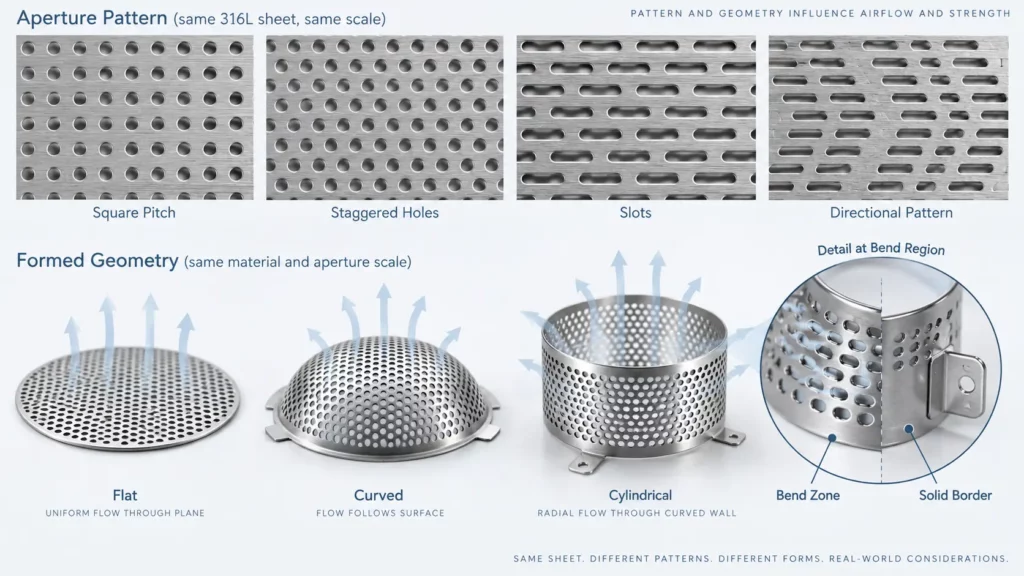
Designs may use staggered holes, slots, directional openings, or custom patterns. The final component may also be flat, annular, curved, or formed into a cylindrical structure.
There is no universal best pattern.
The geometry should support the required airflow, mechanical strength, optical layout, and assembly method.
Surface condition may also matter in optical designs. If the screen contributes to stray-light control, engineers may need to evaluate reflectivity or a dark surface finish. Any coating should be considered in the final aperture dimensions because coating build can reduce the effective opening.
What Standards Apply to Smoke Detector Insect Mesh Design?
Smoke detector standards provide the framework for complete device performance. They do not provide one universal insect-mesh drawing.
For European fire alarm systems, BS EN 54-7:2018 covers point-type smoke detectors using scattered light, transmitted light, or ionization.
For international applications, ISO 7240-7:2023 specifies requirements, test methods, and performance criteria for point-type smoke detectors used in building fire detection systems.
In North America, UL 217 Edition 10 covers smoke alarms, while UL 268 Edition 8 covers smoke detectors for fire alarm systems. Both are active standards as of 2026.
For component engineers, the most important point is simple:
A mesh can support a detector design intended to meet a standard, but final compliance is determined at the complete detector level.
A supplier should therefore avoid treating an aperture dimension alone as proof of UL, EN, or ISO compliance.
Woven vs. Stamped vs. Photo-Etched Mesh: Which Process Fits Which Design?
There are several ways to manufacture a smoke detector insect screen.
The correct process depends on the geometry, volume, and design maturity.
| Design Factor | Woven Mesh | Stamped / Punched Mesh | Photo-Etched Mesh |
|---|---|---|---|
| Standard high-open-area screen | Strong | Design dependent | Design dependent |
| Custom aperture pattern | Limited | Moderate | Strong |
| Integrated outer profile | Usually secondary process | Strong | Strong |
| Very fine thin-metal features | Possible | More challenging | Well suited |
| Hard tooling | Usually low | Often required | Phototooling |
| Prototype geometry changes | Flexible | Tool changes may be needed | Relatively flexible |
| Integrated tabs / slots | Limited | Possible | Well suited |
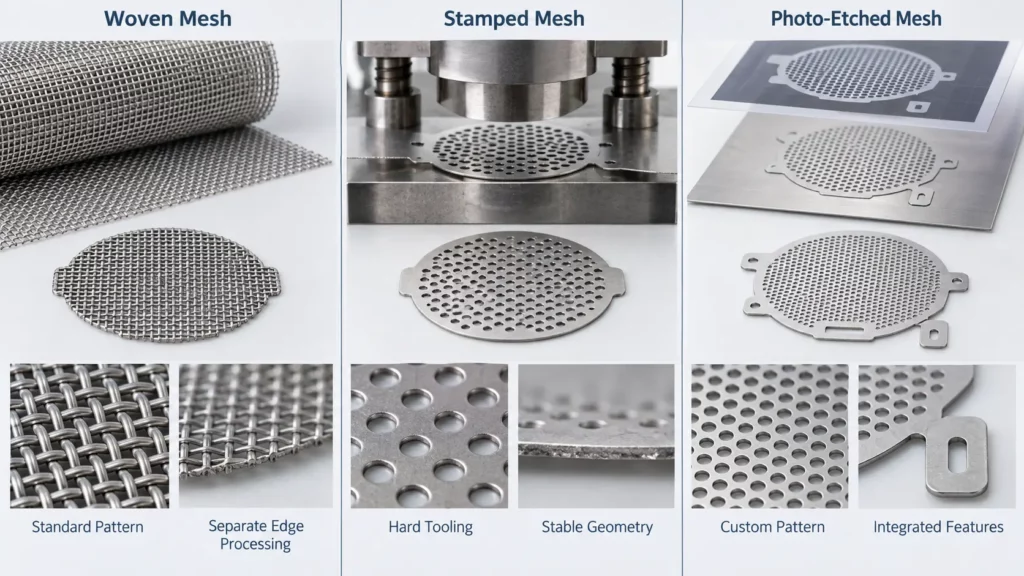
Woven mesh remains a practical choice when standard wire mesh already provides the required airflow and insect protection.
Stamping is often attractive when the geometry is stable and production volume supports dedicated tooling.
Photo chemical etching becomes more valuable when the screen requires thin metal, dense controlled apertures, a custom outer profile, integrated tabs or slots, or frequent prototype changes.
The process can define many holes and the external part profile in the same patterned sheet. It also creates apertures without mechanically punching each opening.
However, photo etching is not automatically the best process for every detector screen.
The process still has thickness-dependent feature limits and lateral etching that must be addressed through DFM. Precision Micro’s technical guide, for example, notes that the etchant attacks the sheet both vertically and laterally, producing a characteristic etched edge profile.
For a broader view of how the process works, see TMNetch’s chemical etching service and process overview.
When Should Each Process Be Used?
Choose woven mesh when a standard mesh structure already meets the required airflow, aperture and assembly requirements.
Choose stamping or punching when the geometry is relatively simple, stable and supported by production volume that justifies dedicated tooling.
Choose photo chemical etching when the screen requires thin metal, dense aperture arrays, custom outer profiles, integrated tabs or slots, or frequent prototype revisions.
DFM for Photo-Etched Smoke Detector Mesh
Good DFM starts before the aperture pattern is frozen.
A practical design sequence is:
Material → thickness → aperture → pitch → web width → open area → outer geometry → forming
This sequence matters because each decision affects the next.
If an engineer selects an extremely small opening first, the chosen sheet thickness may later make that feature difficult to manufacture consistently. Increasing open area may then require narrower webs, which can reduce mechanical stability.
The aperture-to-thickness relationship should therefore be reviewed early.
Published photochemical-etching guidance provides useful starting points. Precision Micro lists minimum hole sizes around the material thickness for much of its standard processing range, while VACCO also links minimum hole or slot width to sheet thickness.
Again, these are industry references rather than TMNetch-specific guarantees.
The next consideration is etch undercut. Because chemical etching removes material laterally as well as through the sheet, artwork must account for the final edge geometry.
Forming adds another variable.
If the finished detector screen is cylindrical, curved, or corrugated, aperture distortion near the bend region should be reviewed. Bend radius, springback, locating tabs, and the position of high-open-area zones can all affect the finished component.
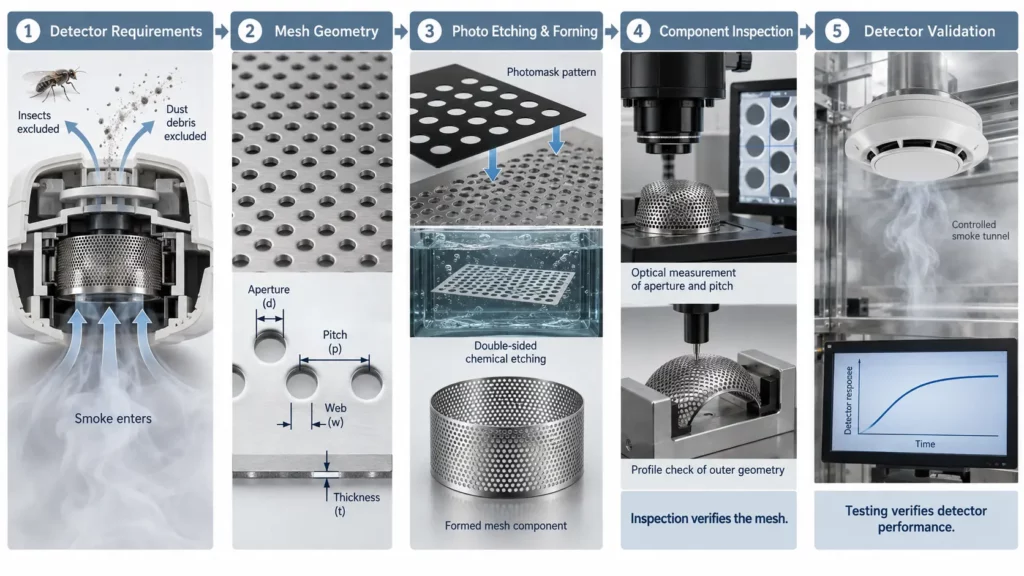
Inspection should then verify the dimensions that matter to function. Depending on the design, these may include aperture size, pitch, web width, total open area, outer dimensions, flatness, and formed geometry.
Component inspection, however, does not prove smoke-detector performance.
NIST’s smoke-entry research shows why final testing must still evaluate the complete detector housing and chamber.
For an initial DFM review, an OEM normally benefits from providing the material, thickness, aperture and pitch or open-area target, outer profile, final formed condition, critical tolerances, prototype quantity, and expected production volume.
TMNetch supports thin-metal components across a range of materials and thicknesses through its precision chemical etching services.
A smoke detector insect mesh may be a small component, but it sits at an important interface between the surrounding environment and the sensing chamber.
The strongest design does not simply maximize insect protection or minimize hole size. It balances foreign-object exclusion, smoke entry, open area, structural stability, and manufacturability.
For custom thin-metal screens, photo chemical etching becomes particularly useful when an OEM needs controlled aperture arrays, integrated profiles, or fast design iteration.
The goal is not to manufacture the smallest possible hole.
The goal is to manufacture a stable protective screen that supports reliable detector performance.
Frequently Asked Questions
What size holes should a smoke detector mesh have?
There is no universal ideal hole size. Engineers should evaluate aperture together with pitch, open area, material thickness, web width, chamber geometry, and detector-level performance testing.
Can insects cause false alarms in smoke detectors?
Foreign particles can disturb the optical sensing environment. NIST research shows that smoke detectors can respond to nuisance aerosols as well as fire-generated particles, which is one reason contamination control matters.
Why use photo etching for smoke detector mesh?
Photo etching is useful when the part requires thin metal, many controlled apertures, complex outer geometry, integrated tabs or slots, or repeated prototype changes. Its suitability still depends on thickness, aperture size, web width, open area, and final forming requirements.
Developing a custom smoke detector insect mesh?
Send TMNetch your material, thickness, aperture geometry, open-area target, outer profile, formed condition, and expected volume for a manufacturability review before the design moves into production.
How Should an OEM Select a Smoke Detector Insect Mesh?
Start with detector requirements
→ define contaminant-exclusion target
→ determine acceptable aperture range
→ establish open-area requirement
→ select sheet thickness
→ verify web width and etching feasibility
→ integrate outer geometry and forming
→ inspect the component
→ validate smoke-entry performance in the complete detector