

Hydrogen cars use a sealed nozzle to transfer compressed gas into the onboard tank. The station—not the driver—controls flow, pressure rise, temperature, and the stop point. Under normal conditions, a compatible passenger fuel cell electric vehicle (FCEV) refuels in about five minutes.
Most passenger FCEVs use 700 bar storage; other platforms use 350 bar or high-flow systems. The vehicle pressure class, receptacle, protocol, and station must match. For the electrochemical process after refueling, see how a PEM fuel cell works.
Quick Answers
- Typical passenger-car pressure: 700 bar / 70 MPa / approximately 10,000 psi
- Common alternative pressure: 350 bar / 35 MPa / approximately 5,000 psi
- Typical light-duty refueling time: About five minutes under normal, compatible conditions
- Main fill controls: Starting pressure, gas temperature, mass flow, pressure ramp, and tank limits
- Main station systems: Supply, compression, high-pressure storage, cooling, dispensing, and safety controls
- Compatibility rule: The station and vehicle must support the same pressure class, interface, and protocol
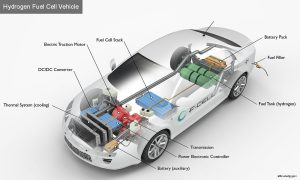
How Does Hydrogen Car Refueling Work?
The driver completes five steps. The station performs the pressure and thermal control.
Step 1 — Connect and lock the nozzle
Switch off the vehicle and attach the nozzle. Hydrogen cannot flow until the pressure-rated connection locks and seals.
Step 2 — Verify the fueling conditions
The station checks connection integrity, starting tank pressure, ambient temperature, available station pressure, and vehicle data where supported.
Light-duty stations commonly use SAE J2601, which defines protocols for 35 MPa and 70 MPa storage systems. The protocol sets the fill sequence; the driver does not select a flow rate.
Step 3 — Transfer compressed hydrogen
Hydrogen follows this path:
Station storage → Dispenser → Hose → Nozzle → Vehicle tank
The station needs enough pressure differential to move hydrogen into the tank. Tank pressure and temperature then rise together. The dispenser follows a controlled pressure or mass-flow profile.
Step 4 — Control pressure and temperature
The controller uses starting pressure, delivery temperature, ambient conditions, and tank limits. If temperature rises too quickly, it reduces flow or stops.
Step 5 — Stop and disconnect
The dispenser stops at the calculated target or an abnormal reading. It depressurizes the connection before nozzle removal.
Why Is Hydrogen Stored at High Pressure?
Hydrogen has low volumetric energy density at ambient pressure. Compression stores more mass in a practical tank volume.
The U.S. Department of Energy identifies 350–700 bar as the common onboard range. Higher pressure improves storage density but raises tank, valve, seal, piping, receptacle, and station requirements.
Passenger cars generally use 700 bar to improve packaging. Larger vehicles may have more tank volume, but pressure still depends on route, payload, capacity, and infrastructure.
350 Bar vs 700 Bar Hydrogen Refueling
Neither class is universally better. Select at vehicle-and-station level.
| Decision factor | 350 bar / 35 MPa | 700 bar / 70 MPa |
|---|---|---|
| Approximate pressure | 5,000 psi | 10,000 psi |
| Typical use | Many buses, industrial vehicles, and some fleets | Passenger FCEVs and some high-flow systems |
| Hydrogen per tank volume | Lower | Higher |
| Vehicle packaging | More volume for equal mass | Less volume for equal mass |
| Component demands | Lower pressure rating | Higher tank and component pressure rating |
| Station demands | H35-compatible equipment | Higher pressure and tighter thermal control |
| Best fit | More tank space or an H35 fleet strategy | Compact storage has higher value |
Service pressure is not a fixed gauge target for every fill. Because temperature changes gas density and pressure, the protocol calculates the completed state within tank limits.
How Long Does Hydrogen Car Refueling Take?
A compatible light-duty FCEV typically refuels in about five minutes, according to the U.S. Department of Energy’s Alternative Fuels Data Center. This benchmark assumes normal vehicle and station conditions.
| Variable | Effect on refueling time |
|---|---|
| Tank capacity | More required hydrogen usually extends the fill |
| Starting pressure | Lower pressure increases the mass transferred |
| Station pressure | Low bank pressure can slow transfer or require compressor recovery |
| Hydrogen temperature | Insufficient pre-cooling can slow the fill |
| Tank and ambient temperature | Changes the permitted fill trajectory |
| Dispenser capacity | Limits maximum mass flow |
| Consecutive fills | Can deplete pressure or cooling capacity before recovery |
For fleets, test several consecutive fills and record station recovery time—not only the first fill.
Why Is Hydrogen Pre-Cooled Before Refueling?
Rapid filling heats the gas inside the tank. Excess temperature can reduce flow, affect fill accuracy, or trigger an early stop.
Fast H70 stations commonly pre-cool hydrogen. SAE J2601 includes delivery-temperature categories down to −40°C; NREL station testing uses chillers and heat exchangers. The target is controlled tank temperature, not maximum cooling.
Engineers should check three linked variables:
- Hydrogen temperature at the dispenser outlet
- Pressure or mass-flow ramp during transfer
- Tank pressure and temperature at the end of the fill
Failure to control one variable can lengthen the fill or reduce delivered mass. For cold-soak operation, see PEM fuel cell cold-start performance.
What Happens Inside the Hydrogen Tank?
Tank pressure, temperature, and stored mass rise together. The controller estimates the final state from the protocol and measurements—not from empty physical volume.
Vehicle systems commonly use composite vessels designed for repeated pressure cycles. Qualification covers valves, sensing, protective devices, service loads, and environmental exposure—not only a static pressure test.
What Equipment Does a Hydrogen Fueling Station Need?
A common station chain is:
Hydrogen supply → Compression → Storage → Cooling → Dispenser → Vehicle
| Station function | Engineering purpose |
|---|---|
| Supply | Delivered gas, delivered liquid, or on-site production |
| Compression | Raises pressure for storage and dispensing |
| Storage | Buffers supply for rapid or consecutive fills |
| Cooling | Controls protocol delivery temperature |
| Dispensing | Meters hydrogen and controls the nozzle and stop sequence |
| Safety and quality | Detects faults and protects hydrogen quality |
The DOE’s hydrogen delivery program identifies these as core functions. One subsystem bottleneck reduces station throughput.
Is Hydrogen Refueling Safe?
Hydrogen refueling safety requires compatible, qualified, and maintained equipment. Because hydrogen is flammable and pressurized, protection uses independent layers.
| Control | Risk addressed |
|---|---|
| Locked nozzle | Release at the vehicle connection |
| Pressure and temperature monitoring | Overpressure or excessive temperature |
| Leak detection and ventilation | Hydrogen accumulation |
| Shutdown and isolation | Flow after an abnormal reading |
| Hose breakaway | Vehicle movement while connected |
| Pressure relief | Abnormal pressure or heat exposure |
| Maintenance | Wear, damage, drift, or failure |
Failed connection checks or abnormal readings should prevent or stop transfer. Safety depends on the full control chain, not one sensor.
What If the Hydrogen Tank Is Nearly Empty?
A nearly empty tank uses the same procedure but requires more hydrogen and follows a different pressure-temperature path. The protocol adjusts to its starting condition.
Two H70 vehicles can take different times because capacity, residual pressure, temperature, and allowed flow may differ.
Hydrogen Refueling vs Battery-Electric Charging
Select a powertrain from the full duty cycle, not refueling time alone.
| Factor | Hydrogen FCEV | Battery-electric vehicle |
|---|---|---|
| Energy storage | Compressed hydrogen tank | Battery pack |
| Replenishment | Pressure-controlled gas transfer | Electrical charging |
| Typical location | Retail station or fleet depot | Home, workplace, depot, or public charger |
| Time pattern | Minutes for many light-duty fills | Depends on charger power, battery size, and charge level |
| Infrastructure | Supply, compression, storage, cooling, dispenser | Grid, site capacity, charger, demand management |
| Strong use case | High use with limited downtime | Predictable dwell time and accessible charging |
Hydrogen can suit long shifts or centralized fleets. Battery-electric operation can suit scheduled charging windows. See where hydrogen fuel cell vehicles fit within the wider application mix.
Why Is Hydrogen Station Infrastructure Difficult to Scale?
A dispenser depends on upstream supply and pressure systems. Cost includes production or delivery equipment, compressors, storage, chillers, metering, controls, safety systems, civil work, permitting, and maintenance.
Availability matters as much as nameplate capacity. Low storage pressure, unavailable cooling, or compressor recovery can prevent a fast fill.
Before specifying a station, calculate:
- Total hydrogen demand in kg/day
- Peak demand in kg/hour
- Vehicles fueled per peak hour
- Hydrogen required per vehicle
- Number of consecutive fills
- Recovery time between filling periods
- Required station availability
Low utilization raises cost per kilogram. Depots concentrate demand but must be sized for peaks, not daily averages.
Passenger Cars vs Heavy-Duty Hydrogen Refueling
Heavy-duty stations need a different throughput model from passenger dispensers.
| Design issue | Passenger car | Heavy-duty or fleet vehicle |
|---|---|---|
| Priority | Compact storage and a short fill | High throughput and uptime |
| Hydrogen quantity per vehicle | Lower | Higher |
| Operating pattern | Individual retail fills | Scheduled or repeated depot fills |
| Pressure strategy | Commonly H70 | H35, H70, or program-specific |
| Critical check | Compatibility and availability | Peak flow, cooling, consecutive fills, recovery |
Emerging medium- and heavy-duty systems include high-flow 700 bar fueling. Vehicle class alone does not determine pressure.
When Does Create Value?
Hydrogen has a stronger operating case when most conditions apply:
- Vehicles run long shifts or high daily mileage
- Downtime has a measurable operating cost
- Refueling demand is concentrated at a depot or corridor
- Charging windows are too short for the required duty cycle
- Hydrogen supply is reliable
- Demand is high enough to use the station efficiently
The case weakens with short routes, long dwell periods, accessible charging, or unreliable hydrogen. Compare uptime, energy cost, utilization, maintenance, and coverage—not fill time alone.
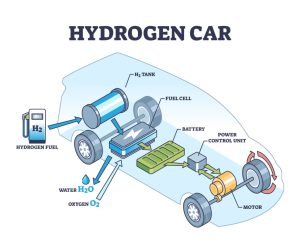
How Does Refueling Infrastructure Affect Vehicle Engineering?
The station network affects tank capacity, pressure, receptacle, valves, piping, thermal limits, controls, and packaging. Confirm compatibility before freezing the storage architecture.
For OEM teams developing stack hardware, metal bipolar plates for fuel cell vehicles require coordinated flow-field, material, coating, tolerance, and validation decisions.
Hydrogen Car Refueling at a Glance
Confirm station compatibility → Connect nozzle → Run system check → Transfer hydrogen → Control pressure and temperature → Reach target fill → Stop automatically → Depressurize and disconnect
Frequently Asked Questions
How long does it take to refuel a hydrogen car?
About five minutes for a compatible passenger FCEV under normal conditions. Capacity, starting pressure, temperature, and station demand change the result.
What pressure does a hydrogen car use?
Common classes are 350 bar / 35 MPa and 700 bar / 70 MPa. Passenger FCEVs commonly use H70; some bus, industrial, and fleet systems use H35 or other architectures.
Is 700 bar better than 350 bar?
No. H70 stores more hydrogen per tank volume. H35 reduces pressure requirements and can suit vehicles with more space. Select at vehicle-and-station level.
Is hydrogen car refueling safe?
Yes, with compatible, qualified, and maintained equipment. Sealed connections, monitoring, leak detection, pressure relief, isolation, and automatic shutdown provide separate protection layers.
Why is hydrogen cooled before refueling?
Rapid filling heats the gas. Pre-cooling keeps tank temperature within limits and supports a practical transfer rate.
Can any hydrogen car use any hydrogen station?
No. Pressure class, nozzle, receptacle, hydrogen quality, and protocol must match. A station cannot necessarily fuel every FCEV.
Conclusion
Hydrogen car refueling is controlled high-pressure gas transfer. The station manages pressure, temperature, mass flow, and the stop point.
Do not evaluate pressure class or fill time alone. Confirm compatibility, hydrogen demand, peak throughput, thermal capacity, consecutive-fill performance, recovery, safety controls, and supply reliability. Fast refueling creates value only when the complete system delivers it consistently.