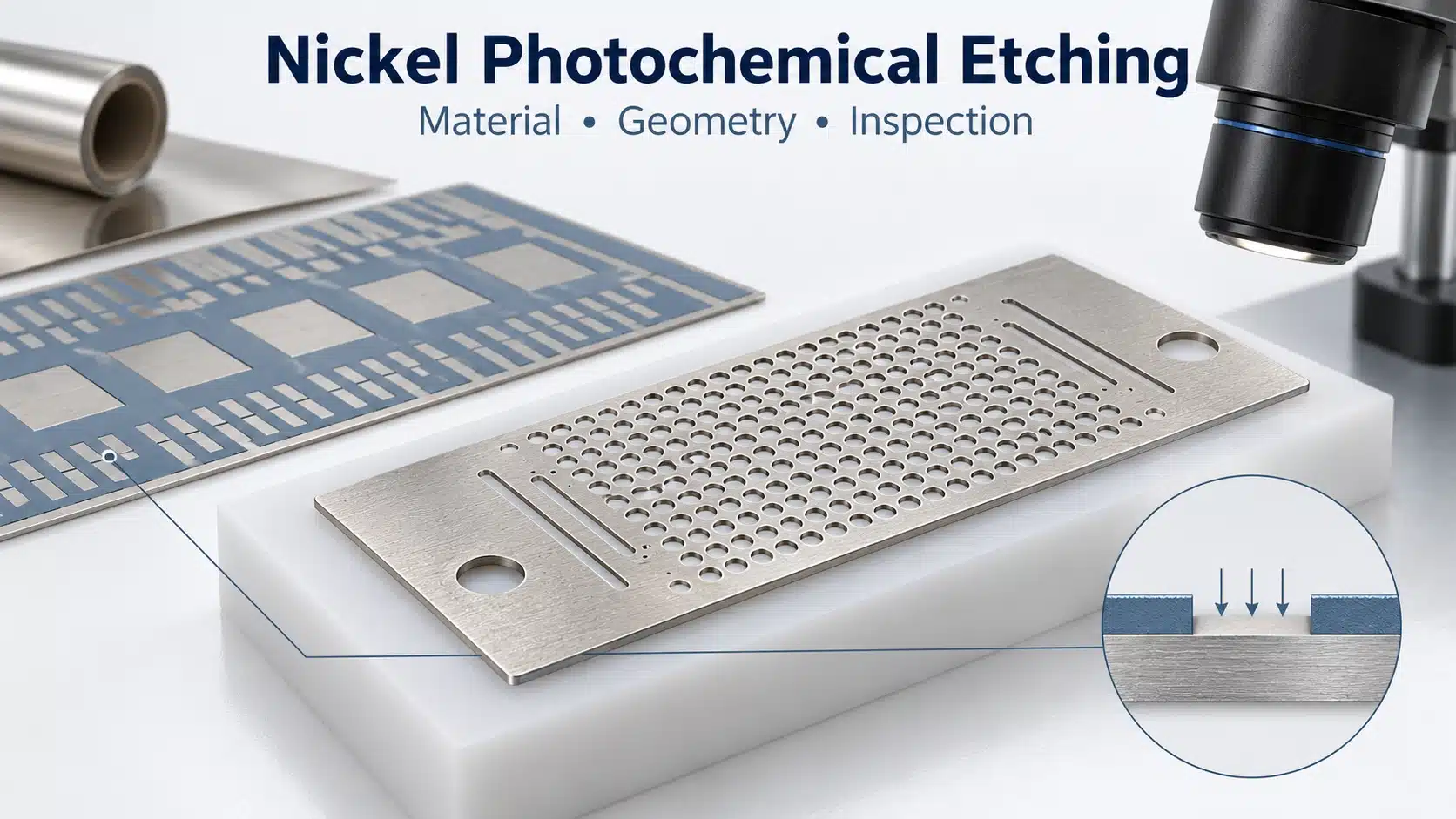

A filter mesh separates particles from liquid, gas or solid streams through controlled openings. The right mesh depends on aperture size, flow rate, pressure drop, material, temperature and mechanical load. For thin precision screens, engineers must also decide whether woven, perforated or photo-etched metal mesh provides the best combination of opening accuracy, strength and manufacturing cost.
This guide explains mesh count, aperture, open area, materials and common filter mesh types. It also compares manufacturing methods and shows when a custom photo-etched metal mesh may be more practical than woven or mechanically perforated alternatives.
What Is a Filter Mesh?
A filter mesh is a material with repeated openings that separates particles by size or protects downstream components. Depending on the system, it may remove unwanted particles, classify material, control flow, or support another filter layer.
The word mesh can cause confusion. In woven wire cloth, it describes a network made from crossing wires. In wider industrial use, people also use “mesh filter” for perforated, expanded, sintered, and etched metal screens.
How Does a Mesh Filter Work?
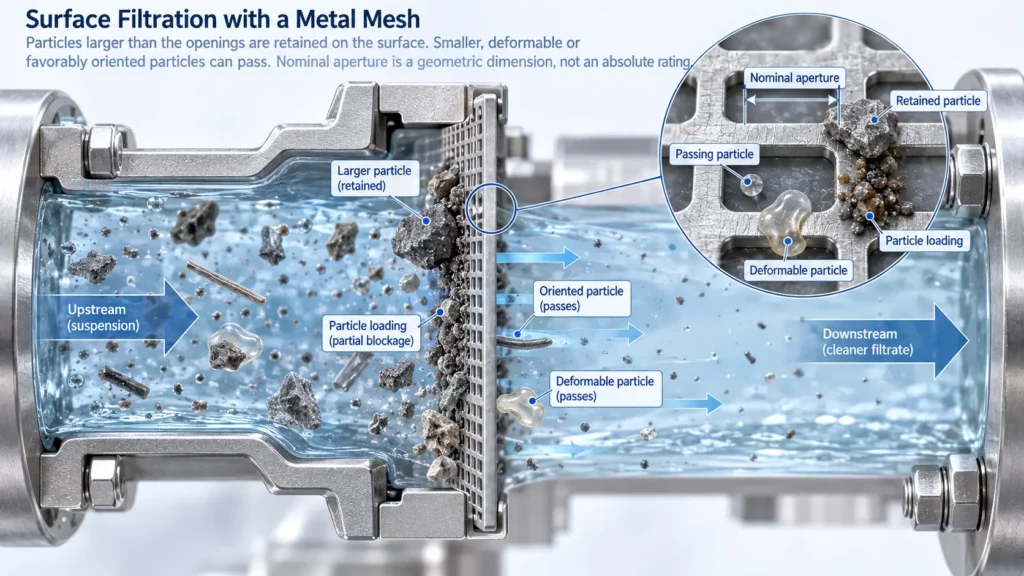
A mesh filter creates a physical path through its openings. A nominal aperture is not the same as an absolute particle-retention rating. Actual retention depends on particle morphology, loading, flow conditions and the test method. Smaller particles may pass through.
However, aperture size does not control the result alone. Particle shape, flexibility, fluid viscosity, flow direction, pressure, loading, and filter orientation can all affect real performance. Critical systems should test the selected mesh under representative operating conditions.
Metal mesh is one form of filter media. Paper, polymer fiber, membrane, ceramic, and porous sintered media serve different particle ranges and operating conditions. Metal mesh is often selected when a product needs a reusable screen, a rigid flat component, controlled openings, or resistance to heat and cleaning.
Mesh Count, Aperture, Pitch and Open Area
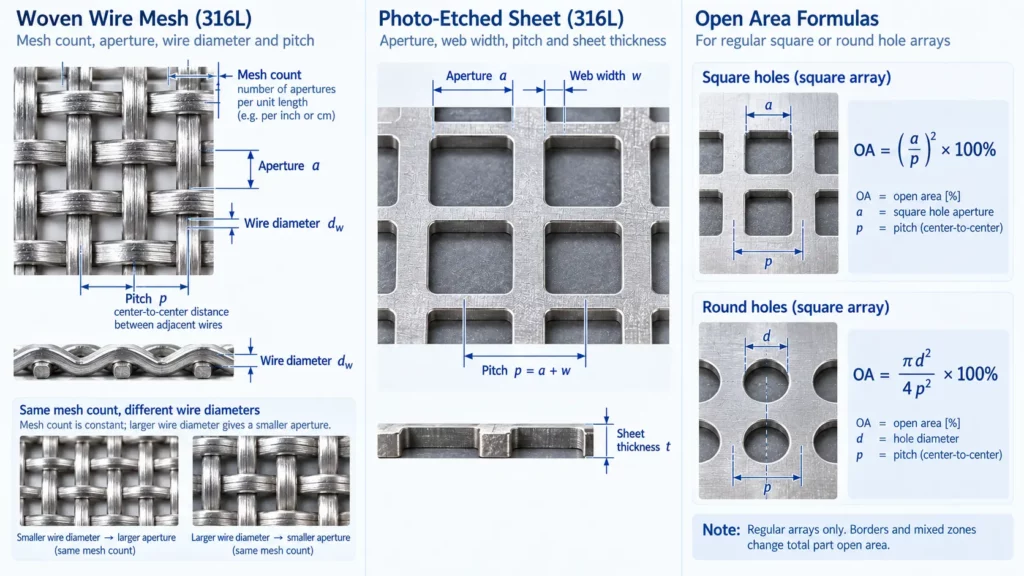
A drawing that only states “100 mesh” may not define a custom metal filter well enough. Engineers should also specify the aperture, wire or web width, pitch, open area, thickness, and overall dimensions.
Mesh Count
Mesh count is the number of openings per unit of linear length, commonly stated as openings per inch for woven wire cloth. The final aperture also depends on wire diameter, pitch and weave.
ISO 9044 uses this definition for industrial woven wire cloth. Mesh count is most useful when the wire diameter and weave are also known.
A higher mesh count often corresponds to smaller openings, but the relationship is not absolute. Two woven screens can have the same mesh count and different apertures because their wire diameters differ.
For an etched or perforated sheet, it is usually clearer to specify the actual hole size and pitch instead of using mesh count alone.
Aperture Size
Aperture size is the clear opening through which fluid and particles pass. A round opening uses diameter. A square opening uses side length. A slot normally requires both width and length.
State the aperture in micrometers, millimeters, or inches. Also define how the manufacturer should measure and sample the openings when the result is critical.
Wire Diameter and Web Width
Woven mesh uses wire diameter to describe each strand. Etched and perforated sheets use terms such as web width, land width, or bar width for the metal between adjacent openings.
This remaining metal supports the pattern. If the web becomes too narrow for the selected material and thickness, the part may bend, tear, or lose flatness during production, assembly, cleaning, or service.
Pitch
Pitch is the center-to-center distance between adjacent openings. It combines the aperture and the metal space between holes.
The drawing should also show whether the pattern is straight, staggered, radial, or divided into zones. Different zones can provide different flow areas or add strength around mounting features.
Open Area
Open area is the percentage of the active surface occupied by openings. It helps engineers compare how much flow area different patterns provide.
Open area does not predict pressure drop by itself. Hole shape, sheet thickness, edge profile, flow rate, fluid properties, and downstream geometry also matter. The U.S. Environmental Protection Agency treats filtration efficiency and pressure drop as separate performance measures, which is also a useful principle for industrial filter design.
| Term | What it describes | Most common use |
|---|---|---|
| Mesh count | Apertures per unit length | Woven wire cloth |
| Aperture | Clear opening size | All mesh types |
| Wire diameter | Diameter of each strand | Woven mesh |
| Web width | Metal between openings | Etched or perforated sheet |
| Pitch | Center distance between openings | Regular hole arrays |
| Open area | Share of surface occupied by openings | Flow and pressure-drop review |
What Are the Main Types of Filter Mesh?
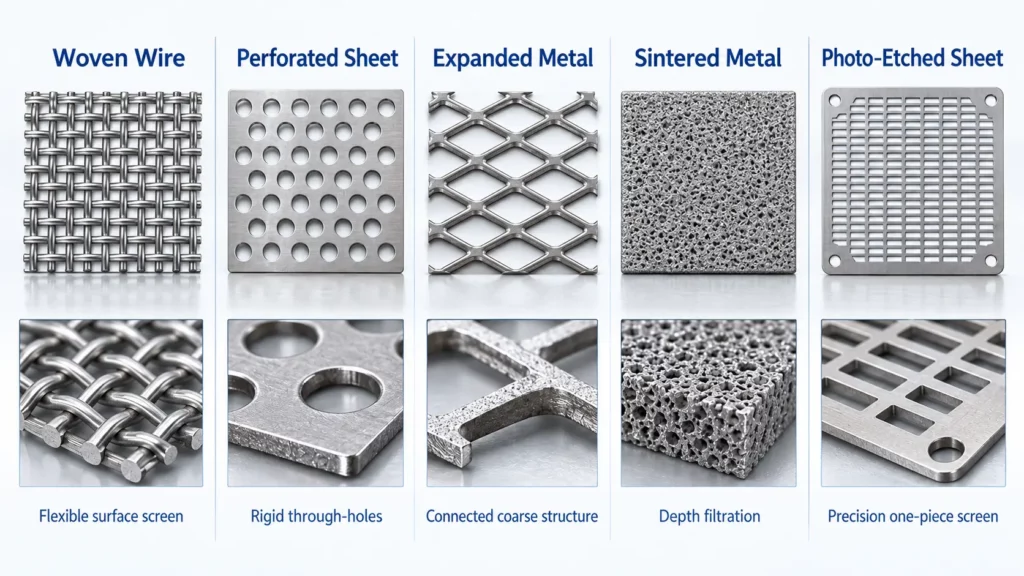
Filter meshes may look similar in an assembly, but their structures and manufacturing limits differ. The correct type depends on whether the project values flexibility, rigidity, fine pattern control, depth filtration, or high-volume cost.
Woven Wire Mesh
Woven wire mesh is made by crossing metal wires in a repeating weave. It is widely available and works well for many continuous screening and filtration tasks.
A cut woven screen may need an edge frame or joining process to prevent loose wires. Opening stability also depends on wire diameter, weave, handling, and assembly.
Perforated Metal Sheet
Perforated sheet contains repeated openings in a solid metal plate. The openings may be produced by punching, drilling, laser cutting, or another removal method.
It is more rigid than most woven mesh and can combine an active area with mounting features. Tooling, burrs, heat effects, and minimum hole size depend on the selected process.
Expanded and Welded Mesh
Expanded metal is made by cutting and stretching a sheet. It creates a connected structure that suits guards, supports, and larger openings, but it offers less freedom for precision micro-patterns.
Welded mesh joins wires at their crossing points. It is useful for baskets, support grids, guards, and coarse separation. It is rarely the first choice for a dense array of small, controlled apertures.
Sintered Metal Mesh
Sintered filters bond layers of wire mesh or metal powder through heat and pressure. They can form a rigid, three-dimensional porous path for depth filtration or backwashing.
The trade-offs include thickness, cost, pore characterization, and cleaning requirements. A sintered filter solves a different problem from a thin sheet with defined through-holes.
Photochemically Etched Mesh
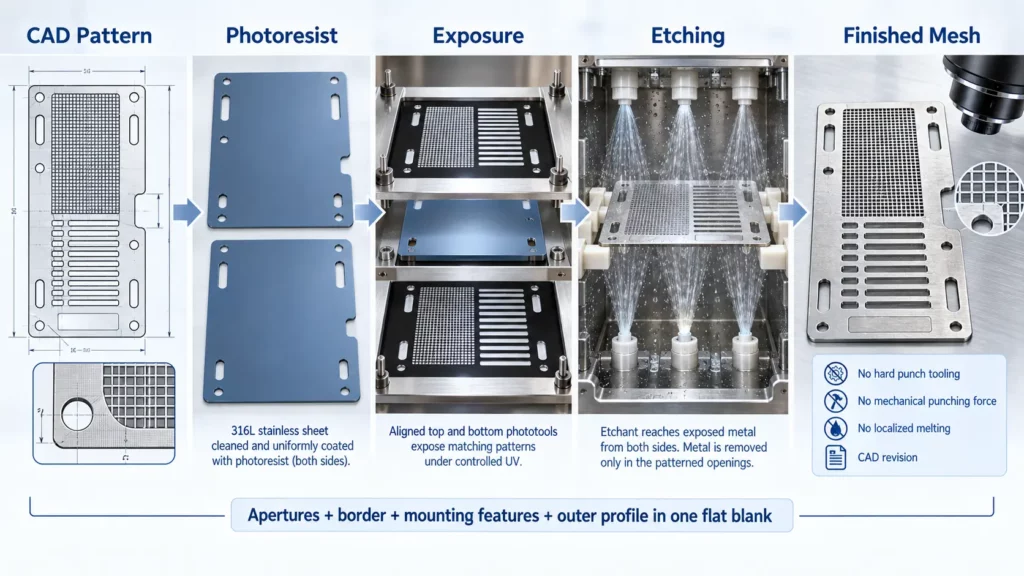
Photochemical etching transfers a digital pattern to sheet metal and removes selected areas with a controlled chemical process. It can form the apertures, outer profile, mounting holes, and identification features in the same flat blank.
The method suits thin, flat parts with many openings or complex patterns. It avoids mechanical punching force and localized cutting heat. Its limits include material thickness, side etching, sheet size, and feature geometry.
| Mesh type | Main strength | Main limitation | Typical fit |
|---|---|---|---|
| Woven wire | Flexible and widely available | Cut edges and opening stability need control | General screening |
| Perforated sheet | Rigid structure | Effects depend on the hole-making process | Guards and medium-to-large openings |
| Expanded or welded | Strong connected structure | Limited precision pattern freedom | Supports and coarse separation |
| Sintered metal | Rigid, porous depth | Higher complexity and thickness | Depth filtration and backwashing |
| Photo-etched sheet | Complex flat patterns and fast revisions | Best suited to thin sheet | Precision screens and flow parts |
Which Materials Are Used for Metal Filter Mesh?
Material selection should begin with the operating environment. Corrosion, temperature, mechanical load, cleaning chemicals, weight, conductivity, and regulatory requirements may matter more than raw material price.
Stainless Steel
Stainless steel combines useful strength with corrosion resistance and cleanability. Grades such as 304, 316, and 316L are common, but they are not interchangeable.
Chlorides, acids, temperature, surface finish, and cleaning chemistry can change corrosion performance. A material specialist should review demanding chemical or hygienic service.
Aluminum
Aluminum is lightweight, workable, and naturally forms a protective oxide film. Alloy selection still matters because strength, conductivity, forming behavior, and corrosion resistance vary by series. The Aluminum Association identifies the 1xxx series as high-purity alloys with strong corrosion resistance and workability.
Aluminum can suit ventilation, electronics, appliances, and other weight-sensitive equipment. It is not universally resistant to every acidic, alkaline, saline, or high-temperature environment. For more detail, read our aluminum mesh filter guide.
Copper, Nickel and Titanium
Copper and its alloys are useful when a screen must also conduct heat or electricity. Performance varies by grade, so projects should review alloy-specific conductivity, strength, and corrosion data.
Nickel alloys can support selected high-temperature or corrosive environments. Their higher cost should connect to a documented chemical, temperature, or electrical need.
Titanium combines low density, useful strength, and corrosion resistance in many process environments. It may suit medical, marine, and chemical equipment, but grade, joining, surface, and validation requirements still depend on the application.
| Material | Why engineers consider it | Important limitation |
|---|---|---|
| Stainless steel | Strength, cleanability, broad industrial use | Grade must match the environment |
| Aluminum | Low weight and good workability | Not compatible with every chemical or temperature |
| Copper | Electrical and thermal conductivity | Oxidation and media compatibility need review |
| Nickel alloy | Selected high-temperature or corrosive service | Higher material cost |
| Titanium | Low density and corrosion resistance | Material and processing cost can be higher |
How Do You Select Filter Mesh for an Application?
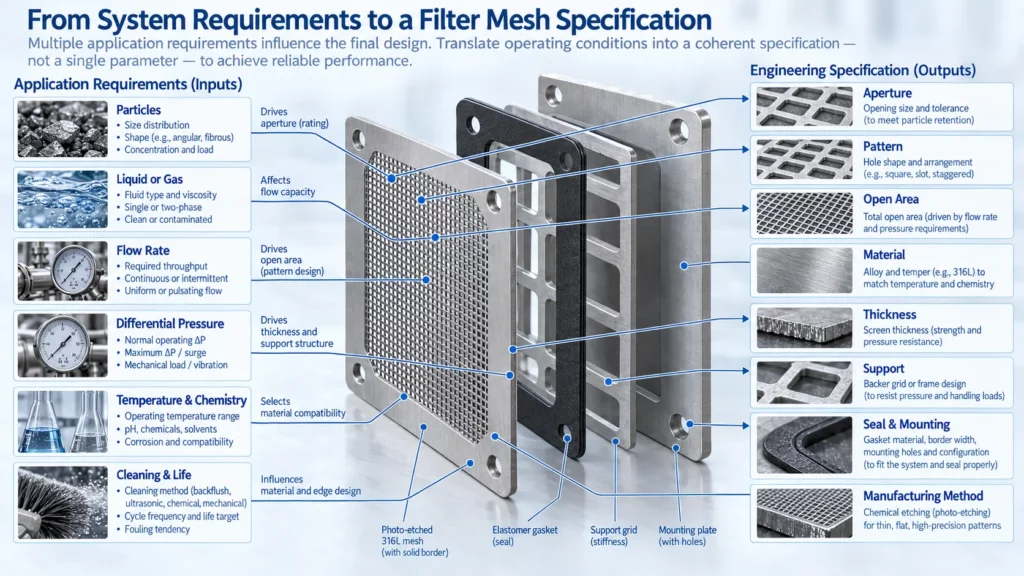
Good filter selection starts with the system requirement, not a catalog mesh number. The following sequence converts a filtration task into a useful specification.
1. Define the Particles
State the target particle size range, shape, hardness, and concentration. Note whether particles are rigid, fibrous, soft, or likely to join together.
Also define what may pass through. A filter that protects a pump has a different acceptance target from one that classifies a process material.
2. Define the Operating Media
Identify the liquid or gas, viscosity, temperature, flow rate, and chemical composition. Include cleaning fluids, start-up conditions, and short exposure events.
These factors influence material compatibility and pressure drop. They may also decide whether the filter should be cleaned, backwashed, or replaced.
3. Set Flow and Pressure-Drop Limits
Smaller apertures can raise flow resistance. Higher open area may reduce resistance, but it leaves less metal to support the pattern.
Define the allowable differential pressure and test the part at its intended flow. EPA filtration guidance also stresses that a filter must stay within the pressure limit of the system moving the air.
4. Review Mechanical Loads
A filter may face pressure pulses, vibration, impact, clamping force, bending, and cleaning loads. The active area, unsupported span, material, thickness, and web width all affect stability.
If an open pattern cannot carry the load, the design may need wider webs, a thicker sheet, a support grid, or a smaller unsupported area.
5. Define Cleaning and Service Life
State whether the part will be rinsed, brushed, ultrasonically cleaned, chemically cleaned, sterilized, or backwashed. A reusable screen must survive both normal service and maintenance.
The cleaning method must also match the metal and any coating. A material that resists the process fluid may still react with an aggressive cleaning chemical.
6. Confirm Installation Geometry
Define the outer dimensions, active area, edge frame, locating holes, tabs, seals, and joining method. A better boundary or seal can reduce bypass leakage more effectively than a minor change in mesh count.
For custom etched mesh, the outer profile and hole array can be designed together. This can reduce separate cutting or assembly steps for a flat element.
What Design Trade-Offs Control Filter Performance?
Filter design is a balance. Improving one parameter can create a new limit elsewhere.
Aperture vs. Particle Retention
A smaller aperture can retain smaller particles, but it may clog sooner or raise differential pressure. Irregular and flexible particles can also behave differently from rigid test particles.
Use aperture as a starting point. Confirm performance with the real contaminant and operating media when failure carries a high cost.
Open Area vs. Strength
More open area gives the fluid more paths through the screen. However, it reduces the amount of metal connecting the pattern.
The design must keep enough web width around openings, edges, mounting features, and high-load zones. Local reinforcement can be more effective than applying one pattern across the full part.
Thickness vs. Feature Size
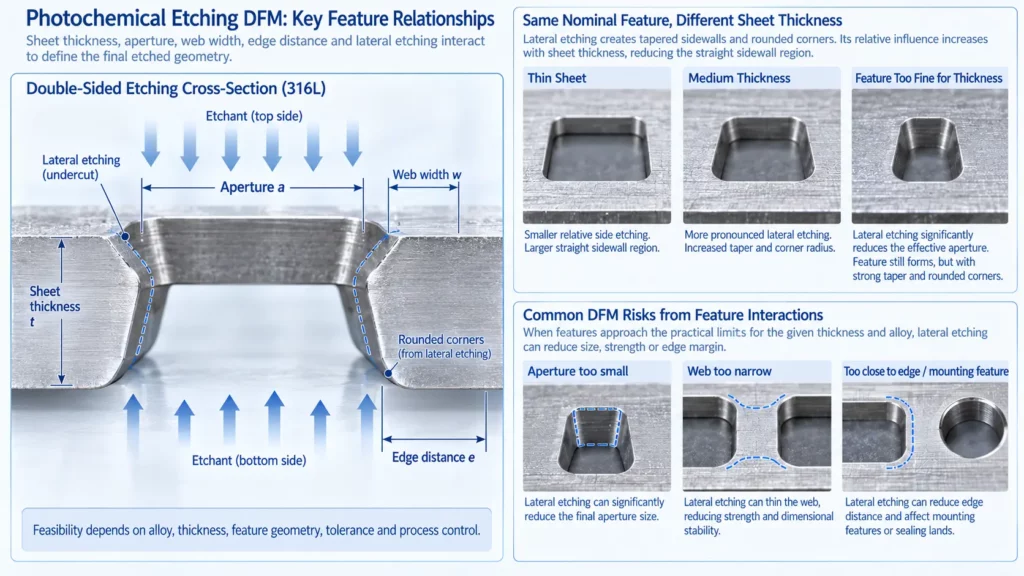
Thicker sheet can improve stiffness, but fine apertures become harder to manufacture as thickness increases. This relationship affects etching, laser cutting, punching, and drilling in different ways.
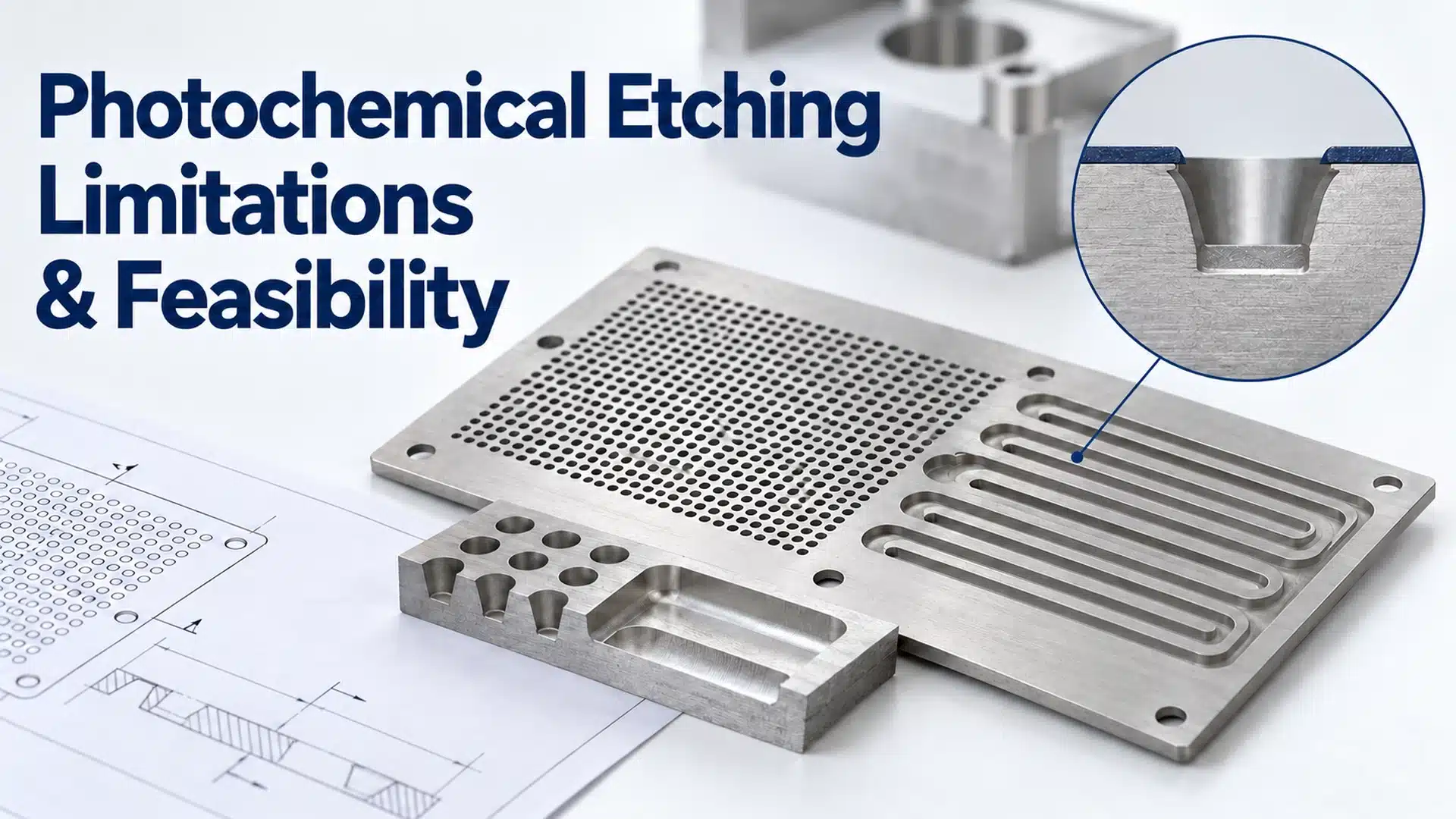
During photochemical etching, the etchant removes material downward and laterally. The manufacturer should therefore review material, thickness, aperture, web width, and tolerance together.
Hole Shape vs. Flow
Round holes are easy to dimension and avoid sharp internal corners. Squares, hexagons, slots, and custom openings may use space differently or guide flow in a preferred direction.
No single shape is best for every system. Compare flow, particle behavior, strength, manufacturability, and inspection before selecting the pattern.

When Should You Use Photochemically Etched Mesh?
Photochemical etching can make a one-piece mesh from many etchable sheet metals. Common choices include stainless steel, copper, nickel, aluminum, and titanium, subject to alloy-specific process review.
The process can produce round, square, hexagonal, and slotted openings. It can also combine several aperture zones, solid borders, mounting holes, markings, and a custom profile in one flat part.
Main Advantages
The process does not press a cutting tool through the sheet. It avoids the mechanical shearing force associated with conventional punching and can reduce burr formation and deformation when the process is properly controlled. It also avoids the localized melting associated with thermal cutting.
Phototooling can be changed without building a new hard punch tool. This supports prototypes, design revisions, and related products that share an outline but use different patterns.
Industry guidance identifies filters, screens, shims, lead frames, and flow plates as common applications. It also notes that photochemical machining is best suited to relatively thin, flat parts.
Main Limitations
Photochemical etching is not a replacement for every mesh process. It is mainly a two-dimensional sheet method and does not directly create a deep filter body.
Etching also removes material laterally. Very small openings and narrow webs become more difficult as thickness increases. Sheet size, alloy chemistry, flatness, surface finish, and inspection requirements may also limit feasibility.
Consider photo etching when the part is thin, flat, dense with openings, sensitive to burrs or heat, or likely to need several design versions. Consider another method for thick load-bearing parts, depth filtration, commodity woven rolls, or simple large openings.
Filter Mesh Manufacturing Methods Compared
The lowest quoted piece price does not always mean the lowest total cost. Tooling, design revisions, inspection, finishing, assembly, and failure risk should all enter the decision.
| Method | Best suited to | Main advantage | Main limitation |
|---|---|---|---|
| Woven wire | Flexible media and standard rolls | Wide availability | Limited custom outline and opening shapes |
| Stamping | Stable high-volume designs | Fast production after tooling | Hard tooling and possible burr control |
| Laser cutting | Profiles and lower hole counts | Flexible programming and wider thickness range | Heat effects and dense-hole efficiency need review |
| Mechanical perforation | Regular openings in suitable sheet | Efficient for simple patterns | Tooling and deformation depend on design |
| Photochemical etching | Thin sheets with dense or mixed patterns | No hard tooling and fast design changes | Thickness and side-etch limits |
| Sintering | Rigid porous depth filters | Three-dimensional pore structure | Greater thickness and process complexity |
Woven and sintered products serve needs that etched sheet cannot copy. Stamping and perforation may offer better economics for stable, simple, high-volume parts. Laser cutting may suit thicker profiles or designs with fewer openings.
Etching becomes attractive when aperture density, pattern freedom, flatness, design changes, and the absence of hard tooling matter at the same time.
Where Is Metal Filter Mesh Used?
Industrial Liquid and Chemical Processing
Metal screens can protect pumps, valves, nozzles, meters, and downstream equipment from particles. Chemical-processing mesh must match the fluid, temperature, pressure, cleaning chemistry, and target retention size.
Stainless steel, nickel alloys, or titanium may be considered for corrosive conditions. Select the grade from documented compatibility data, not a general material name.
Airflow and Equipment Protection
Metal mesh can stop larger dust, fibers, insects, or debris while allowing ventilation. It may serve as a washable pre-screen or guard rather than a fine-particle air filter.
Pressure drop and fan capacity still matter. For lightweight equipment and selected environments, an aluminum mesh filter may be considered.
Appliances and Coffee Machines
Espresso shower screens use repeated openings to distribute water and limit coffee-particle movement. Aperture pattern, open area, thickness, flatness, and surface finish can affect assembly and flow distribution.
Photo etching is useful when the screen combines a dense pattern with a custom outline or mounting feature. Similar logic applies to selected appliance, spray, and small flow-control screens.
Automotive, Medical and Precision Equipment
Compact screens may protect fuel, lubrication, hydraulic, cooling, laboratory, or instrument passages. These projects often need clear limits for temperature, vibration, cleanliness, material traceability, and inspection.
Precision geometry alone does not make a component suitable for a regulated application. The part, process, testing, and quality system must meet the project specification.
Filter Mesh RFQ Checklist: What to Send Your Manufacturer
Inspection should focus on characteristics that affect fit, flow, retention, and reliability. A typical drawing or quality plan may cover:
material and thickness;
aperture size and shape;
pitch and pattern position;
outer dimensions and mounting features;
web integrity, surface, and edge condition;
flatness;
project-specific flow, pressure-drop, leakage, or strength tests.
Do not assume that every order includes functional testing. Define the method, fixture, fluid, flow rate, pressure, sampling plan, and acceptance limit when a test is required.
For an efficient quotation, provide:
material and grade;
thickness;
outer dimensions and active area;
aperture, pitch, and pattern arrangement;
open-area target, if required;
tolerances and datums;
finish and cleaning requirements;
prototype and production quantities;
drawing file and revision;
operating media, temperature, pressure, and flow conditions.
For a thin, flat filter with a precision aperture pattern, submit the drawing through TMNetch’s custom metal mesh filter and screen page. A DFM review should confirm the relationship between material, thickness, aperture, web width, tolerance, and volume before production.
Frequently Asked Questions
What is filter mesh used for?
Filter mesh separates particles, protects equipment, controls flow, or supports another filter layer. Common uses include liquid filtration, ventilation protection, appliance screens, process equipment, and precision flow-control parts.
What is the difference between mesh count and aperture size?
Mesh count states how many openings occur per unit length in woven wire cloth. Aperture size states the clear size of each opening. Mesh count alone does not define the aperture because wire diameter also takes up space.
Does a higher mesh count always mean finer filtration?
Not always. A higher count often means smaller openings, but wire diameter and weave also matter. For etched or perforated sheet, specify the actual aperture and pitch.
What materials are used for metal filter mesh?
Common materials include stainless steel, aluminum, copper, nickel alloys, and titanium. Selection depends on corrosion, temperature, strength, weight, conductivity, cleaning, and cost.
What is the difference between woven and etched mesh?
Woven mesh is made from crossing wires and is often flexible. Etched mesh is made from a flat sheet and can combine controlled openings, solid borders, mounting features, and a custom outer profile.
When should photochemical etching be used for filter mesh?
Consider photochemical etching for a thin, flat screen with many controlled openings, a complex pattern, a custom outer shape, or frequent design changes. Review another method for thick structural parts, depth filters, or simple commodity mesh.
Select Filter Mesh by Function, Not by Mesh Count Alone
The correct filter mesh is defined by the system around it. Particle size matters, but so do aperture geometry, open area, pressure drop, mechanical support, material compatibility, cleaning, and manufacturing method.
Woven, perforated, expanded, welded, sintered, and photo-etched meshes solve different problems. Photochemical etching is most useful when a project needs a thin, flat, one-piece metal screen with many controlled openings and a custom profile.
Before releasing a drawing, confirm material, thickness, aperture, web width, pitch, tolerance, and test conditions together. This creates a specification that both the filtration system and the manufacturing process can support.
Need a Custom Precision Filter Mesh?
If your project requires a thin metal filter with controlled apertures, custom hole patterns or integrated mounting features, send us your drawing for review.
Include the material, thickness, aperture geometry, operating medium and estimated annual quantity. Our engineering team will review aperture size, web width, open area, tolerance and secondary processing before quotation.