
Modern electronic devices are becoming smaller, faster, and more connected. As a result, controlling electromagnetic interference (EMI) and radio frequency interference (RFI) has become an important part of product design because unwanted electromagnetic energy can affect the operation of electronic systems.
Choosing the right EMI shielding solution is not only about selecting a conductive material. Engineers and procurement teams must also consider shielding structure, operating frequency, thermal requirements, available space, manufacturing method, and production volume.
There is no single shielding method that works for every application. A metal enclosure may provide strong protection for a PCB module, while shielding mesh may be a better choice when airflow is required. For thin, precision shielding components with complex patterns, photo etching can provide design flexibility without traditional tooling.
This guide compares common EMI/RFI shielding methods, materials, and manufacturing processes to help engineers select the right solution for their applications.
Quick Answer: How Do You Choose the Right EMI/RFI Shielding Solution?
The best EMI/RFI shielding method depends on your product requirements.
- Metal shielding enclosures are suitable for strong protection of electronic modules.
- Shielding mesh is useful when both EMI protection and ventilation are required.
- Conductive coatings work well for lightweight or complex plastic housings.
- EMI gaskets help reduce electromagnetic leakage through joints and gaps.
- Photo etching is suitable for thin precision shielding parts with complex openings and customized designs.
Before selecting a solution, engineers should evaluate:
- Frequency range
- Required shielding effectiveness
- Material properties
- Space limitations
- Thermal requirements
- Manufacturing cost
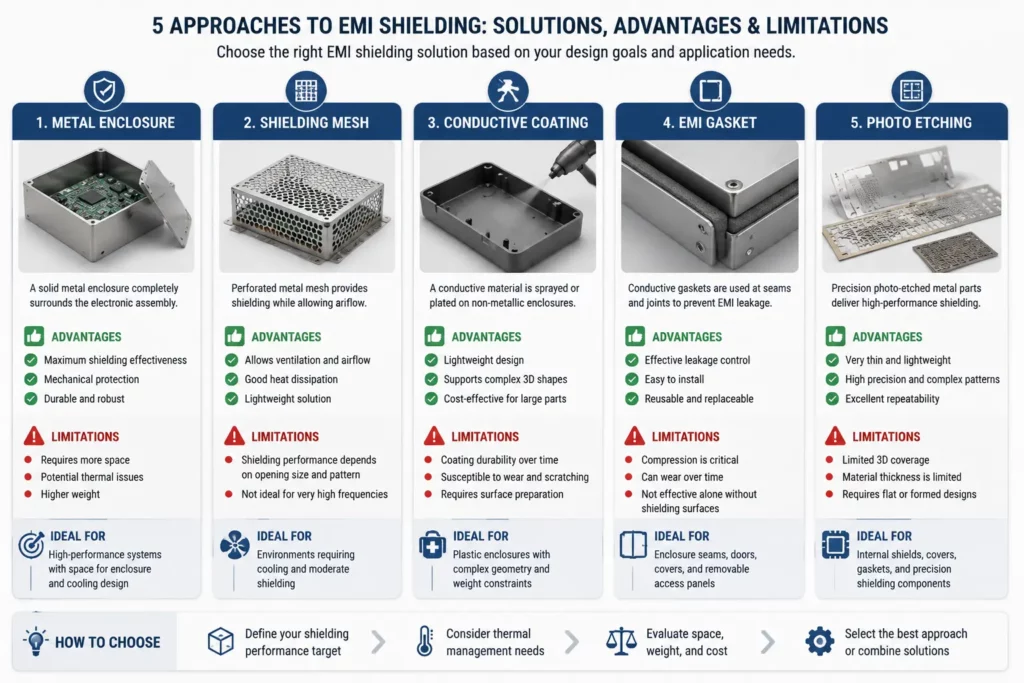
EMI/RFI Shielding Methods Comparison
Different shielding methods solve different design challenges. The correct choice depends on the application environment and product requirements.
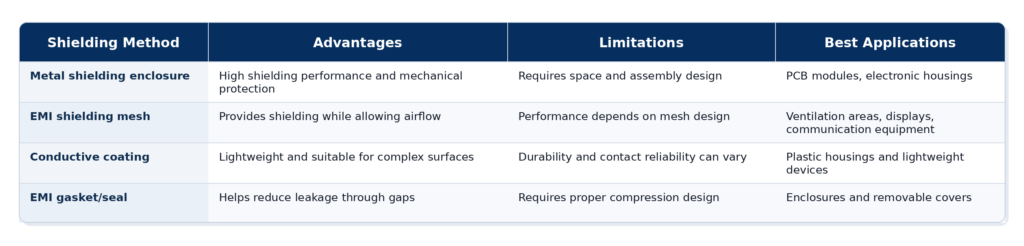
Metal Shielding Enclosures
Metal shielding enclosures are one of the most common EMI/RFI shielding solutions.
They create a conductive barrier around sensitive electronic components and help reduce electromagnetic emissions or interference from external sources.
Common examples include:
- Shielding covers
- Shielding cans
- Electronic housings
Advantages
- Strong shielding capability
- Provides mechanical protection
- Suitable for sensitive electronic modules
Limitations
- Requires additional space
- May affect thermal management
- Needs careful design around seams and openings
Metal enclosures are often used in applications such as communication equipment, automotive electronics, and industrial control systems.
EMI Shielding Mesh
EMI shielding mesh provides a balance between electromagnetic protection and airflow.
Unlike a fully closed metal enclosure, mesh structures allow ventilation while maintaining shielding performance.
Common applications include:
- Electronic displays
- Ventilation openings
- Communication devices
- Equipment requiring heat dissipation
Advantages
- Supports airflow
- Reduces heat buildup
- Allows lightweight designs
Limitations
- Shielding performance depends on opening size and design
- Requires careful frequency consideration
For products that require both cooling and EMI control, shielding mesh can be a practical alternative to solid metal covers.
Conductive Coating
Conductive coatings create a conductive layer on non-metal surfaces, such as plastic housings.
This approach is often considered when weight reduction or complex external shapes are important.
Advantages
- Lightweight
- Suitable for complex geometries
- Does not require a full metal enclosure
Limitations
- Coating durability must be considered
- Electrical contact consistency can affect performance
Conductive coating is commonly used for consumer electronics and lightweight equipment where mechanical shielding structures are difficult to apply.
Choosing Between Methods
The table above covers the core trade-off for most projects. Two comparisons come up often enough to call out directly:
Metal shielding vs. shielding mesh — choose metal shielding when maximum protection and mechanical strength are the priority; choose mesh when airflow and heat management have to work alongside EMI protection. Mesh performance is more sensitive to opening size and pattern design, so this is also where photo etching’s pattern precision matters most (see the manufacturing comparison below).
Conductive coating vs. metal shielding — coating suits plastic housings, lightweight devices, and complex external shapes where adding a metal structure isn’t practical, but shielding performance depends on coating durability and long-term electrical contact. Metal shielding remains the more stable, predictable choice for high-reliability electronics, at the cost of added weight and space.
EMI Shielding Materials Comparison
Material selection has a direct impact on EMI/RFI shielding performance. Engineers should consider conductivity, weight, mechanical strength, corrosion resistance, cost — and, critically, whether the application needs to block an electric field, a magnetic field, or both, since different materials excel at each.
Copper EMI Shielding
Copper is widely used in shielding applications because of its high electrical conductivity. For thin precision copper shielding parts, copper etching can create complex patterns without mechanical cutting stress.
Advantages
- Excellent conductivity
- Effective for many high-frequency applications
- Suitable for precision shielding parts
Limitations
- Higher material cost
- Lower mechanical strength compared with some alternatives
Copper is often selected when electrical performance is a primary concern.
Aluminum EMI Shielding
Aluminum is commonly selected when weight reduction is important.
Advantages
- Lightweight
- Good conductivity
- Suitable for aerospace and portable electronics
Limitations
- Lower conductivity than copper
Aluminum can provide a good balance between shielding performance and weight.
Stainless Steel EMI Shielding
Stainless steel is selected when mechanical strength and durability are important.
Advantages
- High strength
- Corrosion resistance
- Good structural performance
Limitations
- Lower conductivity compared with copper
Stainless steel can be suitable for applications requiring both shielding and physical durability.
Nickel and Nickel Alloys for Magnetic Shielding
Copper, aluminum, and stainless steel all shield mainly through conductivity — induced eddy currents in the metal oppose an incoming electric field or high-frequency electromagnetic wave, which is why these metals work well against RF interference in the megahertz-to-gigahertz range. But conductivity alone does very little against low-frequency magnetic fields. Below roughly 100 kHz, a magnetic field passes through a highly conductive, non-magnetic metal almost as if the shield weren’t there.
This is the gap nickel alloys fill. High-nickel alloys such as mu-metal and permalloy work through magnetic permeability rather than conductivity — they provide a low-reluctance path that redirects magnetic field lines around the protected space instead of blocking them electrically. This makes them the standard choice when the interference source is a transformer, motor, low-frequency power circuit, or another magnetic-field-dominant source, rather than RF emissions.
Advantages
- High magnetic permeability, effective against low-frequency magnetic fields where copper and aluminum are largely ineffective
- Can be etched into thin, precisely shaped shielding components for compact assemblies
Limitations
- Lower electrical conductivity than copper or aluminum, so less effective against high-frequency RF interference on its own
- Shielding performance can be reduced by mechanical stress or bending after processing, which is one reason chemically etched (stress-free) nickel alloy parts are often preferred over stamped ones for magnetic shielding components
In practice: if the interference source is RF (radios, digital clocks, switching power supplies operating above roughly 1 MHz), copper or aluminum is usually the starting point. If the interference source is low-frequency magnetic (power transformers, motors, or fields below roughly 100 kHz), nickel alloys are usually necessary regardless of how conductive the surrounding shield is. Many designs use both — a conductive outer shield for RF, plus a high-permeability layer or insert where a magnetic source is nearby.
Material selection should always match the frequency range, environment, and application requirements. For shielding effectiveness testing, ASTM D4935 covers measurement of planar material shielding effectiveness from 30 MHz to 1.5 GHz, while enclosure-level testing across a wider 9 kHz–18 GHz range — worth checking against whichever standard your customer’s spec references before finalizing a material choice.
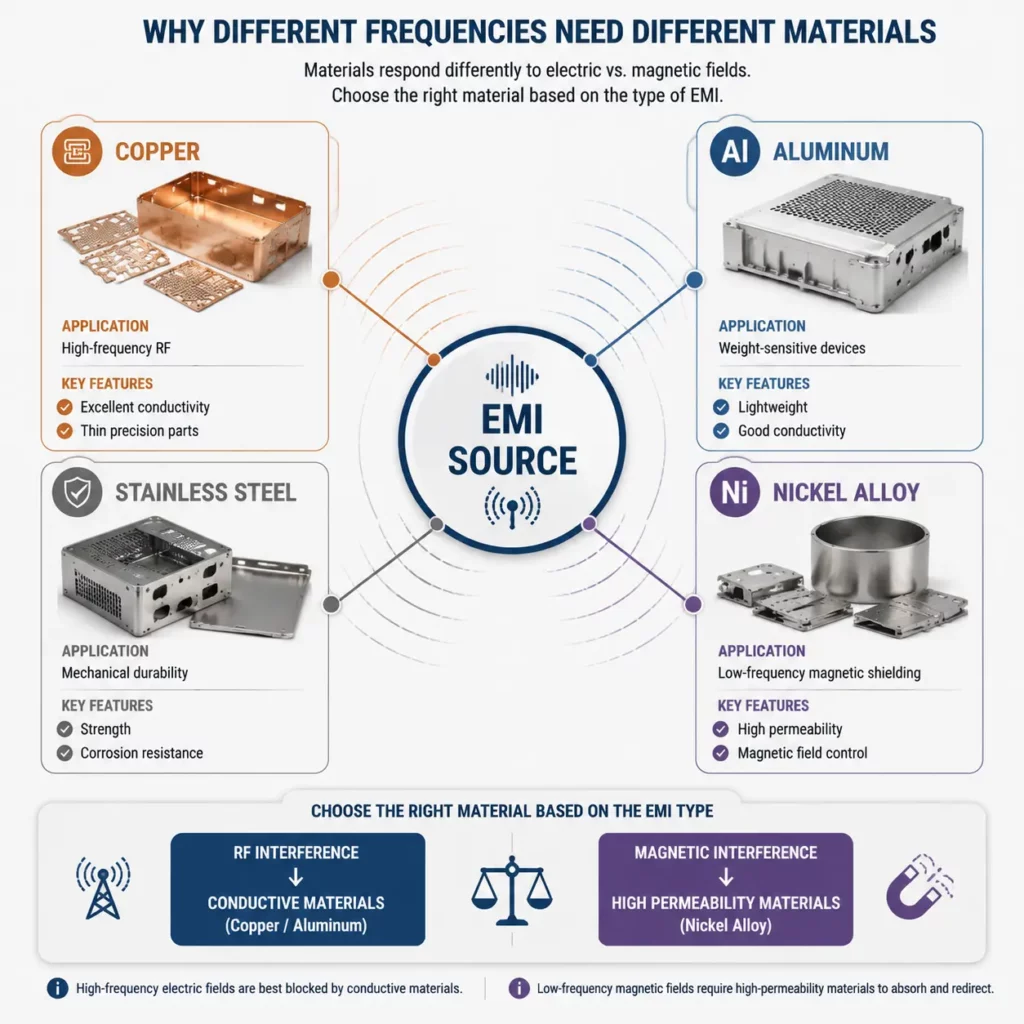
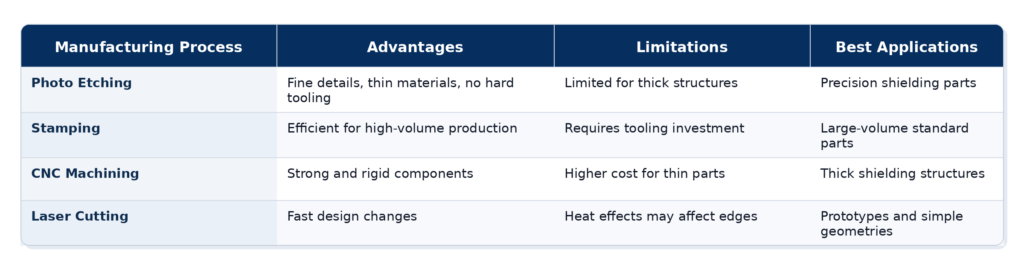
Photo Etching vs Stamping vs CNC vs Laser Cutting for EMI Shielding Parts
The manufacturing process affects design flexibility, cost, and production capability.
For custom EMI shielding components, engineers should consider not only the shielding design but also how the part will be manufactured.
Why Photo Etching Fits EMI Shielding Specifically
EMI shielding parts often combine two requirements that are hard to satisfy with mechanical processes: a large number of small, precisely sized vent holes or mesh openings (which determine both airflow and the frequency at which the shield stops being effective), and a thin, flat, stress-free structure so the shield seats cleanly against the enclosure without warping the seal.
Photo etching addresses both directly — because material is removed chemically rather than punched or cut, hole size and spacing stay consistent across a dense pattern without the tool wear or burr formation that affects stamped or laser-cut mesh, and the part comes out flat with no residual mechanical stress. This makes it a strong fit for shielding covers, fine mesh vents, and ventilated shielding cans in particular.
For a full explanation of how the photo etching process itself works — phototool preparation, resist coating, etching, and inspection — see TMNetch’s [chemical etching process overview]. Thick structural shields or very high-volume simple parts may still be better suited to CNC machining or stamping; the comparison table above covers those trade-offs.
How to Choose the Right EMI/RFI Shielding Solution
Selecting an EMI shielding method requires balancing technical requirements and manufacturing considerations.
1. Identify the Interference Source
Understand:
- Where interference occurs
- Frequency range — and whether the source is electric-field/RF or low-frequency magnetic (see the materials section above)
- Sensitive components affected
2. Define Shielding Requirements
Consider:
- Required shielding effectiveness
- Environmental conditions
- Regulatory requirements
3. Consider Thermal Requirements
Some electronic products need ventilation.
In these cases, shielding mesh or specially designed openings may provide a better solution than a fully enclosed shield.
4. Select the Right Material
Consider:
- Conductivity vs. permeability, depending on whether the interference is RF or low-frequency magnetic
- Weight
- Mechanical strength
- Corrosion resistance
5. Choose the Appropriate Manufacturing Process
The best process depends on:
- Part thickness
- Design complexity
- Production volume
- Cost requirements
How TMNetch Supports Custom Photo-Etched EMI/RFI Shielding Components
Selecting an EMI/RFI shielding supplier requires evaluating both product requirements and manufacturing capability.
TMNetch uses photochemical etching to produce custom EMI/RFI shielding components in stainless steel, aluminum, brass, copper, nickel alloys, and other metals suited to precision etched parts, including stainless steel etched components for corrosion-resistant shielding applications. TMNetch’s ISO 9001:2015 certification (Registration No. 25025Q13591R0S) was issued by ZhongQiu United International Certification (Beijing) Co., Ltd., an IAF-accredited certification body, with a certified scope covering the etching of hardware products, valid through November 11, 2028. Certificate status can be independently verified through China’s National Certification and Accreditation Administration (CNCA) at www.cnca.gov.cn.
For EMI shielding designs that require thin metal structures, fine openings, or customized patterns, photo etching can provide an alternative manufacturing approach compared with processes that require hard tooling. TMNetch’s photo etching process includes material preparation, photoresist processing, chemical etching, and inspection to support customized metal component production.
For engineers and procurement teams, selecting the right shielding supplier requires reviewing:
- Material capability
- Manufacturing process
- Design requirements
- Inspection expectations
- Production needs
Frequently Asked Questions
What is the best material for EMI shielding?
The best material depends on what you’re shielding against. Copper and aluminum are effective against high-frequency RF interference because of their conductivity; nickel alloys such as mu-metal are needed for low-frequency magnetic interference because of their permeability, a case where copper and aluminum are largely ineffective regardless of thickness.
Is copper better than aluminum for EMI shielding?
Copper generally offers higher conductivity, while aluminum provides lower weight. The better choice depends on shielding requirements, product design, and cost considerations.
Why doesn’t copper or aluminum shielding work against magnetic interference?
Copper and aluminum shield mainly through conductivity-driven eddy currents, which are effective against electric fields and higher-frequency electromagnetic waves but do little against low-frequency magnetic fields. Blocking a low-frequency magnetic field requires a high-permeability material like a nickel alloy instead.
When should I use photo etching for EMI shielding parts?
Photo etching is suitable for thin precision shielding parts requiring fine, dense patterns — such as ventilated mesh covers — where hole size consistency and a flat, stress-free part matter. Thicker structural shields or very high-volume simple parts are usually better suited to stamping or CNC machining.
What manufacturing process is best for custom EMI shielding?
The best process depends on part requirements. Photo etching suits thin precision parts, stamping suits high-volume production, and CNC suits thicker structural components.
How do I choose an EMI shielding manufacturer?
Evaluate the supplier’s material capability, manufacturing process, quality control system and certifications, and ability to support your specific design requirements.
Conclusion
Choosing the right EMI/RFI shielding solution requires more than selecting a material. Engineers must consider shielding method, operating environment, manufacturing process, and product requirements — and, above all, whether the interference source is electric-field/RF or low-frequency magnetic, since that distinction determines whether conductivity or permeability is the property that actually matters.
Metal enclosures, shielding mesh, conductive coatings, and EMI gaskets each have their own advantages. For thin and precision shielding components, photo etching can provide design flexibility without traditional tooling requirements.
By comparing methods, materials, and manufacturing options, companies can select a shielding solution that balances performance, cost, and production feasibility.
For custom EMI shielding components, provide your design requirements, material preferences, and application details to evaluate the most suitable manufacturing approach.