
Choosing the right custom lead frame manufacturer means checking more than price. Buyers should compare process fit, material support, fine-feature control, plating, inspection, prototype support, and production repeatability. Buyers should review process capability, material support, fine-feature control, burr and stress control, plating options, inspection systems, prototype support, and production scalability. For thin, complex, fine-pitch lead frames, photo etching or chemical etching can be a strong option because it supports design flexibility and clean edges. Stamping may still be better for mature, high-volume designs where hard tooling is justified.
The best supplier depends on your drawing, material, tolerance, plating requirement, annual volume, and assembly process.
What Does a Custom Lead Frame Manufacturer Do?
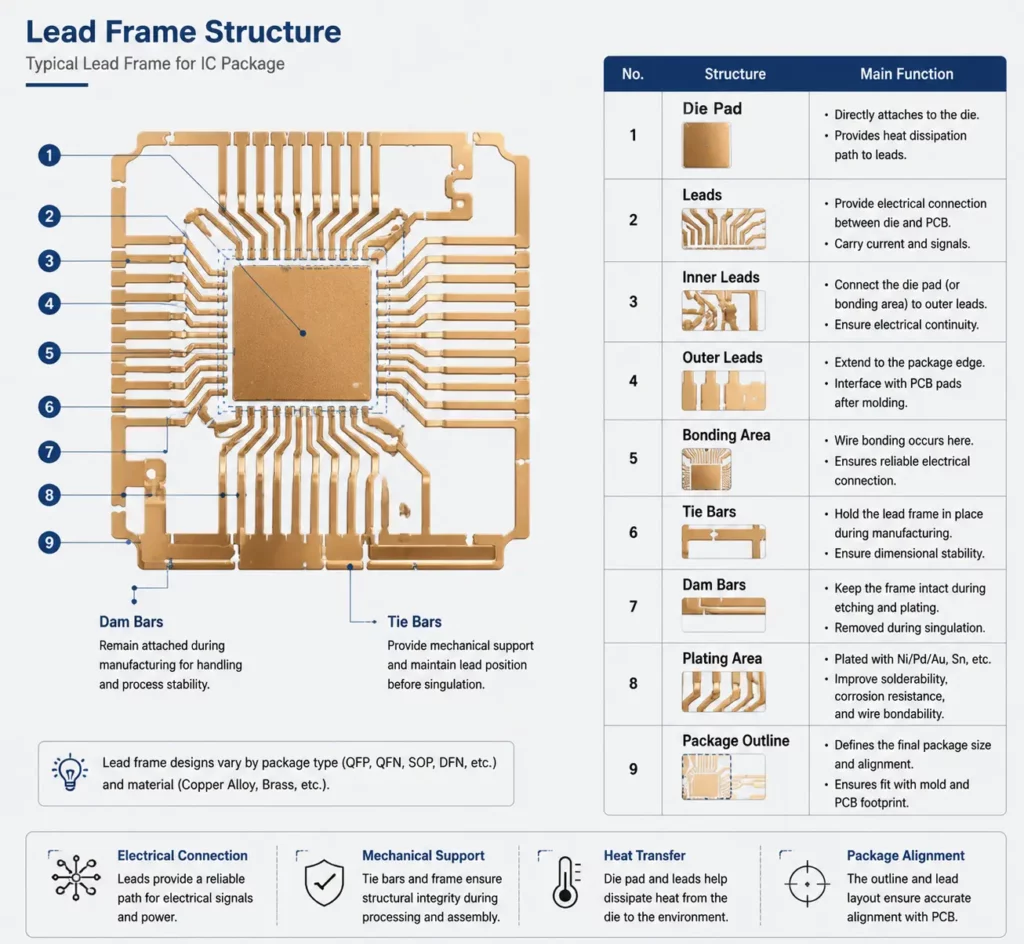
A lead frame is the metal structure in a chip package that provides external terminals and mechanical support. JEDEC defines a lead frame as a metal frame that provides external terminals and mechanical support to align them.
In electronic and semiconductor packaging, a lead frame helps connect the die or chip to the outside circuit. It also supports mechanical handling and package stability. A semiconductor package protects the device and provides electrical connections to the outside system, such as a printed circuit board.
A Custom Lead Frame Manufacturer does not only make a standard metal outline. It supports custom geometry, lead pitch, pin layout, material selection, thickness, plating, forming needs, and inspection requirements.
Custom lead frame manufacturing is common in projects where standard frames cannot meet the electrical, thermal, mechanical, or packaging requirements. These projects may involve IC packages, sensors, connectors, LEDs, power devices, medical electronics, and automotive electronics. TMNetch’s photo etching capabilities for electronic components provide additional examples of thin, detailed parts used in electronic assemblies.
Why Manufacturer Selection Matters for Lead Frames
Lead frames affect electrical performance, signal paths, heat transfer, package support, bonding compatibility, soldering compatibility, and contact reliability. A small defect can create a larger problem during downstream assembly.
Burrs can affect wire bonding, soldering, or package fit. Mechanical stress can change flatness or alignment. Plating defects can affect solderability, bondability, corrosion resistance, or contact performance.
In our production experience, a lead frame supplier should not be evaluated only by unit price. Buyers also need to check material selection, fine-feature control, burr and stress control, flatness, plating compatibility, inspection reports, and whether the supplier can support both prototype review and repeat production.
A low quote may become expensive if the supplier cannot control edge quality, dimensional repeatability, plating, or documentation. Buyers should also review material experience, inspection methods, revision control, capacity, and secondary-process coordination. Use this hemical etching supplier checklist before approving a new supplier. For precision lead frames, supplier capability is part of the product risk.
Etched Lead Frame vs Stamped Lead Frame: Which Should You Consider?
Lead frames can be made by etching or stamping. Wikipedia’s lead frame article notes that material can be removed from a flat plate by etching or stamping, with etching suitable for a high density of leads and stamping suitable for lower lead density.
Etched lead frames are often a strong fit for thin, complex, fine-pitch, high-density, burr-sensitive, or design-changing projects. Photo etched lead frames can be useful when the drawing has many fine leads, small gaps, narrow bridges, or dense flat features.
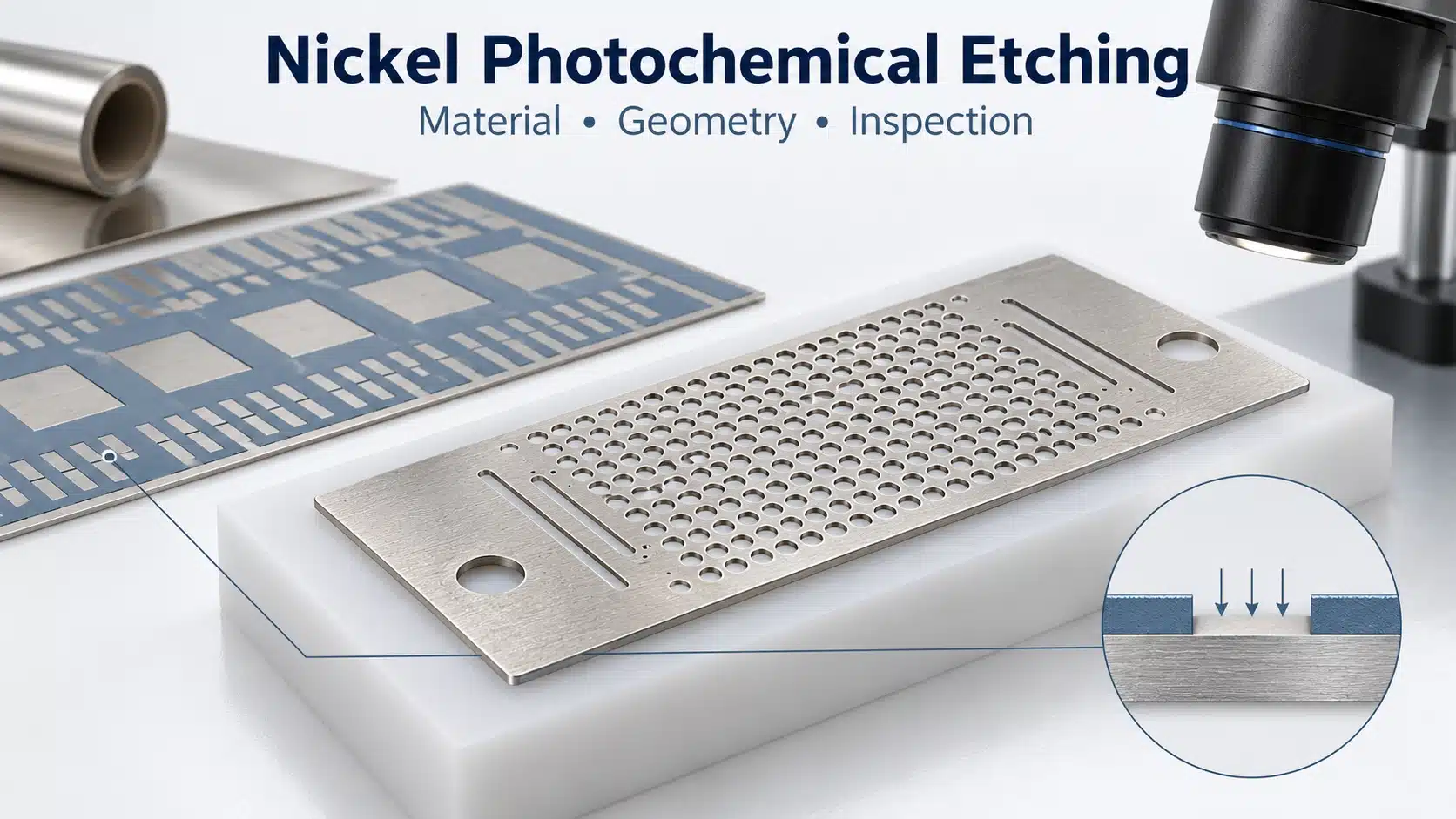
Photo etching is also known as photochemical machining or photochemical etching. A patterned photoresist protects the areas that must remain, while controlled chemistry removes the exposed metal. ASM describes photochemical machining as a metal-etching process that uses photoresist to define where the metal will be etched, followed by steps such as masking, etching, stripping, and inspection.
Stamped lead frames may still be better when annual volume is very high, geometry is stable, and hard tooling cost is justified. Stamping uses a press and die to form or cut sheet metal, and it can include processes such as punching, blanking, bending, and coining.
In etched lead frame projects, we usually review pitch, lead width, gap, bridge width, material thickness, plating area, bonding or soldering requirements, and annual volume before recommending a process route.
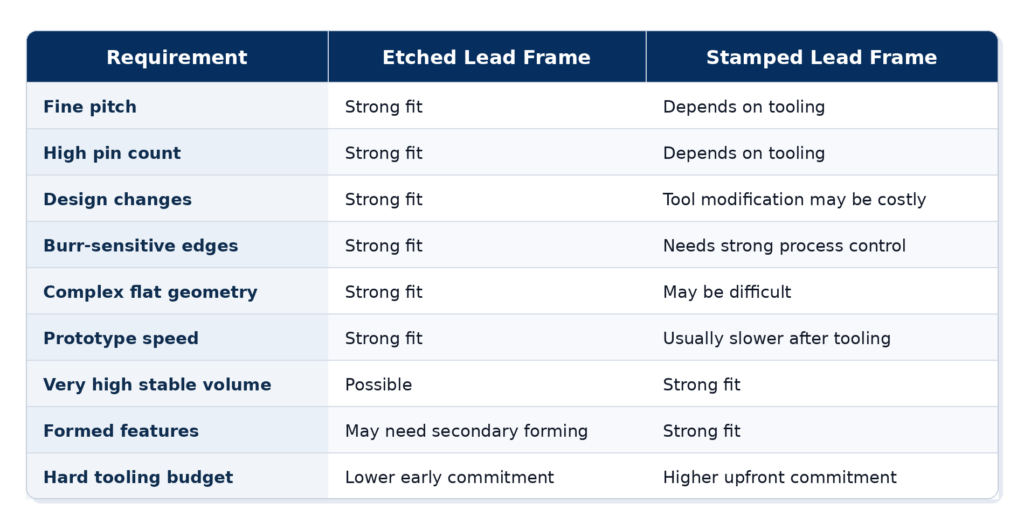
Do not choose by process name alone. Review geometry, material, thickness, plating, tolerance, annual volume, and assembly requirements first.
Key Criteria for Choosing a Custom Lead Frame Manufacturer
1. Process Capability
A good Custom Lead Frame Manufacturer should explain which process fits your drawing. The supplier should know when to use chemical etching, photo etching, stamping, forming, or secondary operations.
TMNetch’s photo etching page states that photo etching, also called photochemical milling, is a chemical process that produces accurate metal components. It also states that the process is stress-free and burr-free because no physical force touches the parts.
This matters for fine-pitch lead frames. If burrs, cutting stress, or distortion affect package assembly, photo etched lead frames may be a better route to evaluate.
2. Material Capability
Lead frame materials should be selected by electrical conductivity, thermal behavior, mechanical strength, corrosion resistance, plating compatibility, and package requirements.
TMNetch lists several materials for chemically etched lead frames, including beryllium copper, brass, phosphor bronze, stainless steel, and nickel silver. Because many lead-frame projects use copper-based alloys, buyers can also review TMNetch’s copper and copper-alloy etching capabilities. Final material approval should consider conductivity, strength, temper, plating compatibility, and package requirements.
For custom lead frame manufacturing, material choice should match the function. A connector contact may need spring behavior. A power device frame may need thermal and current capacity. A sensor package may need dimensional stability and clean edges.
3. Fine Feature and Tolerance Control
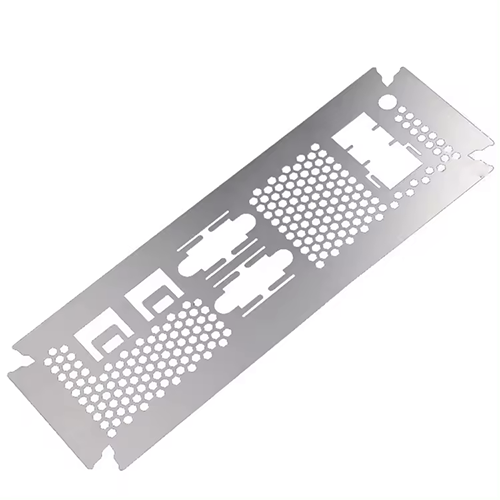
Check whether the supplier can control pitch, lead width, gap, bridge width, slot width, and flatness. These factors become more important as lead density increases.
TMNetch lists precision down to ±0.025 mm for lead frames. It also states that lead frame batches include dimensional reports and material certifications.
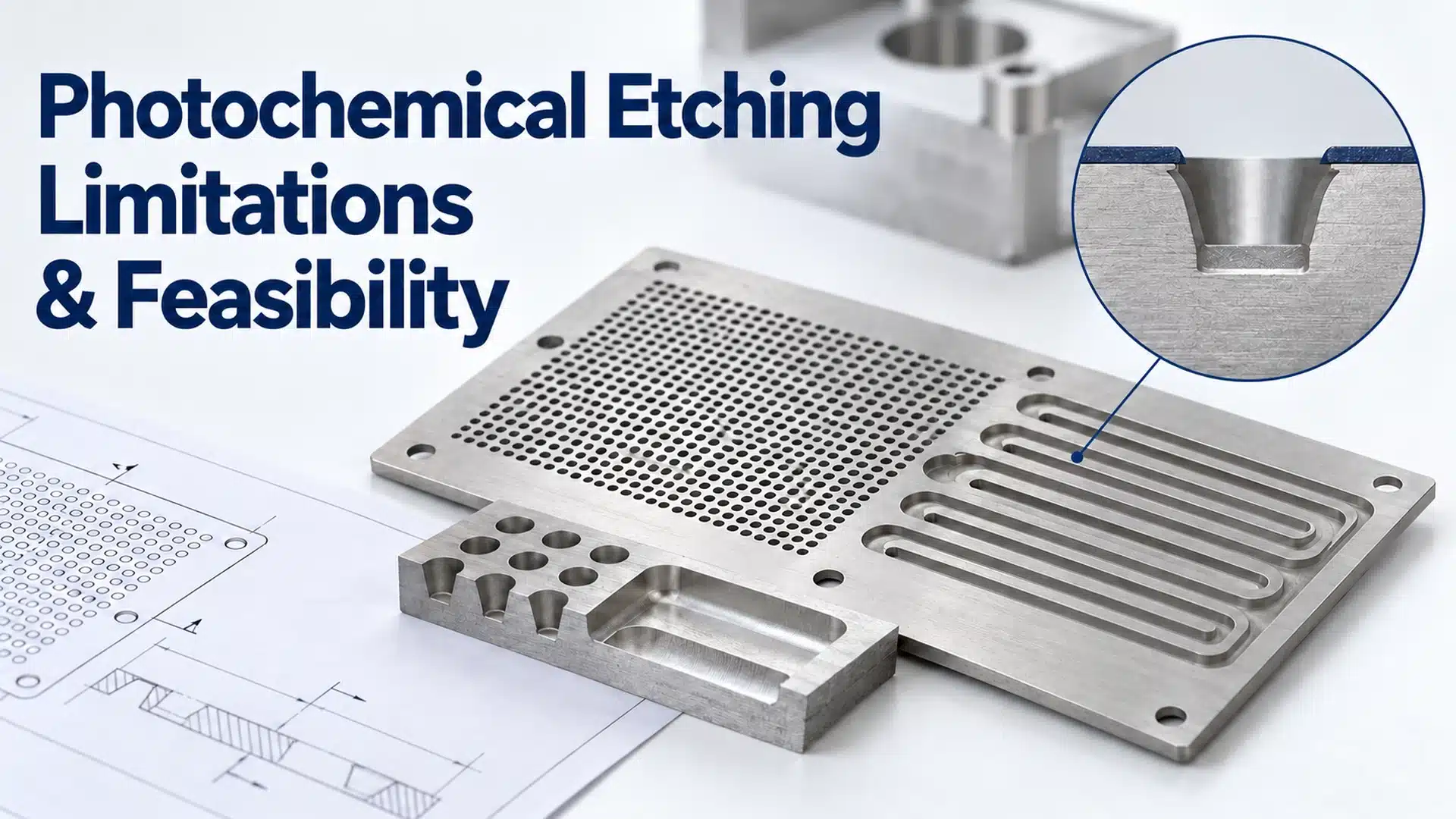
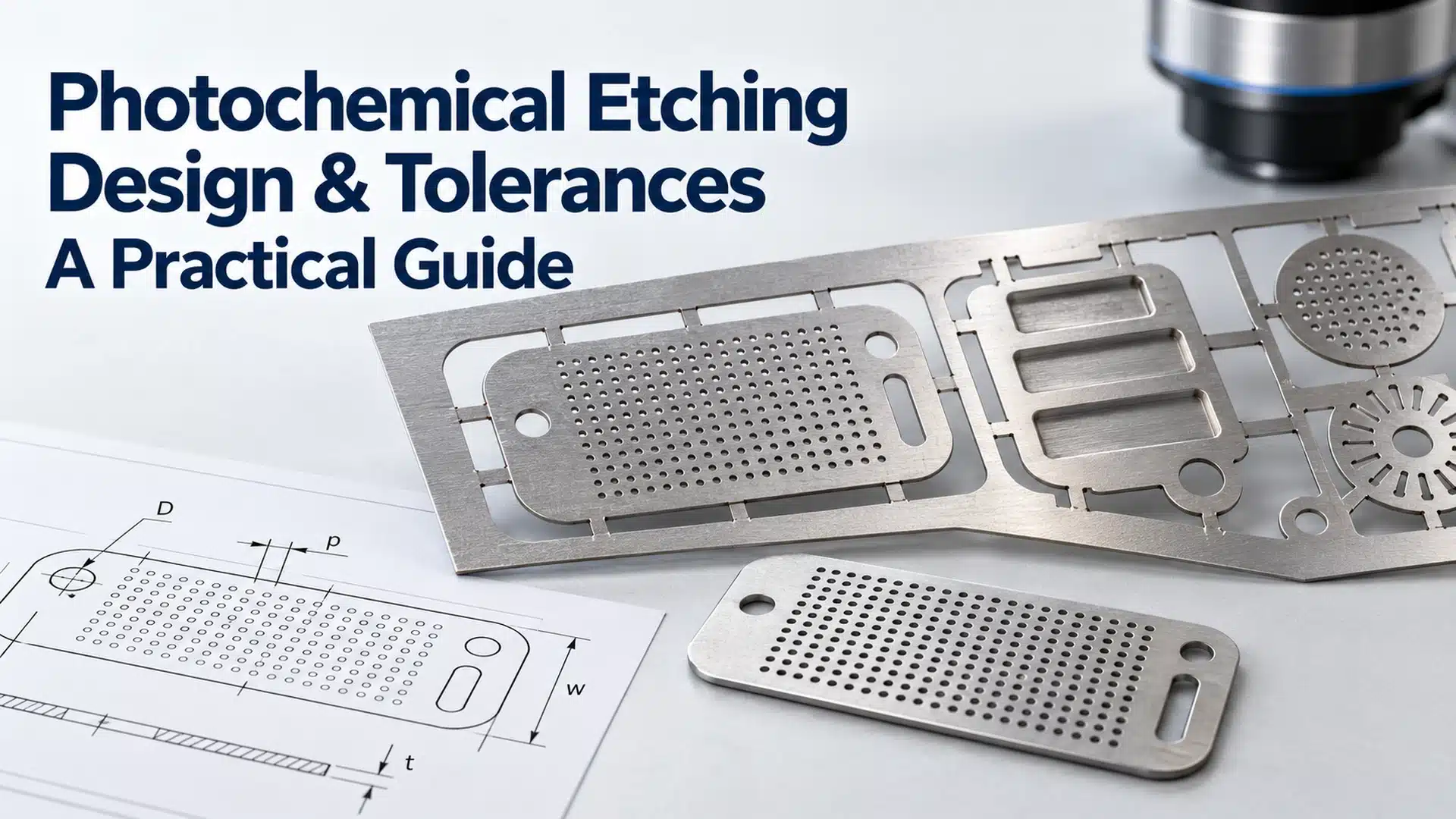
Do not assume every lead-frame design can reach the same tolerance. Final capability depends on the material, thickness, lead width, pitch, gap, pattern density, etching depth, plating, and inspection method. Review the tolerances and limits of photochemical etching before fixing the drawing requirements. Final capability depends on material, thickness, geometry, etching depth, plating, and inspection requirements.
4. Burr and Stress Control
Burr control is important for bonding, soldering, handling, and assembly. Mechanical stress can affect flatness and package alignment.
For etched lead frames, the advantage is that material removal does not require mechanical punching of each feature. This can help when the lead frame has narrow leads, fine gaps, or delicate geometry.
5. Plating and Surface Finishing Support
Lead frame plating can affect solderability, bondability, corrosion resistance, contact reliability, and package performance. Buyers should define plating type, plating area, thickness requirement, and inspection method before RFQ.
TMNetch lists silver, gold, tin, and nickel plating options for custom lead frames. Buyers should confirm the plating stack, plated area, thickness, masking, solderability, bondability, and inspection method for their project. Learn how etching and plating can be coordinated through one-stop chemical etching services. Its lead frame page states that these plating options are performed in-house with controlled thickness.
Keep this section practical. The article does not need to become a plating engineering guide, but plating should not be ignored.
6. Prototype and Production Support
A supplier should support the project stage. Early design work may need prototypes and revisions. A production program may need repeatability, stable delivery, inspection control, and packaging support.
TMNetch’s lead frame page states that prototype lead frames can be provided within 6 hours and that automated production lines can scale from prototypes to millions of units.
Buyers should confirm what this means for their own design. Geometry, material, plating, quantity, and inspection needs may affect lead time.
7. Inspection and Documentation
For precision lead frames, inspection is not optional. Ask about dimensional reports, material certificates, plating reports if required, outgoing quality control, traceability, revision control, and packaging.
The supplier should be able to explain how it checks critical dimensions. This may include pitch, gap, lead width, bridge width, flatness, hole location, plating area, and surface condition.
Custom Lead Frame Manufacturer Evaluation Scorecard
Use this scorecard before selecting a custom lead frame supplier.
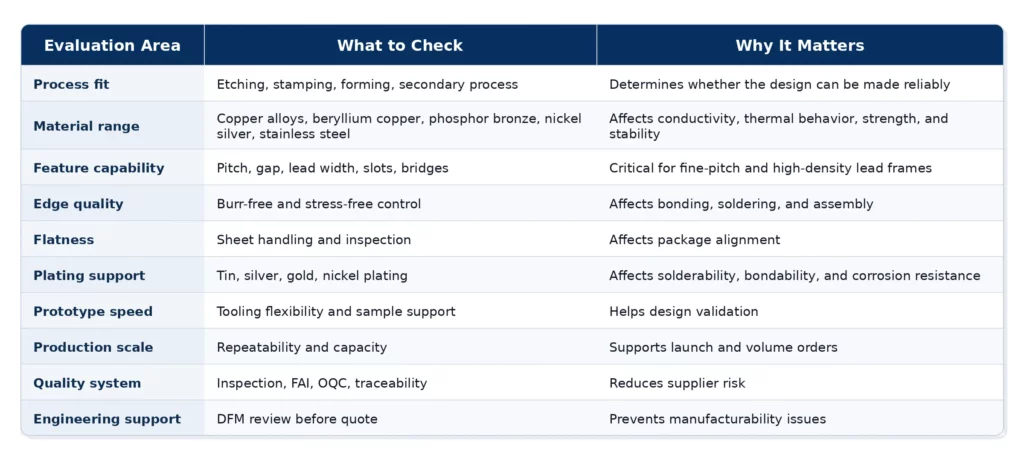
If a lead frame manufacturer cannot explain process limits, material fit, plating support, and inspection control, supplier risk is higher. For etched lead frames, engineering review is often more important than a fast quote.
Match the Manufacturer to Your Application
Different applications need different supplier strengths. A good Custom Lead Frame Manufacturer should understand how the lead frame works in the final assembly.
IC Packaging and Semiconductor Devices
For IC packaging and semiconductor devices, check fine pitch, lead flatness, bondability, plating, dimensional stability, and clean edges.
Lead frames may carry signals from the die to the outside of the package. The lead frame normally includes a die pad, leads, bond pads, and structures that support automatic handling.
Sensors and MEMS-Related Parts
Sensor projects may need small features, stable material behavior, flatness, and repeatability. Clean edges and accurate geometry can affect assembly and package fit.
Photo etched lead frames may be useful when the sensor package has fine, flat, dense features.
Connectors and Contacts
Connector and contact projects may need conductivity, spring behavior, surface finish, and plating control. Material and plating choices should match the required contact performance.
Power Devices and Energy Electronics
Power device lead frames may need current capacity, thermal path control, and suitable copper alloy selection. Material thickness and geometry may matter more than in low-current signal applications.
LED and Optoelectronics
LED and optoelectronic projects may need package fit, plating, surface finish, heat dissipation, and stable geometry. The supplier should understand both electrical and thermal needs.
Medical and Automotive Electronics
Medical and automotive electronics often need repeatability, cleanliness, documentation, and production stability. Buyers should confirm inspection reports, material certification, and revision control early.
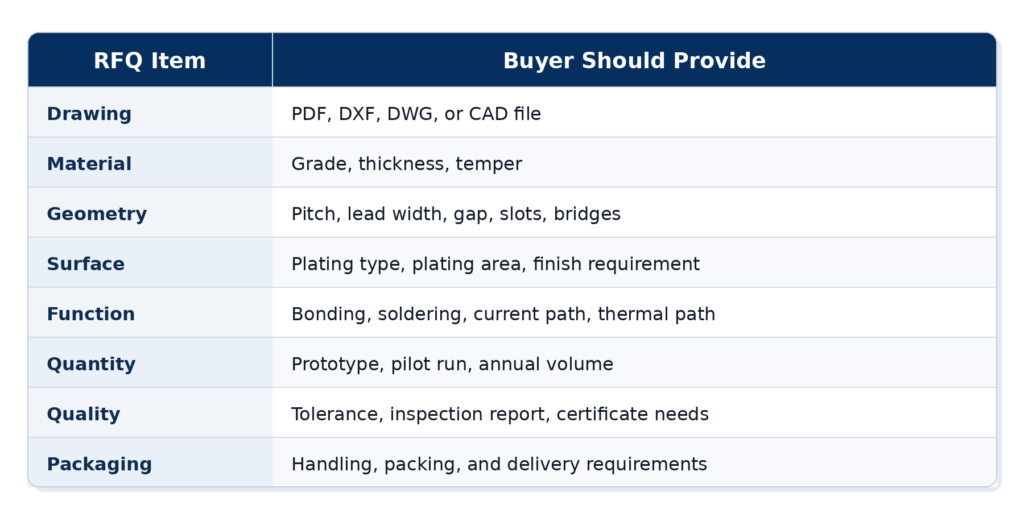
What Should Buyers Prepare Before Requesting a Quote?
A clear RFQ helps the supplier judge the process route faster. It also reduces back-and-forth communication.
Drawing and Design Files
Provide a 2D drawing and revision number. DXF, DWG, STEP, or other CAD files can help the manufacturer review geometry.
Mark critical dimensions clearly. These may include lead width, pitch, gap, bridge width, slot size, forming area, and plating area.
Material and Thickness
Define the material grade, thickness, temper, and any conductivity or thermal requirement. Do not leave the supplier to guess the material.
Functional Requirements
Explain how the lead frame will be used. State whether it must support wire bonding, soldering, current flow, signal transfer, heat dissipation, bending, or package assembly.
Surface Treatment Requirements
Define plating metal, plating area, solderability requirements, bondability requirements, corrosion resistance, and contact performance needs.
Quantity and Production Stage
Tell the supplier whether the project is a prototype, pilot run, engineering validation build, or production order. Include annual volume and target lead time.
Quality Requirements
Define tolerance, inspection method, dimensional report needs, material certificate needs, plating certificate needs, and packaging requirements.
How TMNetch Supports Custom Lead Frame Manufacturing
TMNetch provides chemical etched custom lead frames for electronic and semiconductor-related applications. Its lead frame page states that lead frames support electrical connections, mechanical stability, and thermal performance in semiconductor manufacturing. It also lists integrated circuits, LEDs, and semiconductor sensors as related applications.
Based on TMNetch lead frame capability data, TMNetch supports materials such as beryllium copper, brass, phosphor bronze, stainless steel, and nickel silver. TMNetch also lists precision down to ±0.025 mm, prototype lead frames within 6 hours, ISO 9001:2015 certified quality, dimensional reports, material certifications, and in-house silver, gold, tin, and nickel plating.
TMNetch’s photo etching page also supports the process logic behind photo etched lead frames. It states that photo etching uses chemicals to selectively remove metal, with no physical force touching the part.
Final suitability still depends on material, thickness, geometry, tolerance, plating requirements, production volume, and application environment.
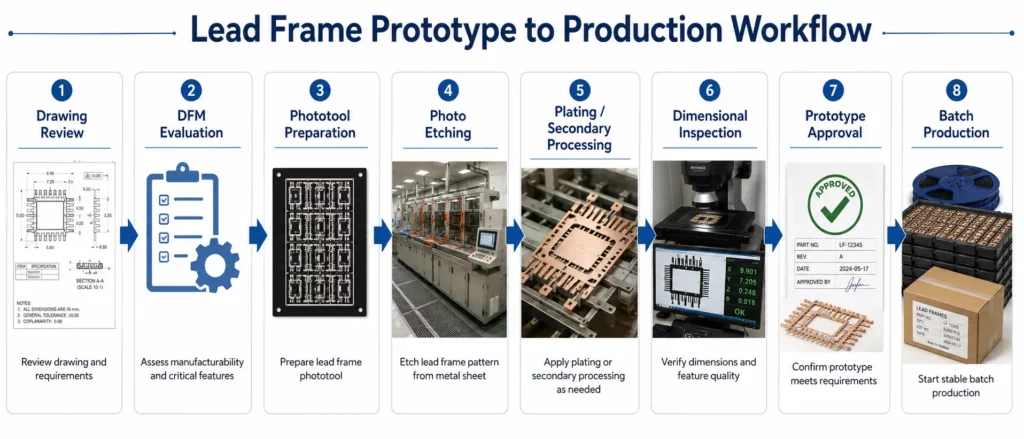
Send your lead frame drawing, material, thickness, plating requirement, tolerance, quantity, and application details to TMNetch for a manufacturability review.
FAQs About Choosing a Custom Lead Frame Manufacturer
What does a custom lead frame manufacturer do?
A custom lead frame manufacturer produces lead frames based on project-specific geometry, material, thickness, pitch, plating, and package requirements. The supplier may support prototype review, production, inspection, and finishing.
How do I choose a lead frame manufacturer?
Choose a lead frame manufacturer by checking process capability, material range, fine-feature control, burr and stress control, plating support, inspection systems, prototype support, production scale, and engineering review.
When should buyers choose etched lead frames?
Buyers should consider etched lead frames when the design is thin, flat, complex, fine-pitch, high-density, burr-sensitive, or still changing during development.
Are etched lead frames better than stamped lead frames?
Not always. Etching is often better for fine, complex, flat, or design-changing lead frames. Stamping may be better for mature, very high-volume designs with stable geometry and justified hard tooling.
What materials are used for custom lead frames?
Common lead frame materials include copper alloys, beryllium copper, phosphor bronze, brass, nickel silver, stainless steel, and other application-specific alloys.
Why is plating important for lead frames?
Plating can affect solderability, bondability, corrosion resistance, contact reliability, and package performance. Buyers should define plating type, plating area, and inspection needs before RFQ.
What should buyers provide for a lead frame RFQ?
Buyers should provide a drawing, material, thickness, pitch, lead width, gap, tolerance, plating requirement, quantity, production stage, functional requirements, and inspection requirements.
Can photo etched lead frames support prototypes and production?
Yes, if the supplier has suitable etching capability, inspection control, and production scalability. Final suitability depends on design, material, tolerance, plating, and volume.
Conclusion
Choosing a Custom Lead Frame Manufacturer is not only about price. Buyers should evaluate process capability, material support, fine-feature control, burr and stress performance, plating options, inspection systems, prototype support, production scale, and engineering review.
Etched lead frames are often a strong choice for thin, complex, fine-pitch, high-density, burr-sensitive, or design-changing projects. Stamped lead frames may still be better for mature, high-volume designs with stable geometry.
Send your lead frame drawing to TMNetch for a manufacturability review. Include the material grade, temper, thickness, lead pitch, lead width, gap, plating requirement, critical tolerances, prototype quantity, annual volume, and inspection needs.