
When sourcing custom metal mesh filter manufacturers, ISO 9001 certification is often one of the first quality indicators buyers review. For OEMs, engineers, and purchasing teams, an ISO 9001 certificate can show that a supplier follows a structured quality management system.
However, ISO 9001 does not mean that every filter mesh product will automatically meet your application requirements. It does not directly certify filtration efficiency, mesh accuracy, material performance, or product lifetime.
Instead, ISO 9001 confirms that a manufacturer has controlled processes for managing quality, documentation, inspections, and continuous improvement.
For buyers selecting a custom filter mesh manufacturer, ISO 9001 should be considered a supplier qualification baseline. Additional verification, such as material documentation, inspection reports, and sample validation, is still necessary before production approval.
Quick Answer: What Does ISO 9001 Mean for Filter Mesh Manufacturers?
ISO 9001 certification means that a filter mesh manufacturer operates a documented quality management system (QMS). It helps ensure that manufacturing processes, quality records, corrective actions, and improvement procedures are controlled.
However, ISO 9001 does not guarantee:
- A specific mesh opening size
- A certain filtration efficiency
- A specific material grade
- Zero defects
- Long-term application performance
Buyers should combine ISO 9001 verification with technical evaluation of the actual filter mesh requirements.
What Does ISO 9001 Mean for Filter Mesh Manufacturers?
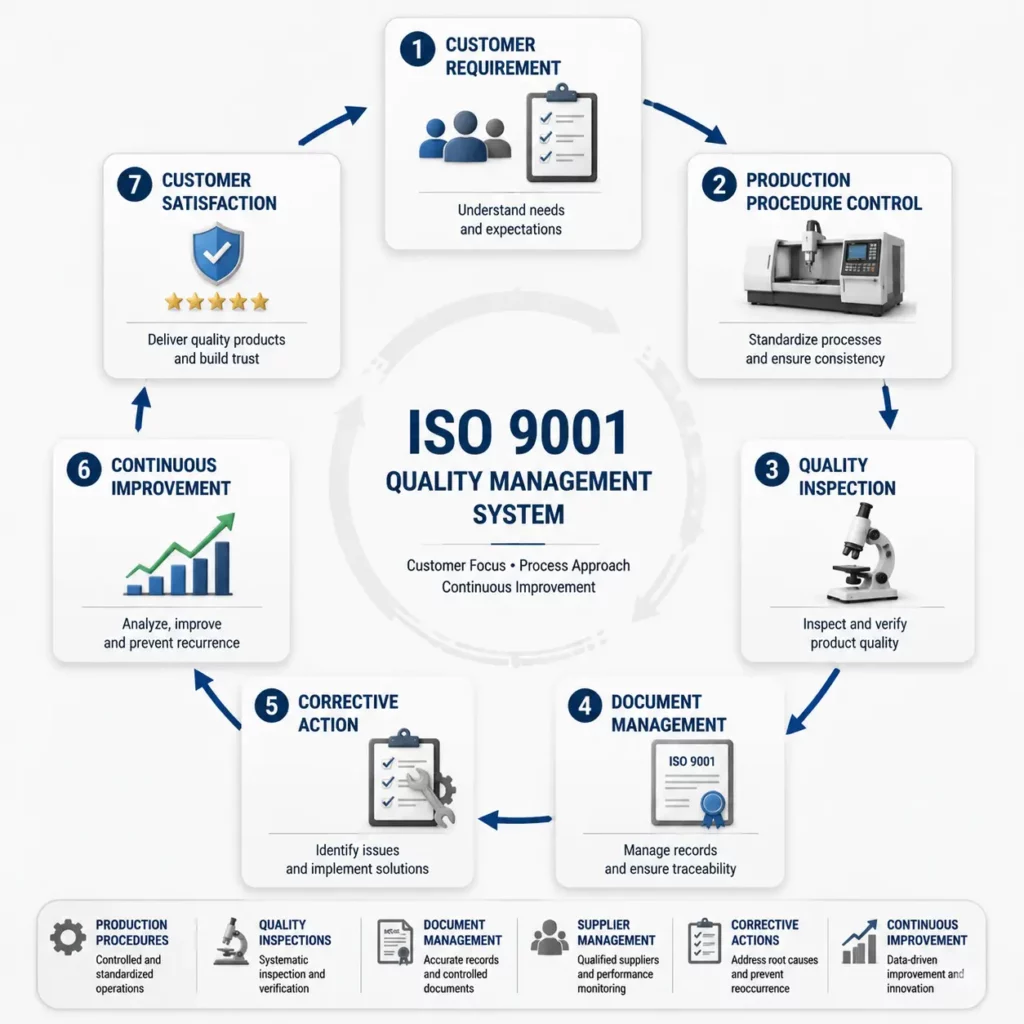
ISO 9001 is a quality management system standard that helps organizations manage processes, improve consistency, and demonstrate their ability to meet customer requirements.
For filter mesh manufacturers, this means the company should have systems for controlling:
- Production procedures
- Quality inspections
- Document management
- Supplier management
- Corrective actions
- Continuous improvement
A filter mesh supplier may manufacture thousands of customized parts with different materials, thicknesses, and opening designs. Understanding filter mesh types, materials, and applications helps buyers evaluate whether a supplier’s capabilities match the project requirements. Without process control, small variations during production can affect consistency between batches.
A quality management system helps manufacturers create repeatable processes and maintain records that support customer requirements.
For procurement teams, this creates better visibility into how a supplier manages production risks.
What ISO 9001 Certification Actually Guarantees
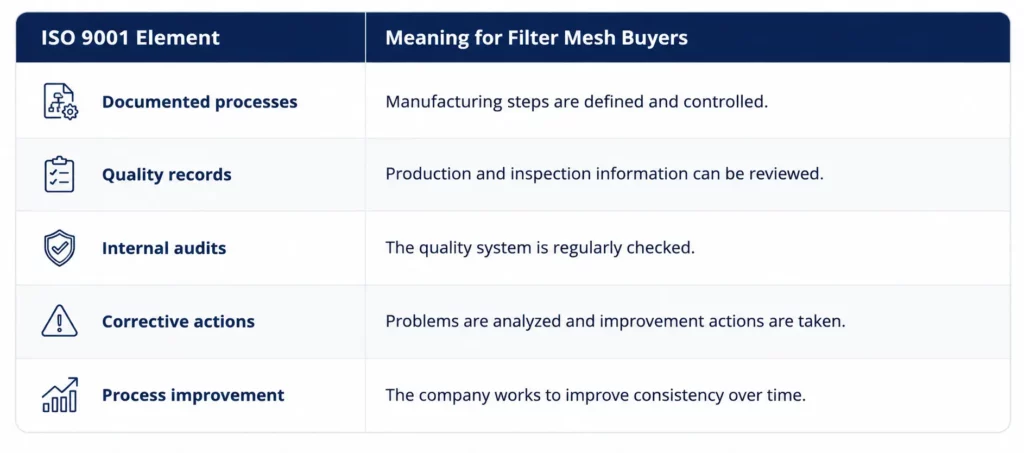
ISO 9001 does not guarantee that a product is perfect. Instead, it provides evidence that the manufacturer has a structured approach to quality management.
For buyers, these elements reduce supplier uncertainty.
A manufacturer with a documented quality system is more likely to have clear procedures for handling:
- Design changes
- Production deviations
- Inspection requirements
- Customer feedback
- Quality issues
This is especially important for industries where filter mesh components are part of larger systems, such as industrial filtration equipment, automotive assemblies, medical devices, or aerospace applications.
What ISO 9001 Does Not Guarantee for Filter Mesh Quality
A common misunderstanding is that ISO 9001 certification means the supplier automatically produces higher-quality filter mesh.
This is not the purpose of ISO 9001.
ISO 9001 does not directly confirm:
For example, two filter mesh manufacturers may both hold ISO 9001 certification. However, their manufacturing capabilities may differ in:
- Material options
- Etching accuracy
- Inspection equipment
- Production experience
- Ability to meet custom drawings
Therefore, ISO 9001 should support supplier evaluation, not replace technical review.
What Quality Documents Should Buyers Request from Filter Mesh Suppliers?
When evaluating ISO 9001 certified filter mesh manufacturers, buyers should review additional quality documents related to the actual product.
Material Certificates
Material documentation and standardized testing methods help buyers verify that supplied metals meet the required specifications for composition and performance.
Important information may include:
- Material grade
- Chemical composition
- Thickness
- Batch information
For custom filter mesh applications, material selection can influence:
- Corrosion resistance
- Strength
- Conductivity
- Temperature performance
Inspection Reports
Inspection records help confirm that manufactured parts match the approved design. For precision filter mesh components, buyers should also understand the metal filter mesh manufacturing process used to control dimensions, openings, and surface quality.
Depending on the application, buyers may review:
- Mesh opening dimensions
- Part thickness
- Overall dimensions
- Flatness
- Surface quality
For precision metal components, reliable measurement and inspection methods are important factors when evaluating a manufacturing supplier.
Traceability Records
Traceability allows manufacturers and customers to track production information.
A strong traceability system can help identify:
- Material batches
- Production dates
- Inspection results
- Manufacturing records
This becomes especially valuable for regulated industries where supplier documentation is part of customer approval requirements.
How ISO 9001 Helps Reduce Supplier Risk
For procurement teams, choosing a supplier is not only about finding a company that can manufacture a part.
It is also about reducing future risks.
An ISO 9001 certified manufacturer can provide advantages such as:
More Controlled Production Processes
A documented process helps reduce unexpected variation during manufacturing.
Better Quality Communication
Clear records and procedures make it easier to discuss:
- Drawing requirements
- Inspection criteria
- Production changes
- Quality concerns
Improved Supplier Management
OEM customers often need suppliers that can support long-term cooperation.
A structured quality system provides a foundation for:
- Supplier reviews
- Corrective actions
- Continuous improvement discussions
However, buyers should still confirm whether the supplier’s actual manufacturing capability matches the project requirements.
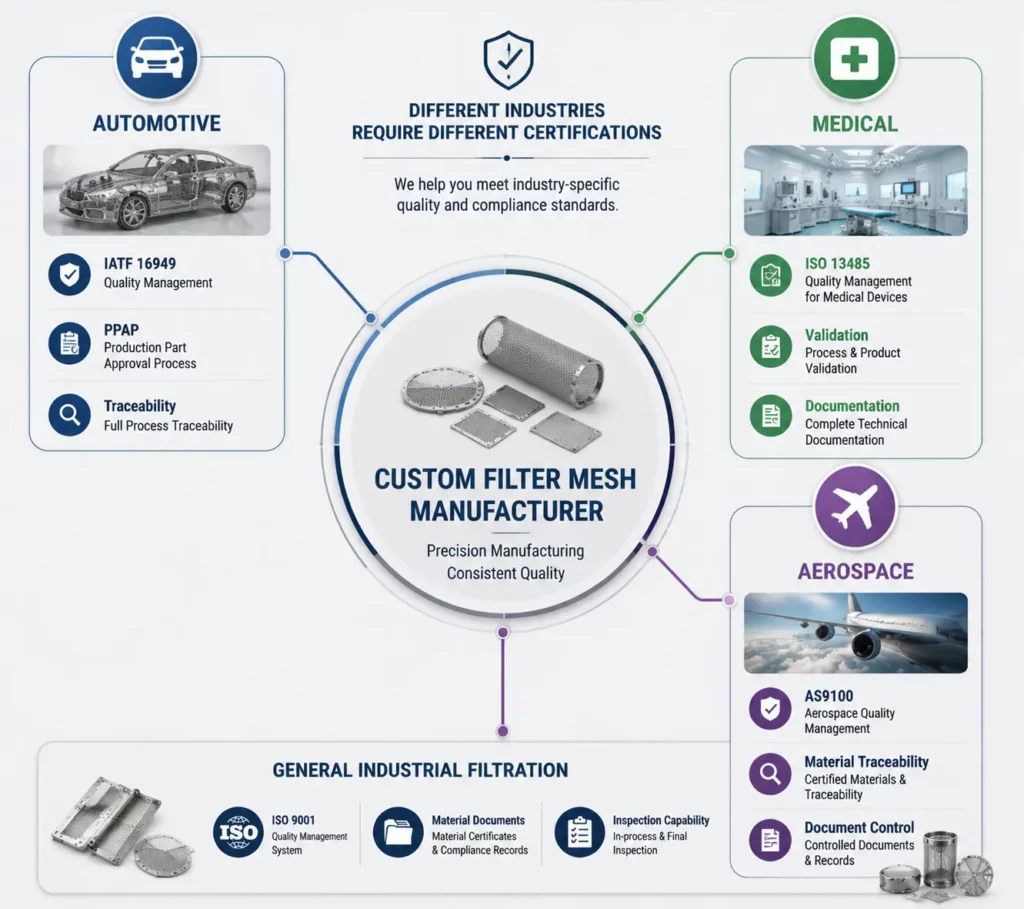
Do Filter Mesh Manufacturers Need Other Certifications?
ISO 9001 is one of the most common quality management certifications for manufacturers. However, specific industries may require additional standards.
Automotive Applications
Automotive suppliers may need to consider requirements such as:
- IATF 16949
- PPAP documentation
- Production traceability
These requirements depend on the customer’s supply chain expectations.
Medical Applications
Medical device supply chains may require:
- ISO 13485
- Additional product validation requirements
The exact requirements depend on the final application.
Aerospace Applications
Aerospace suppliers may need:
- AS9100
- Strict material traceability
- Additional documentation controls
General Industrial Filtration
For many industrial filtration applications, buyers commonly focus on:
- ISO 9001 quality management
- Material documentation
- Inspection capability
- Manufacturing consistency
The right certification depends on the industry, product risk, and customer requirements.
How to Evaluate ISO 9001 Certified Filter Mesh Manufacturers
Before approving a supplier, purchasing teams should evaluate more than the certificate.
Use this checklist:
1. Verify the ISO 9001 Certificate
Check:
- Certification validity
- Certification scope
- Certification organization
Buyers should review the certificate validity, certification scope, and issuing organization because accredited certification provides confidence that the management system has been independently assessed. The certificate should apply to the supplier’s actual manufacturing activities.
2. Review Manufacturing Capability
Confirm whether the supplier can produce:
- Required materials
- Required thicknesses
- Required mesh patterns
- Required tolerances
Buyers evaluating precision metal mesh suppliers can also review a chemical etching supplier checklist to understand capability, tolerance control, inspection methods, and production support.
A certification cannot replace manufacturing capability.
3. Review Quality Documentation
Ask about:
- Inspection procedures
- Material documentation
- Production records
- Quality reports
4. Request Samples Before Mass Production
Sample validation helps confirm:
- Design accuracy
- Assembly fit
- Surface requirements
- Application suitability
5. Confirm Communication and Engineering Support
A reliable supplier should be able to review:
- Drawings
- Material requirements
- Application conditions
- Inspection expectations
This reduces the risk of problems appearing after production begins.
How TMNetch Supports Quality-Controlled Filter Mesh Manufacturing
For buyers evaluating filter mesh manufacturers, certification is only one part of supplier qualification. Manufacturing control and technical communication are equally important.
TMNetch’s ISO 9001:2015 certification (Registration No. 25025Q13591R0S) was issued by ZhongQiu United International Certification (Beijing) Co., Ltd., an IAF-accredited certification body, and is valid through November 11, 2028. The certificate’s stated scope — etching of hardware products — illustrates the point made throughout this article: ISO 9001 certifies TMNetch’s manufacturing process, not the performance specifications of any individual filter mesh product. Buyers can independently verify certificate status through China’s National Certification and Accreditation Administration (CNCA) at www.cnca.gov.cn.
TMNetch’s role is to support customers that require controlled production of custom metal mesh components through:
- Quality management processes
- Photochemical etching manufacturing
- Design and specification review
- Inspection requirements
- Custom project communication
For procurement teams, the key evaluation points remain the same:
- Does the supplier understand the drawing requirements?
- Can the material and thickness meet the application?
- Are inspection requirements clearly defined?
- Can the supplier maintain consistency during repeat production?
A quality certification provides confidence in the management system. Technical evaluation confirms whether the supplier is suitable for the specific filter mesh project.
Frequently Asked Questions
Does ISO 9001 guarantee filter mesh quality?
No. ISO 9001 confirms that a manufacturer has a controlled quality management system. It does not directly guarantee filtration performance, material quality, or product lifetime.
What certification should a filter mesh manufacturer have?
For many industrial applications, ISO 9001 is a common quality management certification. Additional certifications depend on the industry, such as automotive, medical, or aerospace requirements.
What documents should I request from a filter mesh supplier?
Common documents include:
- Material certificates
- Inspection reports
- Dimensional records
- Traceability information
- Sample approval documents
How do I evaluate an ISO 9001 certified filter mesh manufacturer?
Review the supplier’s certification scope, manufacturing capability, quality documents, inspection methods, and ability to support your specific application requirements.
Conclusion
ISO 9001 certification is an important factor when selecting filter mesh manufacturers, but it should not be viewed as a complete product guarantee.
A reliable supplier evaluation should combine:
- Quality management certification
- Manufacturing capability
- Material verification
- Inspection records
- Sample validation
For custom filter mesh projects, the best supplier is not only one with a certificate, but one that can consistently produce parts according to your design, material, and performance requirements.
If you are evaluating a custom filter mesh manufacturer, provide your drawings, specifications, material requirements, and inspection expectations to review the appropriate manufacturing approach.