
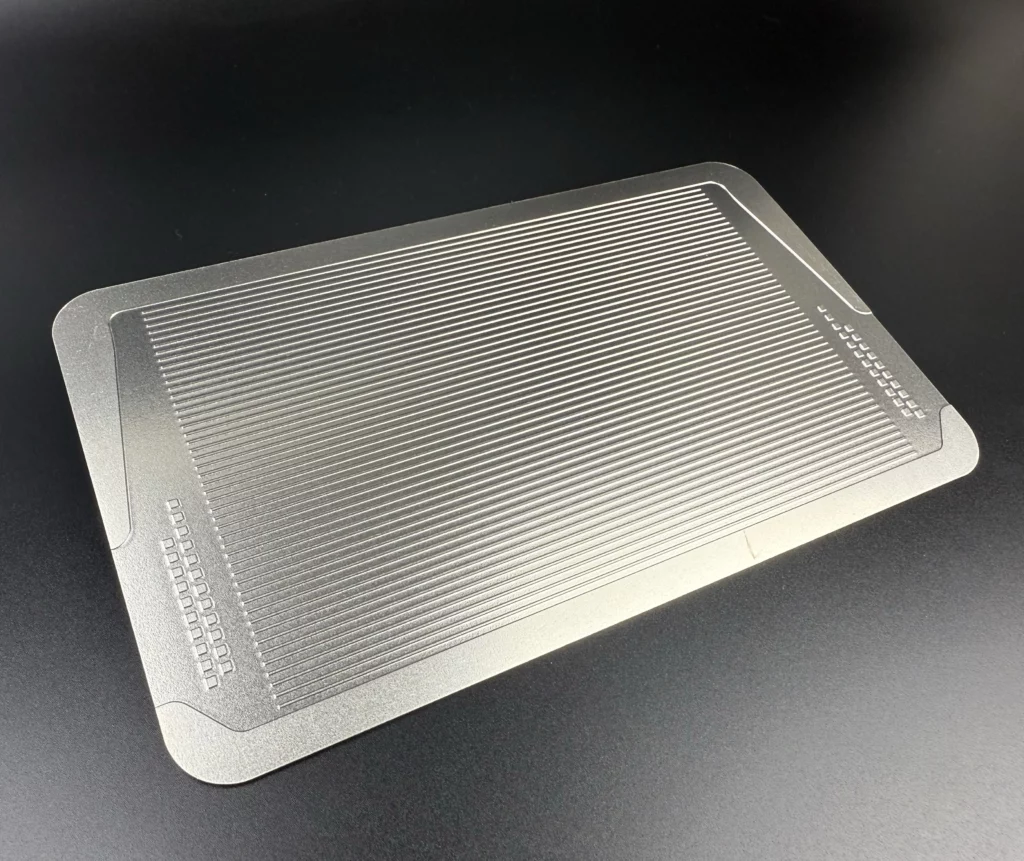
Bipolar plates conduct current, separate gases, distribute reactants, transfer heat, resist corrosion, and withstand stack compression. Because these functions interact, a plate cannot be judged by material or bulk conductivity alone.
A practical specification should define electrical, electrochemical, barrier, mechanical, dimensional, surface, and manufacturing requirements—and how each will be tested. This guide explains how to set and interpret these requirements before approving a material or production plate.
Key Takeaways
- High bulk conductivity does not guarantee low stack resistance.
- Interfacial contact resistance is a critical bipolar plate parameter.
- Corrosion resistance must be tested under representative PEMFC conditions.
- Plate thickness affects stack weight and volume, but also stiffness and manufacturability.
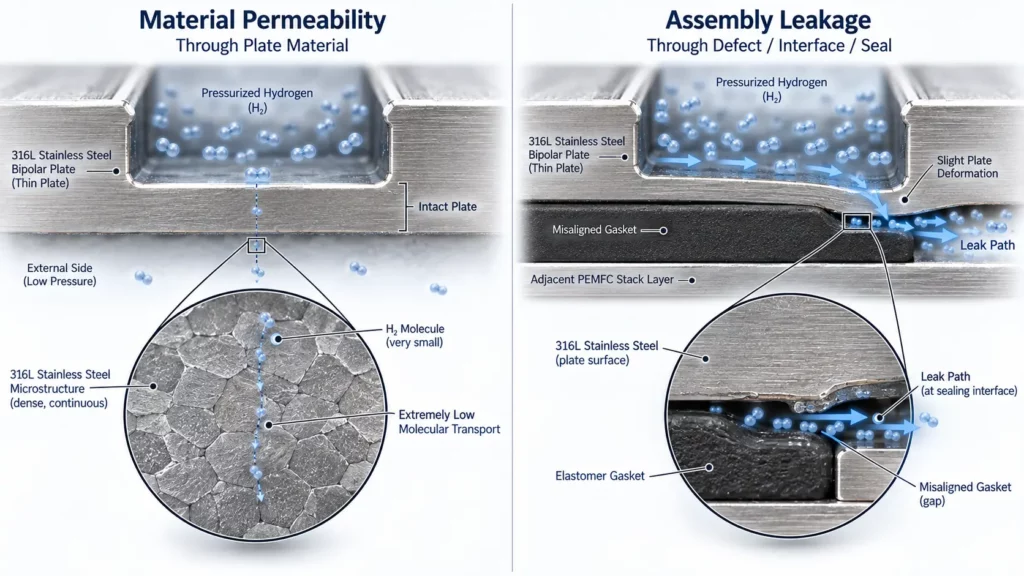
- Hydrogen permeability and sealing integrity are different requirements.
- Flatness influences contact pressure, GDL compression, and sealing.
- Test values are meaningful only when the method and conditions are reported.
- DOE targets, research results, drawing specifications, and acceptance criteria are not interchangeable.
What Requirements Must a Fuel Cell Bipolar Plate Meet?
A suitable plate must control electrical loss, survive the cell environment, separate fluid circuits, support compression, and remain dimensionally stable at the required cost and production rate.
| Requirement Category | Key Parameters |
|---|---|
| Electrical | Bulk conductivity, interfacial contact resistance, ASR |
| Electrochemical | Corrosion current, passivation, surface stability |
| Barrier | Hydrogen permeation, gas and coolant leakage |
| Mechanical | Strength, stiffness, elongation, fatigue resistance |
| Thermal | Thermal conductivity and heat spreading |
| Dimensional | Thickness, flatness, channel and port conformity |
| Surface | Coating continuity, roughness, adhesion, defects |
| Manufacturing | Repeatability, tolerance, burrs, thinning, deformation |
| Commercial | Part cost, tooling, coating, inspection, lifecycle cost |
No single parameter defines a good bipolar plate. A conductive plate may still have high interface resistance, while a corrosion-resistant coating may be poorly bonded, damaged, or too resistive.
Electrical Conductivity and Contact Resistance
Bulk Electrical Conductivity
Bulk conductivity describes current flow through the plate material. The test direction must be reported because graphite and composites can have different in-plane and through-plane conductivity.
For metal plates, base-metal conductivity is only the starting point. Oxides, coatings, contamination, roughness, and contact pressure affect assembled resistance.
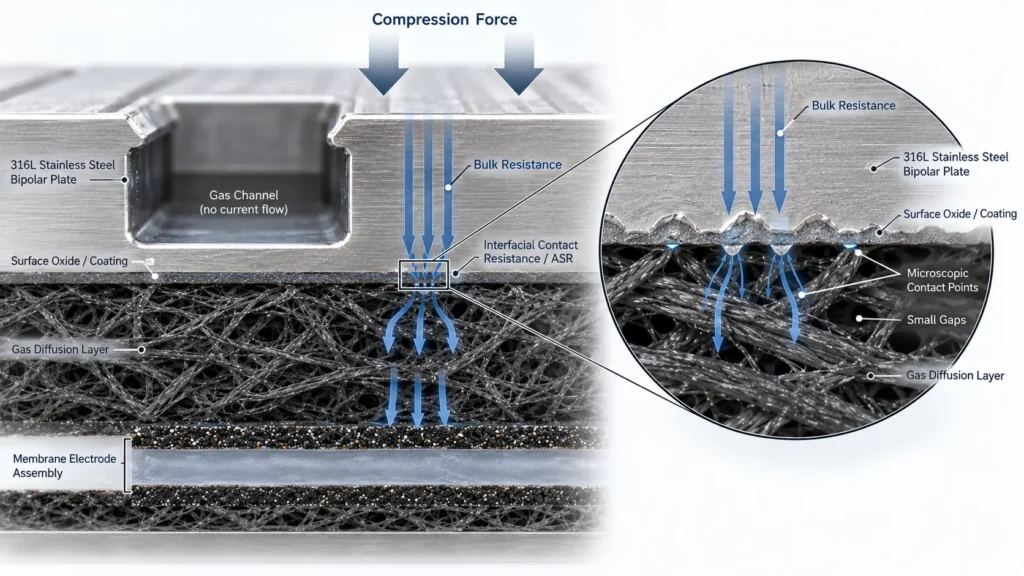
Why Interfacial Contact Resistance Matters
Current must cross the bipolar plate–gas diffusion layer interface. Resistance at this boundary is interfacial contact resistance, or ICR.
ICR changes with compression and surface condition. Higher pressure may increase real contact area, but it must remain compatible with the GDL, seals, channels, and mechanical limits.
Research on stainless steel bipolar plates found that the passive film formed during polarization could increase contact resistance at the carbon paper–steel interface. Metal surfaces must therefore resist corrosion without becoming electrical barriers. See the National Laboratory of the Rockies research record.
Areal Specific Resistance
Areal specific resistance, or ASR, expresses resistance relative to the tested contact area:
ASR=R×A
where $R$ is resistance and $A$ is contact area. ASR can capture interface and surface losses that bulk conductivity misses.
The report must state whether ASR covers one interface or two, which contact medium was used, whether fixture resistance was removed, and whether testing occurred before or after corrosion exposure.
How Contact Resistance Is Tested
A common method compresses the sample between conductive media, passes current through the stack, and calculates resistance from voltage drop. Test across the relevant pressure range.
Record sample area, surface and coating state, GDL type, load, current, temperature, and calculation method. Otherwise, ASR values from different systems may appear comparable when they are not.
Corrosion Resistance in PEM Fuel Cell Bipolar Plates
Why the PEMFC Environment Is Corrosive
PEMFC bipolar plates face humidity, heat, acidic conditions, electrical potential, and different anode and cathode gases. Start-up, shutdown, starvation, and local water add stresses that immersion testing may miss.
Passive oxides can slow metal corrosion but increase ICR. Corrosion resistance and contact resistance must therefore be evaluated together.
What Happens When a Plate Corrodes?
Corrosion can raise contact resistance, release metal ions, damage coatings, and reduce stability. Released ions may interfere with membrane or catalyst behavior.
The key question is whether corrosion changes electrical performance, contaminates other components, or creates service-life defects.
Corrosion Current Density
Corrosion current density normalizes current by exposed area. Lower values generally indicate less electrochemical corrosion under the stated protocol.
Two common methods provide different information:
- Potentiodynamic polarization sweeps potential to identify active corrosion, passivation, and breakdown regions.
- Potentiostatic testing holds a selected potential and tracks current over time to evaluate stability.
Coatings and Surface Treatments
A coating can protect the substrate, limit ion release, and control ICR. It must remain continuous and bonded after processing and exposure.
It must also meet ICR, adhesion, uniformity, defect, and cost limits. For substrate and surface options, see metallic bipolar plates for PEM fuel cells.
Test Conditions Must Represent the Application
Report electrolyte and pH, temperature, gas, reference electrode, potential, scan rate or hold time, exposed area, and sample preparation. Do not directly rank results from different conditions.
Ex-situ tests screen materials but do not replace in-situ durability testing, where compression, water, gas flow, contaminants, and potential cycles act together.
Hydrogen Permeability and Gas Separation
A bipolar plate must separate hydrogen, air, and coolant circuits. Failure reduces efficiency, disturbs gas composition, damages the stack, and creates safety risk.
Permeation is transport through the material and depends on porosity, thickness, microcracks, and defects. The DOE target references ASTM D1434, a steady-state gas-transmission method for film and sheet.
Leakage occurs through welds, joints, ports, pinholes, cracks, or seals even when the material itself has low permeability.
| Test Question | What It Examines |
|---|---|
| Can gas pass through the plate material? | Material permeability |
| Can gas escape through a plate assembly or joint? | Component leakage |
| Can one fluid circuit communicate with another? | Internal cross-leakage |
| Can gas escape outside the stack? | External leakage and sealing |
Define each failure path instead of using “gas-tight” as an undefined requirement.
Mechanical Requirements Under Stack Compression
Bipolar plates face clamping, gasket load, handling, thermal cycling, and local channel stress. They must maintain contact and sealing without collapse, permanent distortion, or fracture.
Strength vs Plate Thickness
Thinner plates reduce stack mass and volume but also lower bending stiffness and increase sensitivity to flatness, handling, forming variation, and local compression.
The optimum is the thinnest plate that still meets structural, sealing, flow-field, coating, joining, and production requirements.
Flexural Strength and Elongation
Flexural strength is important for graphite and composite plates. ASTM’s current D790-25 method covers three-point flexural testing for plastics and high-modulus composites.
Metal plates are commonly evaluated through tensile properties, hardness, forming trials, and finished-part inspection. Elongation matters when forming channels without tearing or excessive thinning.
Flatness and Compression Uniformity
Poor flatness can cause uneven plate-to-GDL contact, higher local resistance, non-uniform GDL compression, or unstable gasket loading.
Define the datum, measurement area, free or restrained state, and temperature. A tolerance without this context can be interpreted differently.
Thermal Conductivity and Heat Management
Bipolar plates help spread heat between the active area and the cooling structure. Poor heat spreading can contribute to temperature gradients and local hot spots, which can change reaction rate, humidity, membrane condition, and degradation behavior.
Bulk thermal conductivity is important, but it is not the complete thermal path. Plate thickness, material direction, coatings, contact interfaces, channel geometry, coolant layout, and compression all influence actual heat transfer.
Thermal requirements should therefore be evaluated as part of the cell and fuel cell stack design, not as an isolated material value.
Dimensional Requirements for Bipolar Plates
Dimensional requirements turn the design intent into measurable acceptance criteria. The drawing should identify which features control assembly, sealing, contact, flow distribution, and plate-to-plate repeatability.
Plate thickness affects packaging, mass, stiffness, process selection, and joining. Flatness affects contact and sealing. Channel width and depth affect flow behavior, but this article treats them as inspection requirements rather than geometry-design variables.
Specify channel and land tolerances only after reviewing the design with the manufacturing process. Detailed relationships between channel width, depth, ribs, ports, and transition zones are covered in bipolar plate structural design.
Alignment holes and port positions also require clear datums and true-position controls. Misalignment can restrict manifolds, interrupt channel continuity, shift sealing areas, or accumulate across a multi-cell stack.
Surface Quality and Coating Requirements
Surface requirements for metallic bipolar plates should cover coating continuity, pinholes, scratches, oxide condition, roughness, adhesion, thickness uniformity, and edge coverage where applicable. The inspection method and defect limits should be stated for each critical zone.
Surface roughness creates a trade-off. A rougher surface may change real contact area and coating adhesion, but it can also affect ICR, sealing, and fluid behavior. The relevant direction depends on the material, coating, compression, and interface.
Coating integrity should be checked after any process that can damage it. Forming, cutting, cleaning, welding, handling, and assembly may create defects that were absent on the incoming coated sheet.
The coating must improve corrosion behavior without increasing contact resistance beyond the project limit. Both properties should be tested after representative processing and exposure.
Bipolar Plate Testing and Characterization Methods
Connect every requirement to a method, specimen, condition, and acceptance limit.
| Parameter | Typical Test Method | Main Purpose |
|---|---|---|
| Bulk conductivity | Four-point probe or through-plane resistance test | Material conduction |
| ICR / ASR | Compression resistance test with defined interface | Interface loss |
| Corrosion resistance | Potentiodynamic and potentiostatic tests | Surface stability |
| Gas permeability | Gas transmission or permeation test | Material barrier performance |
| Component leakage | Pressure-decay, flow, or tracer-gas test | Joint and seal integrity |
| Flexural strength | Three-point bend test | Graphite/composite integrity |
| Metal formability | Tensile test and forming trial | Elongation and process suitability |
| Flatness and position | CMM or optical metrology | Assembly conformity |
| Channel depth | Profilometry, CMM, or optical measurement | Flow-field conformity |
| Surface morphology | Optical microscopy or SEM | Coating and corrosion defects |
| Surface composition | EDS, XPS, or related analysis | Material and coating condition |
| Surface roughness | Contact or optical profilometry | Interface and coating quality |
Development may use SEM, XPS, or long electrochemical tests. Routine quality control can use validated dimensional, visual, electrical, and leak tests.
Test Results Need Context
Report the Test Conditions
Every result must be traceable. Record relevant temperature, pressure, compression, electrolyte, potential, duration, gas, humidity, specimen preparation, area, equipment, and calculation method.
These details define the number and whether it can be reproduced.
Do Not Compare Different Methods Directly
ASR from different compression pressures needs a common test point or pressure-resistance curve. Corrosion data from different electrolytes, potentials, temperatures, or durations cannot form one ranking.
Before comparing permeability, strength, roughness, flatness, or supplier data, confirm the specimen, unit, direction, conditioning, and method.
Target vs Typical Value vs Product Requirement
| Term | Meaning |
|---|---|
| Technical target | A program or roadmap goal used to guide development |
| Published typical value | A result reported for a material or test sample under stated conditions |
| Product specification | The requirement defined for a specific program or drawing |
| Acceptance criterion | The pass/fail rule used to release a part or lot |
A DOE target supports benchmarking but is not automatically an OEM drawing limit. Final criteria must follow project performance, safety, durability, and manufacturing needs.
Reference Targets for Bipolar Plate Performance
The U.S. Department of Energy publishes reference values for transportation fuel cell research. Its current web page still presents the 2020 bipolar plate targets, so they should be cited with that label rather than described as a universal 2026 product specification.
| Parameter | DOE 2020 Transportation Target | Important Test Context |
|---|---|---|
| Electrical conductivity | >100 S/cm | Material property and direction must be clear |
| Areal specific resistance | <0.01 Ω·cm² | Includes interfaces; DOE reference uses 138 N/cm² compression |
| Anode corrosion | <1 µA/cm² and no active peak | Specified simulated anode protocol |
| Cathode corrosion | <1 µA/cm² | Specified simulated cathode protocol |
| H₂ permeation coefficient | <1.3 × 10⁻¹⁴ Std cm³/(s·cm²·Pa) | 80°C, 3 atm, 100% RH |
| Flexural strength | >25 MPa | Mainly relevant to carbon/composite plate testing |
| Forming elongation | 40% | Relevant to metallic forming capability |
The complete conditions and footnotes are available on the DOE technical targets for PEM fuel cell components page.
These values are useful reference points, not a ready-made purchase specification. An aerospace, automotive, stationary, laboratory, or heavy-duty program may use different temperatures, pressures, durability cycles, safety factors, geometry, and acceptance limits.
Bipolar Plate Requirements Are Interdependent
Changing one requirement can improve one function while making another harder to meet.
| Improve This | Possible Trade-Off |
|---|---|
| Reduce plate thickness | Lower stiffness and tighter flatness control |
| Increase coating barrier performance | Higher ICR or coating cost |
| Increase bulk conductivity | Material, corrosion, or cost constraints |
| Increase corrosion resistance | Surface-treatment and qualification burden |
| Use finer flow-field features | Tighter manufacturing and inspection limits |
| Reduce contact resistance | Surface durability or coating trade-off |
| Increase material strength | Lower formability in some alloys or tempers |
The correct specification protects the functions that matter without imposing unnecessary limits on every feature. Over-specification can raise cost and reduce yield without improving stack performance.
Material Selection Comes After Performance Requirements
Do not begin material selection with “graphite or metal?” Begin with the required conductivity, corrosion resistance, permeability, thickness, strength, thermal behavior, production volume, joining route, coating strategy, and cost.
Then compare the most suitable family. TMNetch’s guides cover graphite bipolar plates, metallic bipolar plates, titanium bipolar plates, and 304 vs 316L stainless steel bipolar plates in more detail.
This requirements-first approach prevents one attractive property from hiding a critical weakness elsewhere in the design.
Specifications Must Be Manufacturable
A drawing can define an ideal plate, but the selected process must reproduce its thickness, channel depth, land width, ports, alignment, flatness, surface condition, coating, and joints at the required volume.
Critical-to-quality features commonly include:
- Plate thickness and flatness
- Channel depth and minimum land width
- Port dimensions and true position
- Alignment holes and datum features
- Sealing surfaces
- Coating continuity and condition
- Joint or weld integrity
Prototype and production routes may use different tooling, controls, sampling, and inspection. Prototype tolerances do not always transfer unchanged to high-volume production.
The guide to bipolar plate manufacturing process comparison explains how photochemical etching, stamping, hydroforming, and CNC machining create different trade-offs. For etched metal plates, an early custom bipolar plate manufacturing review can align the drawing, material, channel features, tolerances, coating, joining, and inspection plan before prototyping.
Bipolar Plate Qualification Checklist
Before approving a bipolar plate, verify:
- Electrical conductivity meets the project requirement.
- ASR is tested at a defined compression pressure.
- ICR is checked before and after relevant environmental exposure.
- Corrosion resistance is verified under representative PEMFC conditions.
- Hydrogen permeation and component leakage meet separate limits.
- Mechanical strength is sufficient for stack compression and handling.
- Plate flatness supports uniform contact and sealing.
- Channel, port, and datum dimensions match the drawing.
- Coating continuity, adhesion, and defect limits are verified.
- Critical dimensions are repeatable from plate to plate.
- Test conditions and calculation methods are documented.
- Acceptance criteria are linked to customer or project requirements.
Conclusion
A good bipolar plate is not simply conductive or corrosion-resistant. It must meet electrical, electrochemical, barrier, mechanical, thermal, dimensional, surface, and manufacturing requirements at the same time.
The final specification should define both the target value and the test conditions used to verify it. Engineers should also separate research targets from project acceptance criteria and evaluate contact resistance together with corrosion behavior.
For etched metallic bipolar plates, early DFM review can align channel geometry, plate thickness, tolerance, coating, joining, and inspection requirements before prototype production. This reduces avoidable redesign and makes simulation, testing, and supplier data easier to compare.