
Speaker grilles are more than protective covers. In automotive audio systems, portable speakers, home audio equipment, industrial speakers, headphones, and electronic devices, they also affect sound transmission, appearance, structural protection, brand identity, assembly accuracy, and batch consistency.
For industrial buyers, the manufacturing method directly influences acoustic transparency, dimensional accuracy, surface quality, tooling cost, and lead time. Perforated metal speaker grilles are commonly used for standard hole patterns and simple protective designs. Photo etched speaker grilles are often selected for fine patterns, thin metal parts, tight dimensional requirements, and burr-free decorative grille designs.
What Are Photo Etched Speaker Grilles?
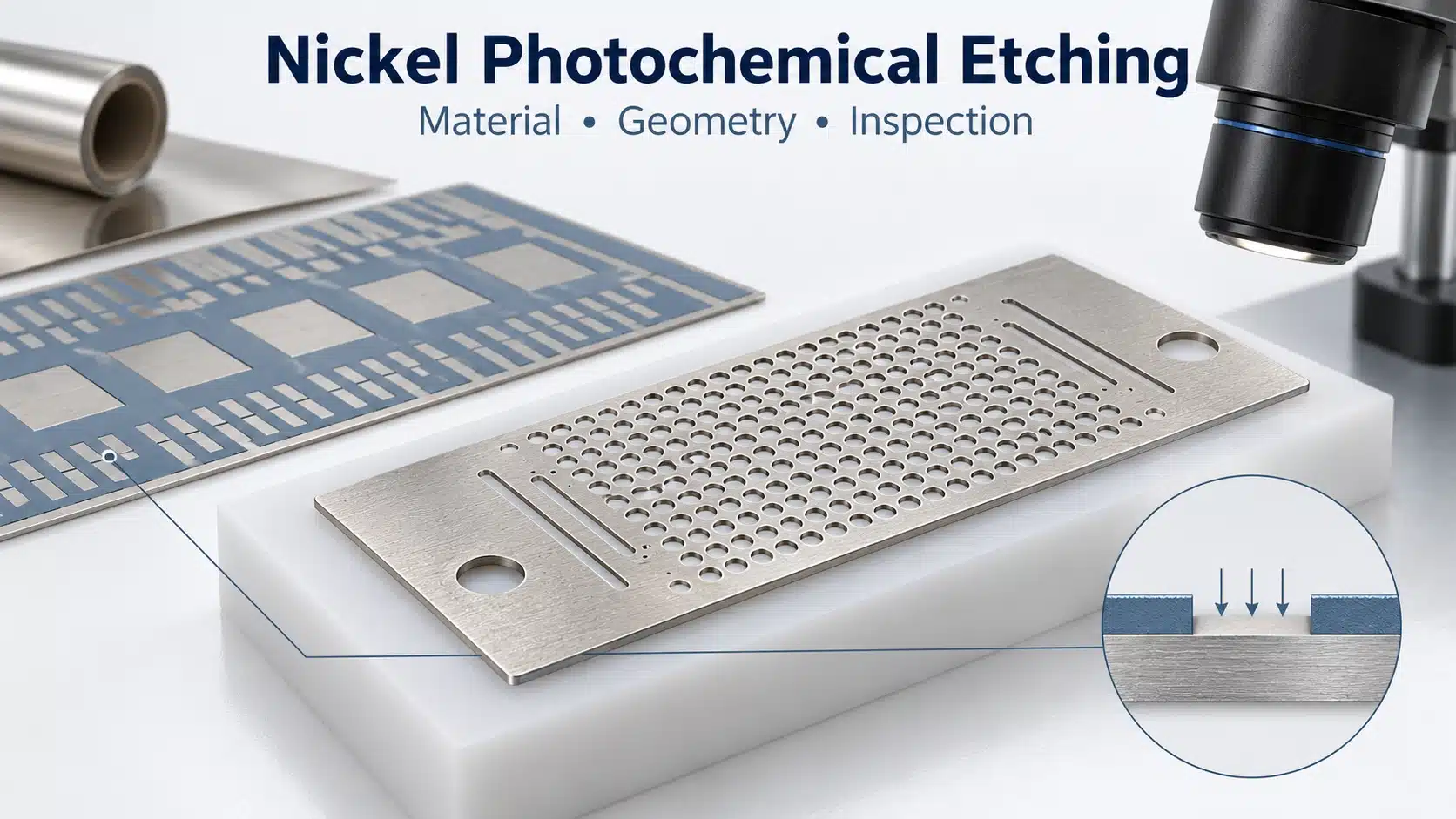
Photo etched speaker grilles are thin metal components produced through photochemical etching, a process that uses patterned photoresist and controlled chemical removal rather than mechanical punching. This process uses a photoresist pattern to protect selected areas of the metal. The exposed areas are then removed by controlled chemical etching.
In simple terms, the process creates holes without mechanical punching. This helps reduce burrs, stress, and distortion.
A typical photo etching manufacturing process includes:
- Metal sheet cleaning
- Photoresist coating
- Artwork exposure
- Developing
- Chemical etching
- Resist stripping
- Cleaning and inspection
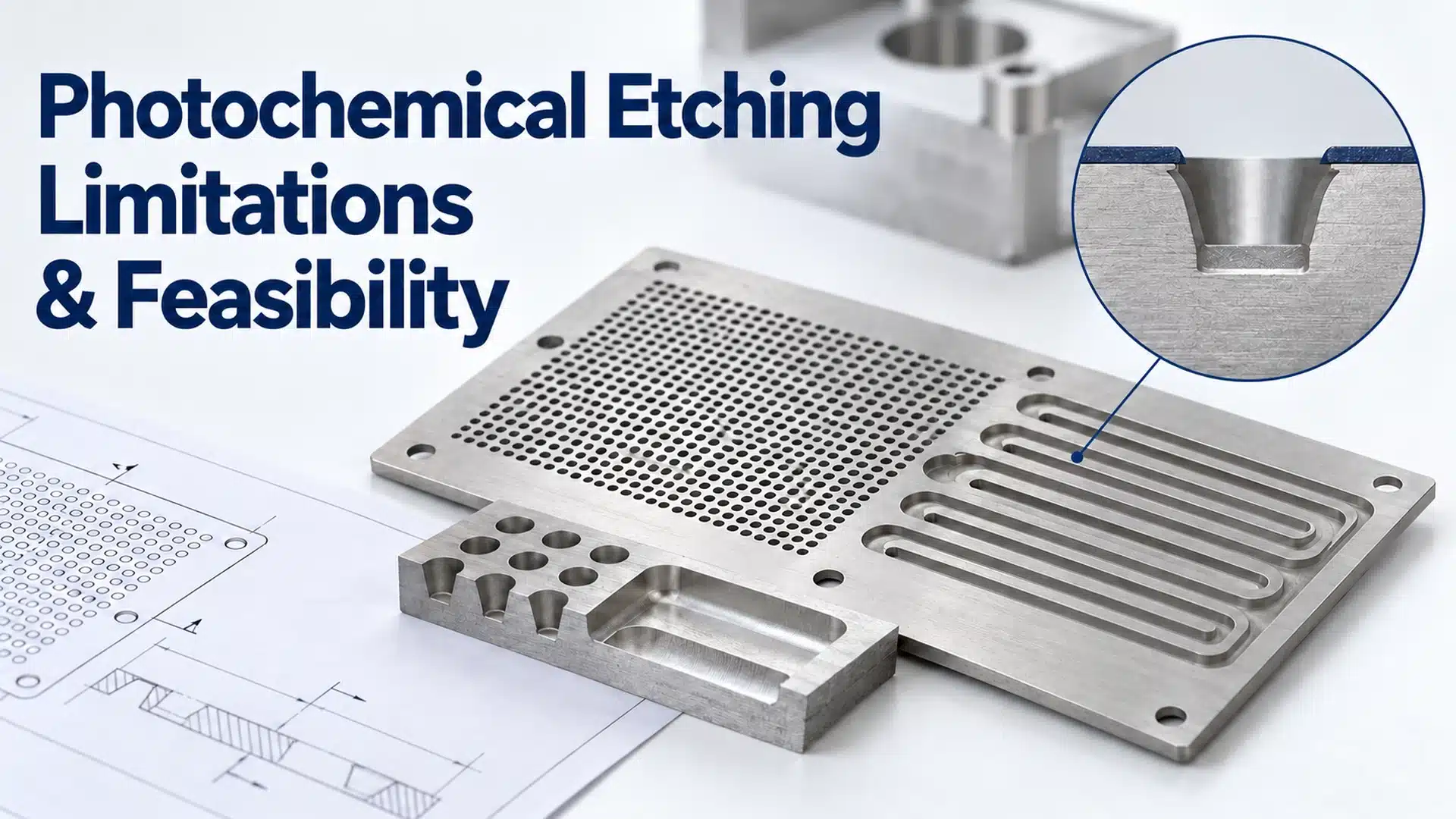
Based on our production experience, photo etching is often used for stainless steel, aluminum, copper, brass, nickel alloys, and titanium. The suitable thickness depends on the material, hole geometry, pitch, and required tolerance, so engineers should review the photochemical etching design limits before finalizing a speaker grille drawing. For many precision metal grille projects, the common range is around 0.1 mm to 0.5 mm. Please replace this range with your factory’s verified capability if different.
Photo etching is useful when the speaker grille design includes:
- Fine mesh openings
- Small holes
- Irregular hole shapes
- Decorative patterns
- Brand logos
- Gradient hole density
- Thin metal structures
- Cosmetic front panels
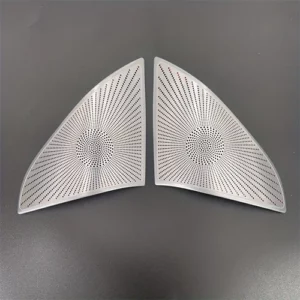
For example, an automotive audio grille may need a premium surface, a logo pattern, and tight hole spacing. A punched process may leave tool marks or restrict the pattern. Chemical etching grilles can form these details without hard punching tools.
This makes photo etching a strong option for custom speaker grills where both function and appearance matter.
What Are Perforated Metal Speaker Grilles?
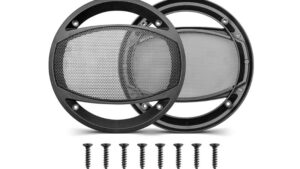
Perforated metal speaker grilles are made by punching holes into sheet metal with mechanical dies. The holes are often round, square, or slotted. The pattern can be straight, staggered, or custom within tooling limits.
Common materials include:
- Aluminum
- Mild steel
- Stainless steel
- Galvanized steel
- Coated steel
Perforation is usually a good choice when the grille has a simple and repeatable hole pattern. It can also be efficient for large panels and high-volume production.
However, mechanical punching has limits. Very small holes, tight pitch, and complex decorative layouts may need special tooling. The process may also create burrs, surface marks, or sheet deformation. These issues depend on material hardness, thickness, punch condition, and hole density.
For industrial speaker covers, these limits may not matter. For visible speaker grille parts in cars, headphones, or premium audio equipment, they can become a quality concern.
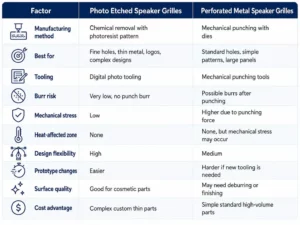
Photo Etched vs Perforated Metal Speaker Grilles: Key Differences
The best way to compare both methods is to look at the real design and production factors.
Comparison by Precision and Tolerance
Precision matters when a speaker grille has dense holes, small openings, or strict assembly requirements.
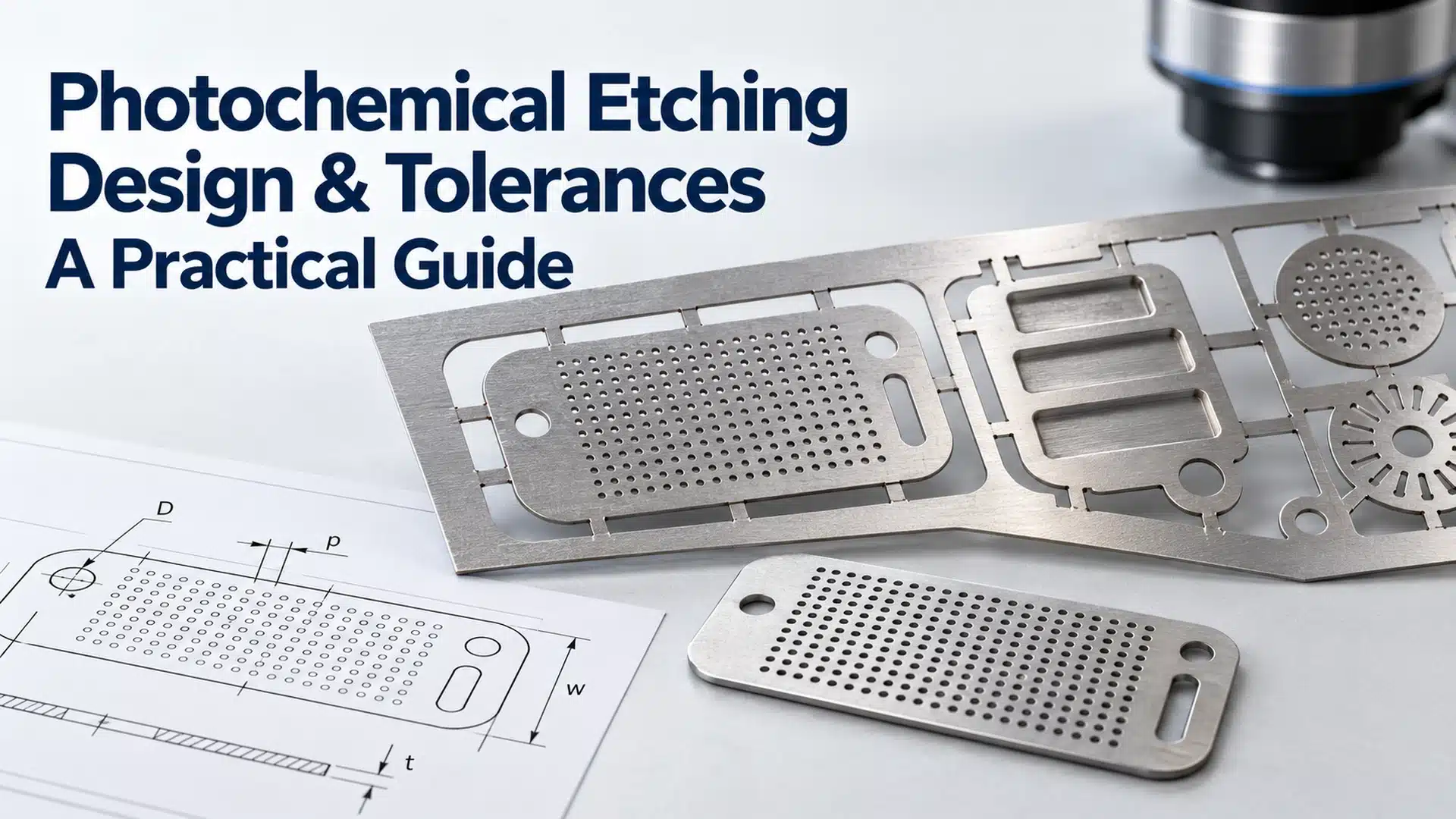
In photo chemical etching, the hole pattern comes from digital artwork. This allows high repeatability across many features. For thin precision parts, typical dimensional tolerance can reach about ±0.02 mm to ±0.05 mm, depending on material, thickness, and feature size.
Perforated metal can also be accurate for standard holes. But when the hole diameter becomes very small, the pitch becomes tight, or the sheet is thin, mechanical punching becomes harder. The punching force may cause burrs or slight deformation.
For example, a grille with a 0.3 mm hole diameter and a fine pitch may be easier to control through etching than punching. A grille with bigger round holes in a thicker panel may be more suitable for perforation.
Photo etching also supports fine hole patterns with complex shapes. This is useful for a precision metal grille used in headphones, microphones, small speakers, or automotive audio trims.
Comparison by Material and Thickness
Material choice affects strength, corrosion resistance, appearance, and cost.
Photo etching can process many metals used in speaker grille manufacturing. These include stainless steel, aluminum, copper, brass, nickel, and titanium. Stainless steel is common for durable grilles, and stainless steel etching can be used when the design requires dense openings, detailed patterns, or clean edges without mechanical punching. Aluminum is useful when low weight matters. Copper and brass can support decorative or conductive designs. Titanium is used when strength, weight, and corrosion resistance are important.
Perforation also works with many metals. But material hardness and thickness affect punch wear, burr formation, and tool cost.
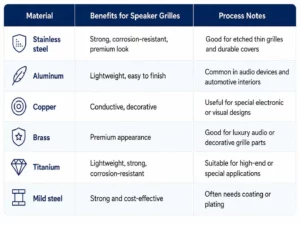
In general, photo etching is better for thin metal sheets with detailed patterns. Perforation is better for thicker, simpler protective panels.
A practical rule is simple: if the speaker grille is a visible precision part, consider etching.
Comparison by Acoustic Performance
A speaker grille must protect the speaker while allowing sound to pass. This is called acoustic transparency, which means the grille blocks as little sound as possible.
Several design factors affect acoustic performance:
- Open area ratio
- Hole size
- Hole pitch
- Hole shape
- Metal thickness
- Pattern distribution
- Distance from the speaker driver
- Surface coating thickness
A higher open area often improves sound transmission. But it may reduce strength and protection. A lower open area gives better protection but may affect sound output.
Photo etching allows engineers to tune the mesh opening with more freedom. The hole density can be changed across the part. The design can also include gradient patterns, decorative openings, or hidden logos.
Perforated metal works well for standard open areas. But it is less flexible when the acoustic design needs fine, irregular, or non-standard hole patterns.
For consumer electronics, headphones, and high-end audio equipment, this flexibility can be important. The grille must look good and support stable sound performance.
Want to see how photo etching performs on your speaker grille design? Send TMNetch your drawing or sample requirements. TMNetch’s team can review the hole pattern, material, and open area before production.
Comparison by Surface Finish and Appearance
Surface quality is very important for visible speaker grilles. This is especially true for automotive interiors, luxury audio systems, and consumer electronics.
Photo etching does not use punching force. So it can create holes without punch marks, sharp burrs, or mechanical stress. This helps keep the surface clean before finishing.
Common finishes include:
- Brushing
- Polishing
- Black coating
- Powder coating
- Anodizing
- Plating
- PVD coating
- Passivation
Perforated metal may need deburring, leveling, or extra finishing after punching. This is not always a problem. For industrial speaker covers, it may be acceptable. But for a front-facing grille, surface marks can affect the final appearance.
A custom speaker cover for an OEM product often needs to meet both functional and cosmetic requirements, including hole-pattern consistency, surface finish, flatness, branding, and edge quality. The buyer may specify scratch limits, color consistency, flatness, and edge quality.
In these cases, chemical etching grilles can reduce secondary work. They can also improve cosmetic consistency.
Comparison by Tooling Cost, Prototyping, and Lead Time
Tooling cost is a key issue for procurement teams.
Photo etching uses digital photo tooling. If the design changes, the artwork can be updated without making a new hard punching die. This makes etching useful for early prototypes and design revisions.
Perforated metal can be cost-effective when the pattern is standard. For example, a simple round-hole pattern may already have available tooling. But if the hole shape, pitch, logo, or pattern is custom, perforation may need special tooling. This can raise cost and lead time.
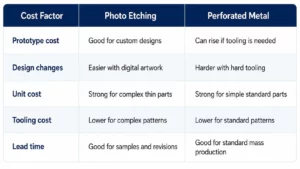
For small batches, pilot runs, and complex custom speaker grills, photo etching is often more flexible. For large volumes of simple grilles, perforation may give a lower unit cost.
Application-Based Recommendations
Different applications need different grille designs. A speaker grille for a factory alarm system does not need the same finish as a grille for a luxury car door panel.
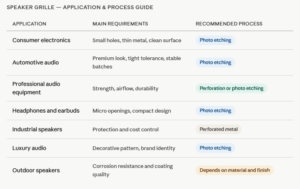
For consumer electronics, the grille is often small and visible. The hole pattern may also affect sound and product identity. Photo etched speaker grilles can support these needs.
For automotive speaker grilles, buyers often care about surface appearance, repeatability, assembly fit, corrosion resistance, and consistency across production batches. Etching can create complex patterns and clean edges without mechanical stress.
For professional audio equipment, the best choice depends on size and use. A large protective grille may use perforated metal. A decorative control panel or fine mesh insert may use photo etching.
For industrial speakers, cost and strength often matter more than fine appearance. Perforation can be a practical option.
FAQs
What material is used for speaker grill?
Common materials include stainless steel, aluminum, copper, brass, titanium, nickel alloys, and carbon steel. The best choice depends on strength, weight, corrosion resistance, appearance, and cost. We can provide material recommendations based on your specifications.
Do metal speaker grilles affect sound?
Yes. Hole size, open area, pitch, material thickness, and pattern layout can affect acoustic transparency. A good speaker grille design should balance sound transmission, protection, and appearance.
Can photo etching create logos or decorative patterns?
Yes. Photo etching can create logos, decorative patterns, fine mesh openings, and custom speaker grille designs. Since it uses digital artwork instead of hard punching tools, it supports irregular holes, gradient patterns, and complex geometries. The chemical process also creates clean edges with very low burr risk, making it suitable for premium audio, automotive, headphones, and consumer electronics.
Conclusion: Selecting the Right Speaker Grille Manufacturing Partner
Both photo etching and perforated metal can make reliable speaker grilles.
Choose perforated metal speaker grilles when you need standard holes, simple patterns, thicker panels, and lower cost for basic protection.
Choose photo etched speaker grilles when you need fine holes, thin metal, custom patterns, burr-free edges, clean surfaces, or fast design changes. This method is especially useful for precision metal grille parts in consumer electronics, automotive audio, headphones, and premium speaker systems.
The best choice depends on material, thickness, hole size, open area, tolerance, surface finish, and production volume.
Need Custom Photo Etched Speaker Grilles?
If your project requires fine hole patterns, burr-free edges, thin metal, or a custom decorative design, photo chemical etching may be the right solution.
Send TMNetch your drawing, material, thickness, quantity, and finish requirements. We can help review manufacturability and provide a practical quotation.