

Have you ever received a batch of bipolar plates and noticed unexpected etch marks?
Even when flow channels appear well-formed, unexpected etch marks may prevent bipolar plates from meeting functional requirements.
In this guide, we examine the causes of localized etching defects, share a TMNetch titanium bipolar plate case study, and discuss how to mitigate these quality risks across your project.
What Are Localized Etching Defects in Metallic Bipolar Plates?
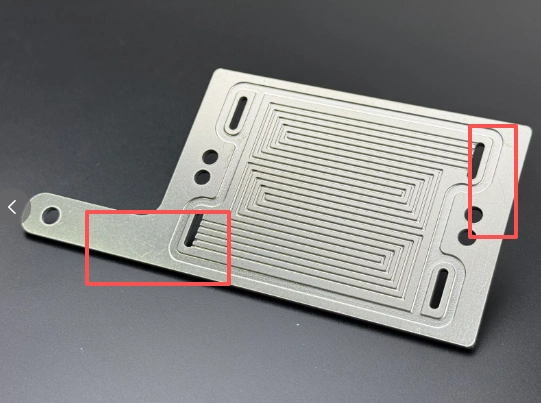
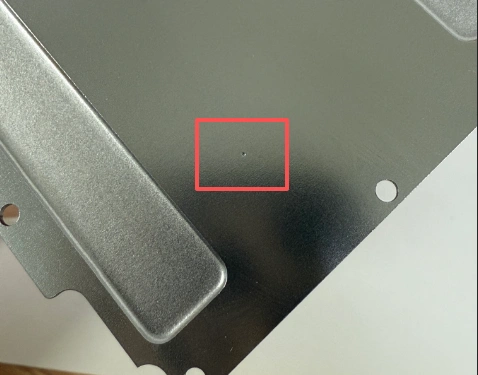
Localized etching defects are unintended changes in the surface or geometry of an etched component. On bipolar plates, they may appear as small recesses, irregular channel edges, or partially damaged ribs.
During photochemical etching, a patterned photoresist protects the metal that needs to remain, while the etchant removes exposed material. If this protection fails, metal may be removed beyond the intended design.
Small marks on bipolar plates can have different origins:
- Localized unintended etching:Metal is accidentally removed from an area that should remain protected.
- Pitting corrosion:Localized corrosion creates small cavities in the metal surface.
- Incomplete etching:Residual metal creates raised features or shallow channels.
- Surface staining:Discoloration or deposits appear without necessarily changing the metal geometry.
Mechanical damage, such as scratches on bipolar plates, requires different preventive measures.
Understanding these differences helps identify the source of a defect and determine how to prevent it.
Why Do Localized Etching Defects Matter in Bipolar Plates?
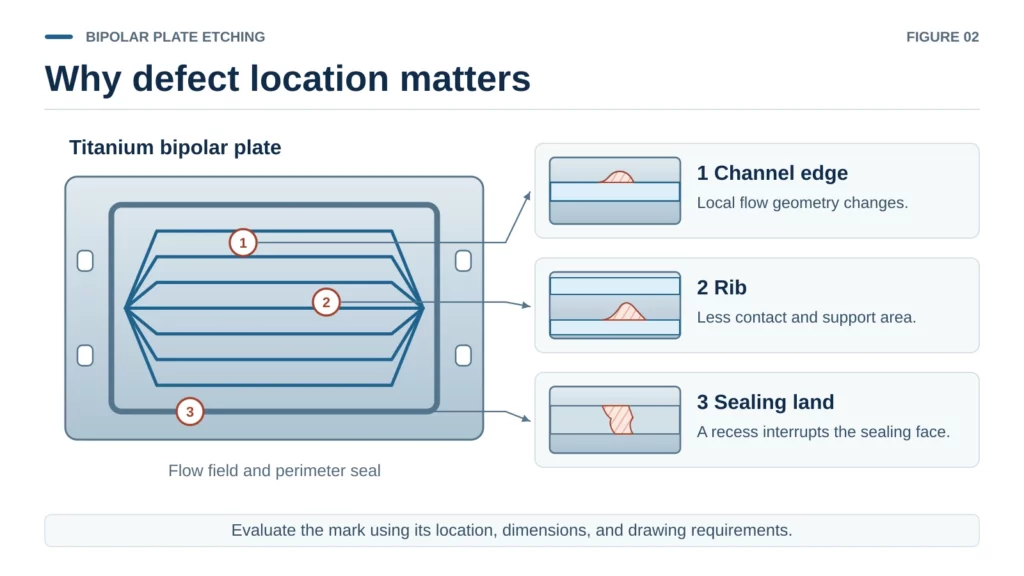
The significance of an etching defect depends on its location, size, and the function of the affected area.
- Flow channels:Unintended geometric changes can affect local fluid distribution.
- Ribs:Metal loss can reduce rib width, electrical contact area, and mechanical support in fuel cell applications.
- Sealing areas:Localized recesses may disrupt the intended sealing geometry.
- Coating surfaces:Surface irregularities and contamination can affect subsequent bipolar plate coating performance.
A small defect in a critical functional area may therefore be more significant than a larger mark elsewhere.
Manufacturers need to evaluate defect location and dimensions against the engineering drawing rather than relying on appearance alone.
The following manufacturing case from TMNetch illustrates how this works in practice.
What Causes Etching Defects During Bipolar Plate Manufacturing?
Etching defects can originate at various stages of production, from raw material preparation to final cleaning.
| Cause | How Defects Develop | Preventive Measures |
| Raw material imperfections | Surface or microstructural differences lead to uneven metal removal. | Incoming material inspection and batch traceability. |
| Photoresist pinholes or poor adhesion | Metal beneath the protective layer becomes exposed. | Surface cleaning and photoresist integrity checks. |
| Phototool defects | Unintended features are transferred to the photoresist. | Phototool inspection, maintenance, and replacement. |
| Exposure or development errors | Unwanted openings or residual photoresist alter the etched pattern. | Exposure control and developed-pattern inspection. |
| Unstable etchant conditions | Changes in chemical activity affect etching rate and uniformity. | Monitoring validated etching parameters. |
| Uneven spray distribution | Different areas receive inconsistent etchant delivery. | Nozzle, flow, and spray coverage checks. |
| Improper undercut compensation | Uncompensated lateral etching alters channel and rib dimensions. | Pattern compensation and prototype verification. |
| Inadequate post-etch cleaning | Chemical residues cause staining or further surface attack. | Controlled rinsing, cleaning, and drying. |
Phototool defects and photoresist failures deserve particular attention because they can expose metal that should never be etched.
Think of the phototool as the template defining the flow-field pattern and the photoresist as the protective layer that transfers this pattern onto the metal.
If either fails, the etchant may remove material from the wrong location.
Controlling lateral undercut is equally important when manufacturing bipolar plate flow channels, especially in designs with narrow ribs and closely spaced channels.
But why can such a small defect matter so much?
TMNetch Case Study: Localized Etching Defects in Titanium Bipolar Plates
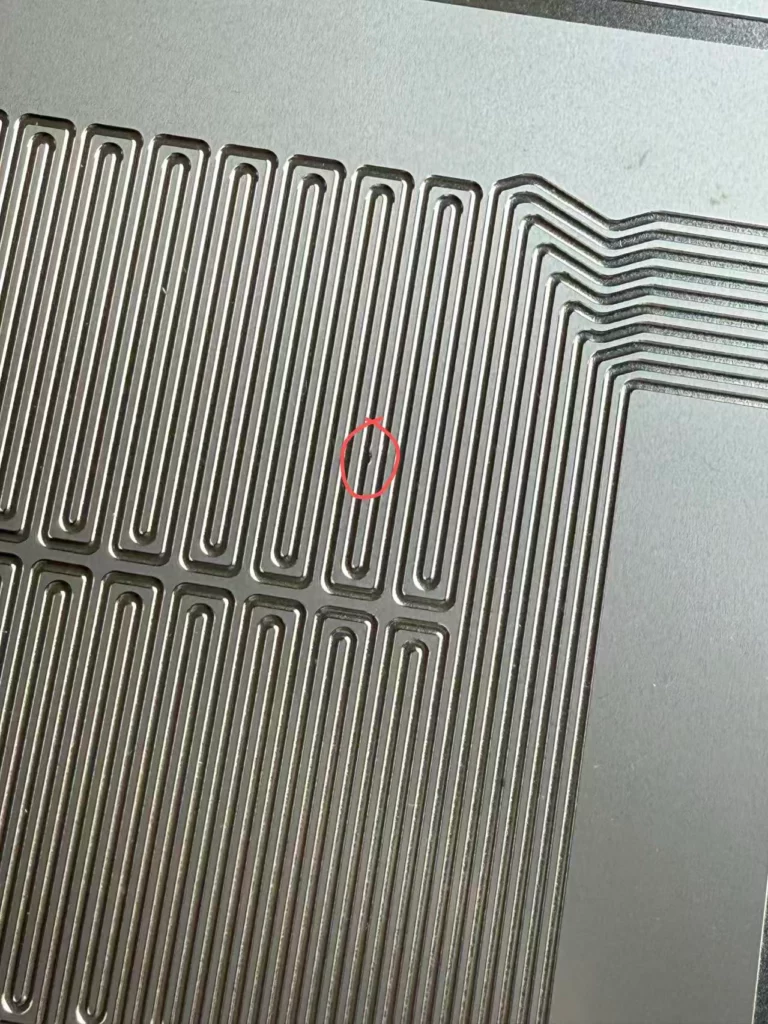
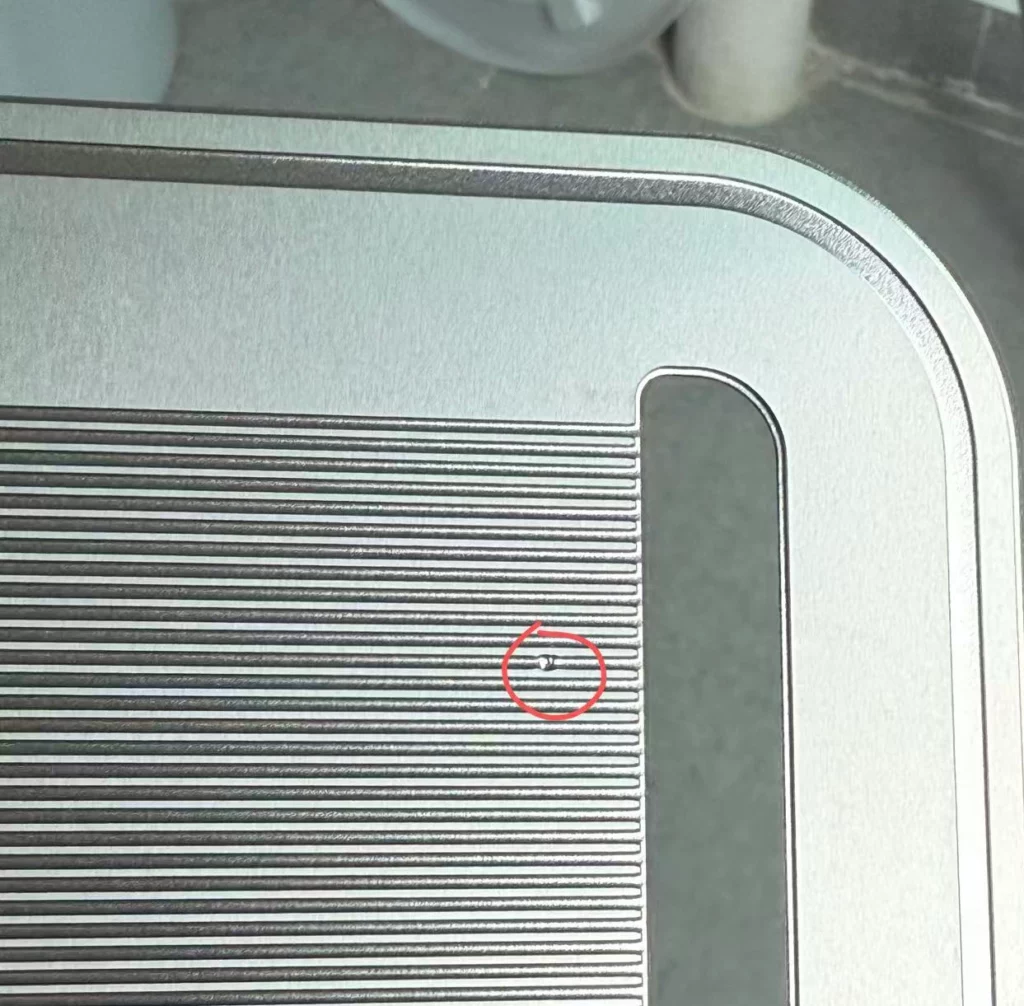
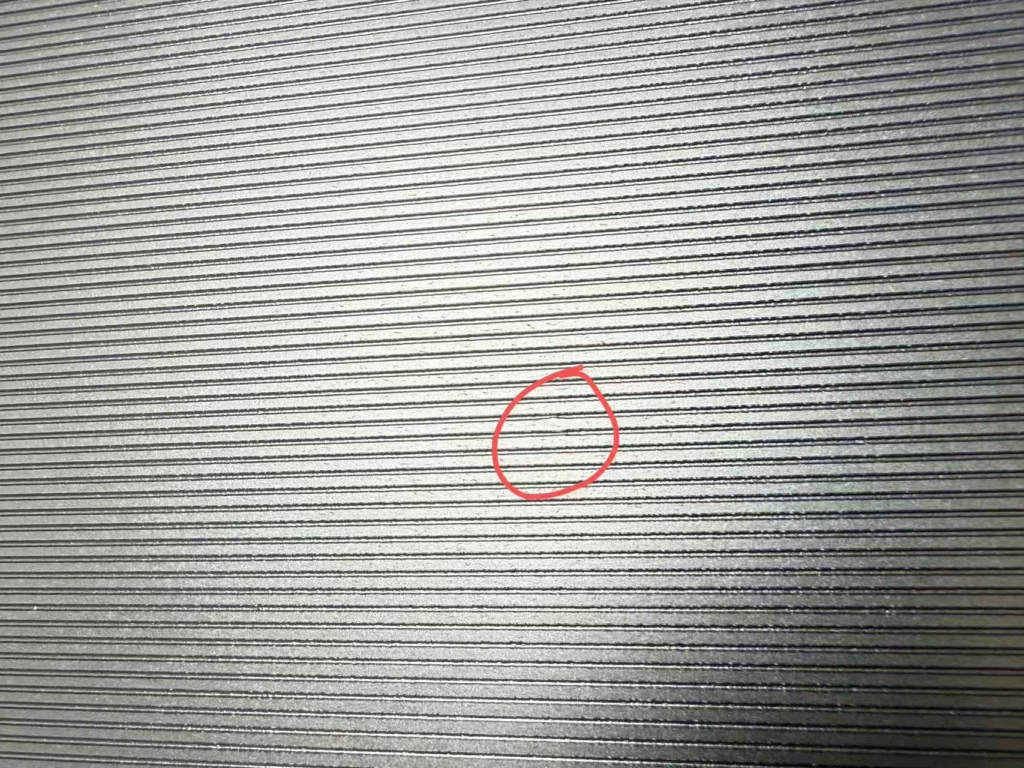
During quality inspection of photo-etched titanium bipolar plates, our team identified several localized recesses extending beyond the intended flow-channel boundaries and into adjacent ribs.
- Defect Observation:Although the surrounding flow channels were well defined, unintended metal removal caused localized damage to the ribs.
- Root Cause:Our quality engineers traced the problem to light leakage through an incomplete opaque region of the phototool. The unintended exposure caused part of the positive-tone photoresist to be removed during development, exposing titanium that should have remained protected.
- Quality Decision:The defects extended into the ribs by more than one-third of their nominal width, exceeding the acceptance limit specified in the customer’s engineering drawing. The affected plates were therefore rejected.
- Prevention and Control:To reduce the risk of recurrence, TMNetch uses pre-production phototool inspections, periodic panel inspections, and scheduled phototool maintenance and replacement. When defects are detected, potentially affected panels should also be traced and evaluated before release.
For a closer look at the inspection methods, acceptance criteria, and defective batch handling procedures, explore our How to Control Bipolar Plate Quality case study.
This case shows why preventing etching defects begins well before the metal enters the etching machine. So, how can you work with your manufacturer to reduce these risks throughout your project?
What Should Buyers Specify When Ordering Etched Bipolar Plates?
Reducing etching defects begins with effective communication between design engineers and manufacturers.
Agreeing on manufacturing and inspection requirements early helps both parties identify potential risks before bulk production.
Design Stage: Define Critical Features
Provide the exact material grade, sheet thickness, channel depth, rib width, and dimensional tolerances.
Discuss etching feasibility and lateral undercut with your manufacturer, particularly around narrow ribs and critical sealing surfaces.
Prototyping Stage: Establish Acceptance Criteria
Sample approval should address both dimensional accuracy and surface quality.
Specify acceptable defect types, locations, and dimensions. For localized rib damage, a maximum intrusion distance or proportion of the nominal rib width provides a measurable acceptance criterion.
Production Stage: Confirm Inspection and Traceability
Before bulk production, agree on inspection frequency, phototool maintenance, batch traceability, and abnormality reporting.
Also establish how potentially affected products will be isolated, inspected, and evaluated before release.
The following checklist summarizes what to discuss with your manufacturer throughout the project.
| Project Stage | What Buyers Should Specify | What Manufacturers Should Confirm |
| Design | Material, thickness, channel geometry, tolerances, and critical functional areas. | Manufacturing feasibility and pattern compensation. |
| Prototyping | Permitted defect types, locations, and dimensions. | Sample measurements and acceptance results. |
| Pre-production | Approved engineering drawings and inspection requirements. | Process controls and phototool maintenance. |
| Mass production | Batch traceability and abnormality reporting requirements. | Inspection records and nonconforming product control. |
| Final acceptance | Inspection reports, sampling requirements, and downstream testing responsibilities. | Drawing conformity and batch release criteria. |
For projects involving additional coating, joining, or assembly, also establish responsibility for subsequent bipolar plate performance testing.
Clear requirements give manufacturers a defined quality target and buyers a consistent basis for accepting finished parts.
Conclusion
Preventing localized etching defects requires more than inspecting finished bipolar plates. It begins with design review, accurate pattern transfer, phototool maintenance, and effective process inspection.
Our titanium bipolar plate case demonstrates how a small phototool defect can cause irreversible metal loss and why early detection and measurable acceptance criteria matter.
At TMNetch, we combine our experience in titanium etching with the specific manufacturing and quality requirements of each project.
If you are developing custom photo-etched bipolar plates, share your engineering drawings, material specifications, and critical tolerances with our team. We can help evaluate manufacturing feasibility and establish suitable inspection requirements before production begins.