
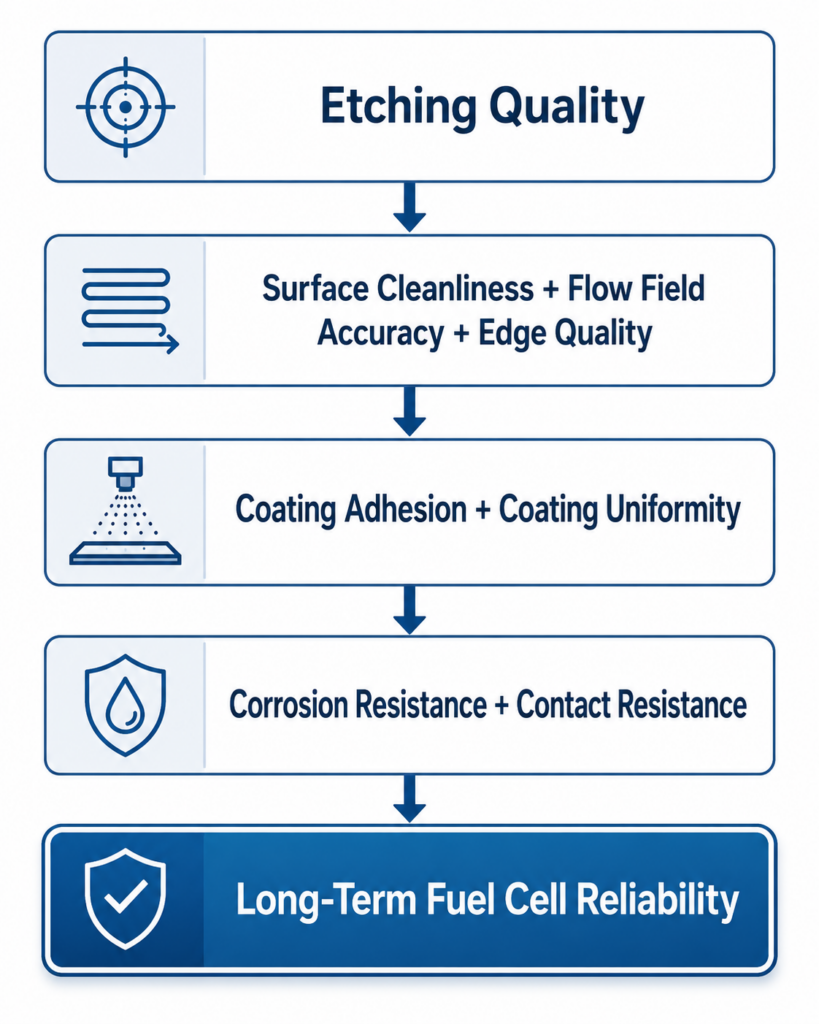
For etched bipolar plates, coating performance is not only decided by the coating material. Surface cleanliness, flow field accuracy, edge quality, and post-etching preparation can affect coating adhesion, corrosion resistance, contact resistance, and long-term fuel cell reliability.
Buyers should review etching and coating requirements as one connected process, especially when sourcing precision etched bipolar plates for custom fuel cell projects. This is especially important for custom flow field designs, prototype validation, and production projects where coating failure can increase stack risk.
Why Coating Performance Matters for Metallic Bipolar Plates
Metallic bipolar plates need stable surfaces because they work in harsh fuel cell conditions. These conditions include moisture, acidity, and electrochemical reactions. A proper bipolar plate coating protects the base metal, reduces corrosion risk, and helps maintain electrical performance during service.
The U.S. Department of Energy’s Technical Targets for PEM Fuel Cell Bipolar Plates (Transportation Applications) list several performance targets, including hydrogen leakage, corrosion resistance, electrical conductivity, areal specific resistance, strength, and forming ability.
These targets show that coating performance is not only about the coating material. It also depends on how well the bipolar plate is manufactured.
Corrosion Resistance and Contact Resistance
A coating must protect the metal surface without blocking current flow. This creates a balance between corrosion resistance and contact resistance.
If the coating protects well but creates high resistance, stack efficiency may drop. If the coating conducts well but leaves weak areas exposed, local corrosion may start earlier.
The DOE target table sets corrosion targets for both the anode and cathode sides. It also requires electrical conductivity above 100 S/cm and areal specific resistance below 0.01 Ω·cm².
Source: U.S. DOE Technical Targets for PEM Fuel Cell Components
For buyers, areal specific resistance and interfacial contact resistance should be treated as core performance metrics, not minor details.
Key Coating Properties Buyers Should Check
Before selecting a supplier, buyers should ask how the coating will be tested and how the etched surface will be prepared. The most important coating properties include adhesion, corrosion resistance, ICR, uniform thickness, and long-term durability. These properties should remain stable after environmental or electrochemical exposure.
For fuel cell bipolar plate coatings, the coating layer must stay attached to the metal substrate. ASTM D3359 highlights the importance of coating adhesion. A coating must remain bonded to the substrate to provide protection. It also shows that substrate condition and surface preparation can have a strong effect on adhesion performance.
How Etching Quality Affects Bipolar Plate Coating Performance
Etching quality affects the surface that the coating must cover. If the surface has residue, uneven roughness, sharp transitions, or poor edge quality, the coating may not perform consistently across the plate.
In precision etching production, coating performance starts before the coating step. The etched surface must be clean, stable, and consistent enough for the later coating process. If flow channels have uneven depth, sharp local transitions, or surface residues, the coating may not cover the plate evenly.
Surface Cleanliness and Coating Adhesion
Surface cleanliness has a direct effect on coating adhesion. Oil, oxide, photoresist residue, etching by-products, and handling contamination can all reduce the bond between the coating and the metal substrate.
For etched bipolar plates, cleaning should not be treated as a simple washing step. It is part of the coating preparation process. A supplier should control degreasing, rinsing, drying, and surface inspection before the coating stage.
Surface Roughness and Coating Coverage
Surface roughness can affect how evenly a coating covers the etched plate. A surface that is too rough may create local thickness variation. A surface that is not suitable for the coating method may reduce adhesion or increase contact resistance.
The right surface condition depends on the base metal, coating type, and application. Buyers should not only ask “what coating is used?” They should also ask “what surface condition is required before coating?”
Flow Field Accuracy and Coating Uniformity
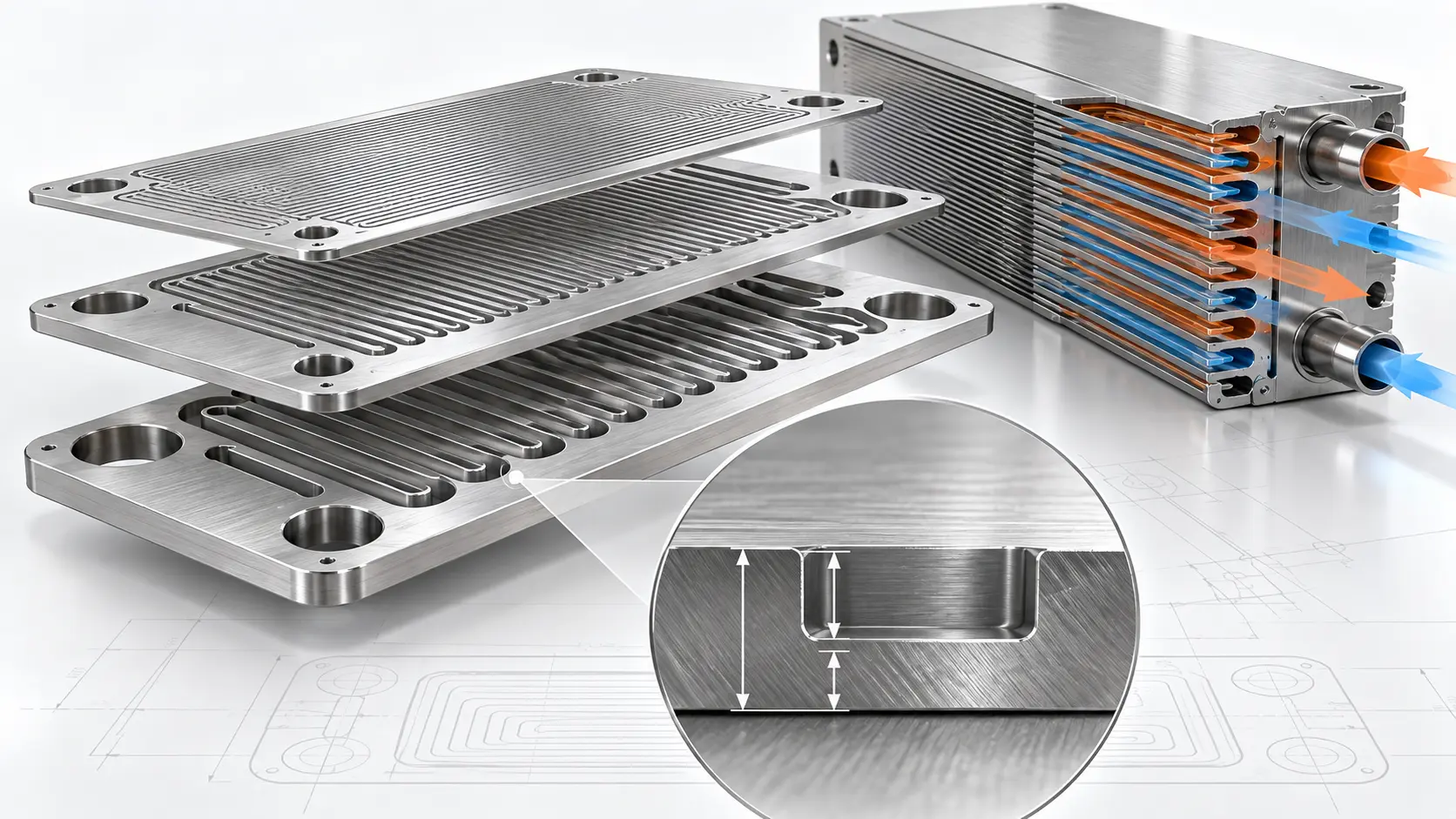
Flow field accuracy matters because coatings must cover channels, ribs, corners, and transition areas. If channel depth, width, or corner geometry varies too much, coating thickness may become less uniform.
This is one reason precision etched bipolar plates are useful for custom designs. Photochemical etching can create complex channel patterns and dual-depth flow fields without hard tooling. This helps engineers adjust the design during development. According to TMNetch, its bipolar plate process can support accurate flow channels, complex geometries, and dual-depth channel designs.
Edge Quality and Corrosion Risk
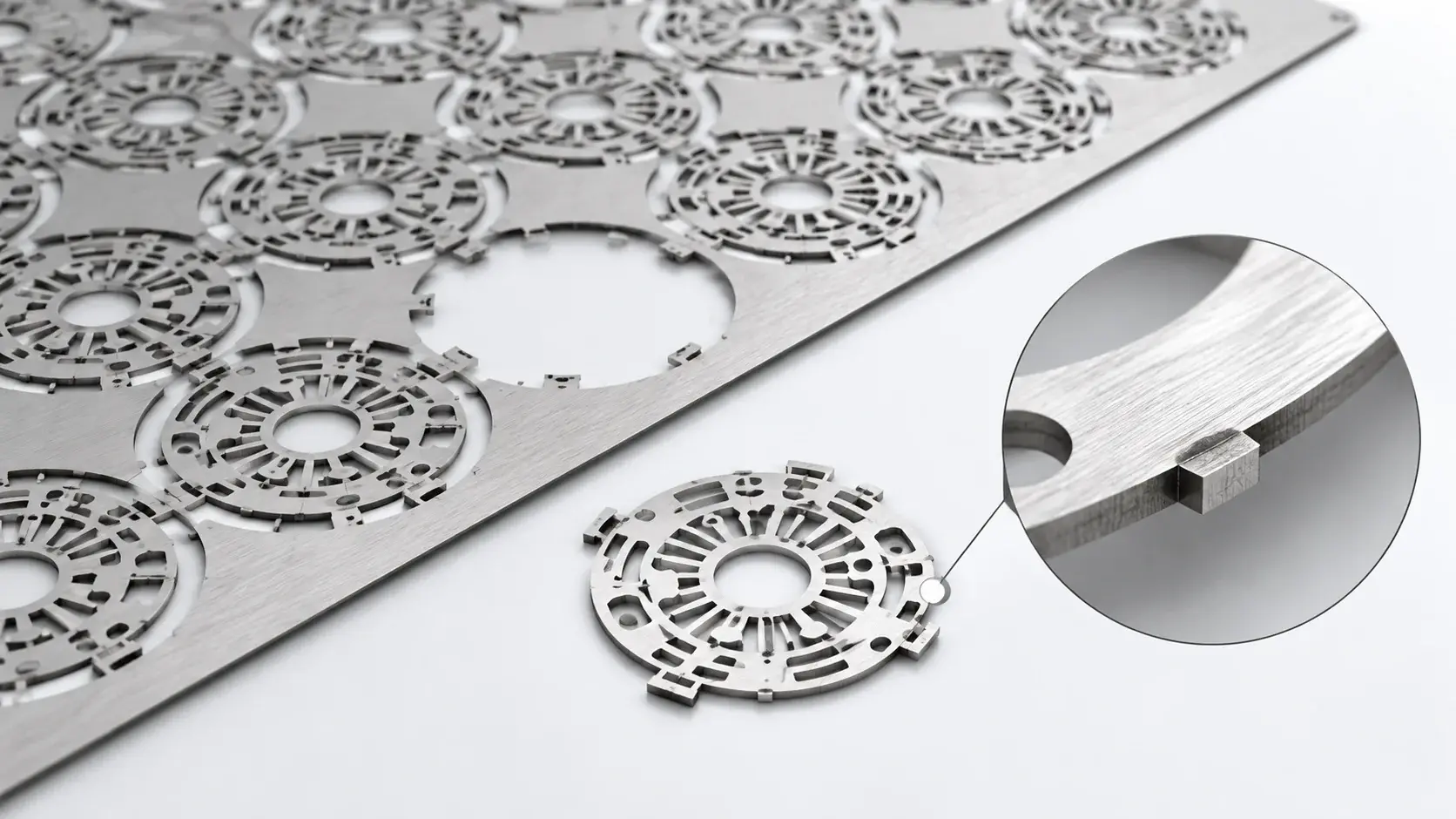
Edges are common weak points in coated metal parts. Sharp edges, micro-burrs, local defects, or exposed substrate areas can become early corrosion sites.
Photo etching is useful because it does not rely on mechanical force to cut the flow field. TMNetch describes chemical etched bipolar plates as offering minimal mechanical stress, with no mechanical deformation during the etching process.
Etching Before Coating vs Coating Before Etching
There is no single coating route that fits every project. Buyers should choose the right manufacturing route based on material type, coating method, flow field complexity, production volume, and final performance targets.
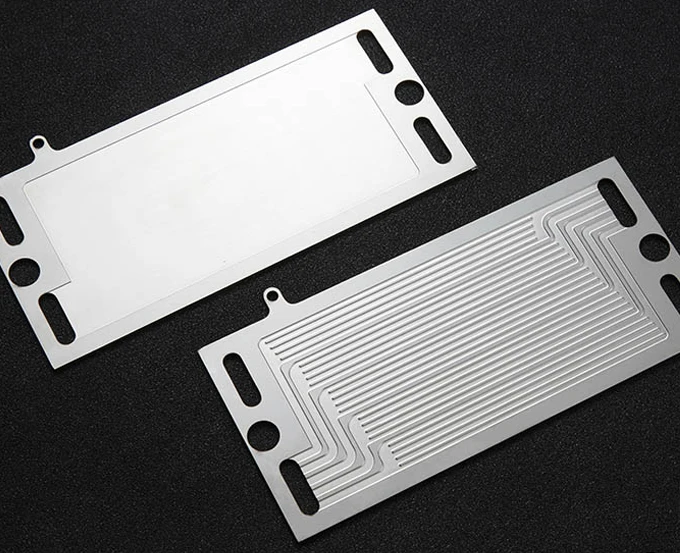
Etching Before Coating
Etching before coating means the flow field is formed first. Then the final surface is cleaned, prepared, and coated.
This route is often suitable for custom etched bipolar plates because the coating can be applied to the final geometry. It also allows engineers to inspect channel quality before surface treatment.
Coating Before Etching
Coating before etching can be useful when using pre-coated material or high-volume strip processing. It may reduce cost in some mass production cases.
However, later etching or forming may expose the plate edges. It may also affect coating continuity or require extra protection. Buyers should confirm that the final plate shape still meets coating requirements after processing.
Which Route Is Better for Custom Etched Bipolar Plates?
For custom projects, etching before coating is often easier to evaluate because the coating is applied after the final channel structure exists. This is useful when channel depth, edge quality, and surface preparation must be reviewed before approval.
For high-volume mature designs, other coating routes may also be practical. Buyers should compare the complete bipolar plate manufacturing process before choosing the route, especially when coating durability and ICR are important.
Key Etching Factors Buyers Should Check Before Coating
A buyer should evaluate the etched part before discussing coating as a separate service. The most important factors are base metal, flow field tolerance, surface preparation, edge quality, and inspection control.
Base Metal Selection
Common metal options include stainless steel, titanium, aluminum alloys, copper, nickel, and specialty alloys. For etched bipolar plates, TMNetch lists materials such as SS304, SS316L, SS310S, titanium Grade 1, titanium Grade 2, aluminum alloys, copper, nickel, and specialty alloys.
Each material reacts differently during etching and coating. Stainless steel may need strong corrosion protection. Titanium offers strong corrosion resistance but may require careful surface preparation. Nickel and specialty alloys may be selected for specific electrochemical or conductivity requirements.
Flow Field Depth and Tolerance
Flow field depth affects gas distribution, coolant flow, pressure drop, and coating access. If depth varies across the plate, the coating may not perform consistently in all channels.
Based on TMNetch production data, its photo etching service can handle metal thicknesses from 0.02 mm to 1.5 mm, etch features down to 0.05 mm, and achieve tolerances as tight as ±0.025 mm on critical dimensions. These values depend on material type, design requirements, and part geometry.
Post-Etching Surface Preparation
Post-etching surface preparation may include cleaning, stripping, rinsing, drying, inspection, and secondary finishing. This step is important because the coating bonds to the actual surface condition left after etching.
When a project needs surface color, protective finishing, or other post-etching surface treatment, buyers can review TMNetch’s metal painting services.
Inspection Before Coating
Inspection should happen before coating, not only after coating. Buyers should ask for dimensional checks, visual inspection, flatness review, surface defect checks, and documentation.
For coated parts, adhesion testing should also be defined. ASTM D3359 covers procedures for assessing adhesion of coating films to metallic substrates using pressure-sensitive tape over cuts made in the film.
Common Coating Problems Linked to Poor Etching Control
Etching quality can affect coating performance after processing. The table below shows common coating problems, possible etching-related causes, and the risks buyers should check before approval.
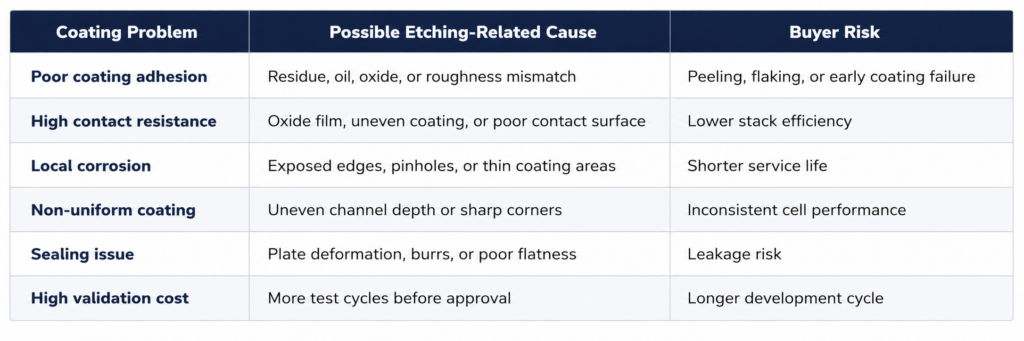
Gas tightness may also matter in some bipolar plate designs. Hydrogen permeation is one of the DOE’s target categories for PEM fuel cell bipolar plates, and the DOE references ASTM D1434 — a standard gas transport test method — as the protocol for evaluating this property in bipolar plate materials. This shows that gas barrier performance should be reviewed alongside coating and etching quality when evaluating a bipolar plate supplier.
How to Evaluate a Supplier for Etched Bipolar Plates
A supplier should understand both the etched plate and the coating requirement. Buyers should not evaluate coating performance only by asking about coating material.
Ask About Etching Tolerance and Flow Field Control
Ask what tolerance the supplier can hold on channel width, channel depth, ribs, ports, and alignment features. Also ask whether the tolerance applies to prototypes only or to production batches.
For etched bipolar plates, stable flow field geometry helps reduce later coating variation. It also helps engineering teams compare test results between sample rounds.
Ask How Parts Are Prepared Before Coating
Surface preparation should be documented. Ask how parts are cleaned, dried, handled, and inspected before coating.
This is important because even a good coating can fail if the surface is not ready. ASTM D3359 clearly notes that substrate and surface preparation can strongly affect coating adhesion.
Ask Whether Coating Requirements Are Considered During DFM
DFM means design for manufacturability. For coated bipolar plates, DFM should include coating access, edge design, channel geometry, surface roughness, and inspection method.
Do not wait until the plate is fully etched to discuss coating. The coating route should be reviewed before tooling files, prototype drawings, and sample approval.
Ask About Inspection and Documentation
A strong supplier should support material review, dimensional inspection, sample approval, and production documents. For critical projects, buyers can also ask for coating-related test reports from the coating provider or a third-party lab.
Good documentation helps procurement teams compare suppliers. It also helps engineering teams reduce risk before moving from prototype to batch production.
TMNetch Support for Etched Bipolar Plates and Surface Finishing
TMNetch supports precision etched bipolar plates for custom flow field designs. According to TMNetch’s bipolar plate page, photochemical etching is used to create accurate flow channels and complex geometries. The page also states that TMNetch supports customers from initial prototype to mass production.
For projects with different functional surfaces, TMNetch also describes side-specific coating options. For example, platinum coating can be used on the cathode side, while MMO coating can be used on the anode side. This makes early review important when the etched plate, coating route, and final inspection must work together.
Buyers can use TMNetch’s engineering support before RFQ to review material, channel design, tolerance, and post-etching surface treatment requirements. This helps align the etched part design with coating performance before sample production.
Buyer’s Checklist Before Ordering Etched Bipolar Plates
Use this checklist before ordering etched bipolar plates for coated fuel cell applications:
What base metal will be used?
What coating method will be applied?
Will the plate be coated before or after etching?
What channel depth and width tolerance are required?
How will the etched surface be cleaned?
Are edge quality and burr-free features inspected?
Is surface roughness controlled before coating?
What coating adhesion test will be used?
What corrosion resistance or ICR tests are required?
Can the supplier support both prototype and production consistency?
Can engineering support be provided before RFQ?
FAQ About Etched Bipolar Plates and Coating Performance
Why do metallic bipolar plates need coating?
Metallic bipolar plates need coating to improve corrosion resistance, protect the base metal, and maintain stable electrical contact. The coating must protect the surface while keeping contact resistance low.
Does etching quality affect bipolar plate coating adhesion?
Yes. Etching quality affects surface cleanliness, edge condition, roughness, and channel geometry. These factors can all influence coating adhesion and coating uniformity.
Is it better to coat bipolar plates before or after etching?
It depends on the project. Coating after etching is often useful for custom etched bipolar plates because the final channel geometry can be cleaned, inspected, and coated. Pre-coated material may suit mature high-volume designs.
What coating properties should buyers check?
Buyers should check coating adhesion, corrosion resistance, contact resistance, coating uniformity, and durability. For fuel cell projects, ICR and corrosion performance are especially important.
Why are etched bipolar plates suitable for custom flow fields?
Etched bipolar plates are suitable for custom flow fields because photochemical etching can create complex patterns without hard tooling. This helps buyers test different channel designs during development.
What should buyers ask before ordering etched bipolar plates?
Buyers should ask about material selection, channel tolerance, surface cleaning, coating route, edge quality, inspection reports, and prototype-to-production consistency.
Conclusion
Coating performance starts before coating. For etched bipolar plates, buyers should evaluate etching quality, surface preparation, coating compatibility, and inspection capability as one connected process. Each step can affect the next step, so the final plate quality depends on the whole manufacturing route.
Need custom flow fields, coating support, or prototype validation?
TMNetch can help review your material, channel design, tolerance, and surface finishing requirements before production. This helps reduce design risks and supports a smoother path from prototype to mass production.
If your project requires custom flow fields, coating-related review, or prototype validation, contact TMNetch to discuss your bipolar plate project before production.