
Choosing the right material for stainless steel bipolar plates is not only a cost decision. It affects corrosion resistance, contact resistance, coating performance, stack life, and manufacturing stability.
304 and 316L are both common austenitic stainless steels. They look similar on a drawing, but they behave differently in fuel cell environments.
For buyers and engineers, choosing between 304 and 316L is not just a material question. For stainless steel bipolar plates, how the metal is machined into flow channels also affects whether its corrosion resistance holds up under real operating conditions.
Why Material Selection Matters for Stainless Steel Bipolar Plates
Stainless steel bipolar plates are key parts in a fuel cell stack. They guide gases, conduct current, support the stack, and help manage heat and water.If you need a broader overview, this guide explains the function of bipolar plates in fuel cells and how they affect stack performance.
A fuel cell design using stainless steel bipolar plates must balance several needs at the same time. The plate needs good corrosion resistance, low contact resistance, accurate flow channels, stable flatness, and controlled cost.
In PEM fuel cells, hydrogen and air react through an electrochemical process to produce electricity, heat, and water, which makes corrosion and contact resistance important material concerns.
If the material corrodes, the plate surface can change over time. This may increase contact resistance, reduce power output, and shorten stack life.
Material selection also affects manufacturing. A metal bipolar plate with fine flow channels needs a process that can keep the plate flat, clean, and repeatable.
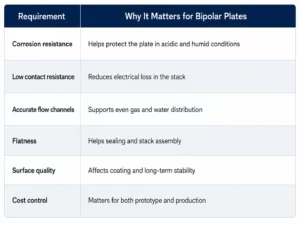
The grade matters, but it is not the only factor. The manufacturing process also affects the final plate.
304 Stainless Steel for Bipolar Plates: Composition, Benefits, and Limits
304 stainless steel is one of the most widely used stainless steel grades. It contains chromium and nickel, which help improve corrosion resistance and formability.
A 304 stainless steel bipolar plate can be attractive when cost matters. It is often easier to justify during early-stage testing or low-volume prototype work.
304 also has good general processing behavior. It can be etched, formed, and handled in many industrial projects.
However, fuel cell environments are more demanding than normal use conditions. Acidic moisture, temperature changes, and electrochemical reactions can challenge the surface of 304.
Composition Basics of 304 Stainless Steel
304 stainless steel is a widely used austenitic Cr-Ni stainless steel with good ductility, forming behavior, and general corrosion resistance. In simple terms, this means it has a stable structure, good ductility, and good general corrosion resistance.
It is often used in thin metal parts because it is available, cost-effective, and easy to process.For thin stainless steel components, stainless steel etching can help create detailed features without mechanical cutting stress.
For bipolar plate manufacturing, 304 can be useful when the project is still in the testing stage. It allows buyers to check flow field design, fit, assembly, and basic performance before moving to a more expensive grade.
Corrosion Performance in Fuel Cell Conditions
The main limitation of 304 is corrosion resistance in harsher fuel cell conditions.
In a fuel cell stack, the plate may face acidic moisture and electrochemical stress. Over time, this can affect surface stability.
For this reason, 304 should not be selected only because it is cheaper. Engineers should test it under real operating conditions before using it in long-term stack designs.
In many cases, 304 may also need coating or surface treatment. The coating can help improve corrosion resistance and reduce contact resistance.
When 304 Still Makes Sense
304 is not a poor material. It is just not the best fit for every stainless steel bipolar plate project.
304 may make sense when:
- The project is in early prototype validation.
- The budget is tight.
- The test cycle is short.
- The environment is less aggressive.
- The team wants to compare several bipolar plate material options.
- The plate will receive a coating and still be tested.
For many OEM buyers, 304 can be a practical starting point. It helps reduce early development cost while the design is still changing.
316L Stainless Steel Bipolar Plates: Why This Grade Is Often Preferred
A 316L stainless steel bipolar plate is often chosen when corrosion resistance matters more than the lowest material cost.
316L contains molybdenum. This element helps improve resistance to localized corrosion.
The “L” in 316L means low carbon. Low carbon content helps reduce the risk of intergranular corrosion after heat exposure or welding-related processes.
For stainless steel bipolar plates in fuel cell applications, 316L often gives engineers a wider safety margin. This is why it is commonly used in more demanding stainless steel bipolar plates.
The Role of Molybdenum and Low Carbon Content
Molybdenum is one key difference between 304 and 316L. It improves the material’s resistance to certain corrosive environments.
This does not make 316L perfect. But it usually gives better protection than 304 in more aggressive conditions.
Low carbon content also helps the material stay more stable after certain thermal processes. This is useful when the bipolar plate project includes welding, coating, or other secondary operations.
Corrosion Resistance Advantages and Trade-Offs
316L usually offers better corrosion resistance than 304. This makes it a safer choice for many fuel cell bipolar plate projects.
But 316L is not a complete solution by itself. In long-term fuel cell use, metallic bipolar plates need corrosion protection because passive films and surface changes can affect both corrosion behavior and electrical contact resistance in PEM fuel cell environments.
Uncoated stainless steel can still develop surface changes over time. These changes may increase contact resistance.
This is why the best material choice should consider the full system. The final result depends on material grade, coating, channel design, and bipolar plate manufacturing quality.
Why 316L Is a Common Industrial Default
Many engineers prefer 316L when stack reliability matters. It costs more than 304, but the better corrosion resistance may reduce long-term risk.
316L is often a better fit when:
- The plate is used in a PEM fuel cell.
- The environment is humid or acidic.
- Long service life is required.
- Coating or surface treatment will be applied.
- The buyer wants a stronger durability margin.
For production programs, 316L is often easier to defend from a risk-control view.
304 vs 316L Stainless Steel Bipolar Plates: Side-by-Side Comparison
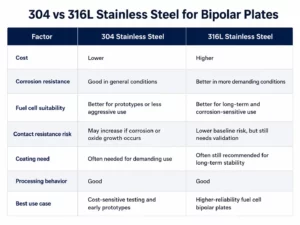
The table shows a simple pattern. 304 helps control cost, while 316L offers better corrosion resistance.
But material grade alone does not decide final performance. Even a good stainless steel bipolar plate material can fail if the flow channels have burrs, stress, poor flatness, or unstable coating quality.
This is where the manufacturing method becomes important.
Manufacturing Process Matters as Much as Grade Selection
Stainless steel bipolar plates need accurate channels and stable surfaces. The channel geometry affects gas flow, water removal, and stack assembly.
The manufacturing route can change the final plate quality. It can affect burrs, mechanical stress, flatness, and coating behavior.
For this reason, bipolar plate manufacturing should not be treated as a separate topic from material selection.
A good grade needs a suitable process. A good process also helps both 304 and 316L perform more consistently.
For a full process overview, you can also read this guide to the bipolar plate manufacturing process.
Limitations of Stamping and Hydroforming for Stainless Steel Bipolar Plates
Stamping and hydroforming are common methods for metal bipolar plate production. They can be efficient for high-volume parts.
But these methods use mechanical force. That force can introduce stress, work hardening, deformation, and burr risk.
Burrs near channel edges can affect sealing and assembly. Mechanical stress may also influence plate flatness and surface condition.
These risks can appear in both 304 and 316L. Choosing 316L does not remove the need for careful process control.
How Photochemical Etching Supports Both 304 and 316L
Photochemical etching is a strong manufacturing option for stainless steel bipolar plates that require clean channels, low burr risk, and complex flow field designs. Because the process uses chemical removal instead of mechanical force, it helps reduce stress on thin metal parts and supports smoother channel surfaces for later coating.
For prototype development, etching also offers good flexibility. Photo tooling allows faster design changes without the cost and delay of hard dies. TMNetch can process thin metal sheets and support precision etched bipolar plate prototypes based on your drawing, material, thickness, channel depth, and coating requirements.
In real production, these advantages depend on process control. TMNetch works with thin and mid-range metal sheets from 0.01 mm to 2.5 mm, with maximum part sizes up to 600 × 1500 mm. For suitable designs, fine features can reach ±0.025 mm, while general tolerance is usually related to material thickness. For bipolar plate projects, our team can also support half-etching, full-etching, double-depth channel etching, and double-sided etched structures. This allows engineers to test different channel depths, coating plans, and stainless steel grades before moving into volume production.
Not sure whether 304 or 316L is right for your bipolar plate fuel cell project? Share your design with TMNetch for a technical review before prototype production.
Decision Framework: Which Grade Fits Your Application
The best bipolar plate material depends on your actual design and use conditions.
Choose 304 when cost matters most and the project is still in early testing. It can be a practical choice for prototypes and less demanding applications.
Choose 316L when corrosion resistance and long-term stability are more important. It is often the safer direction for PEM fuel cell projects and other demanding fuel cell environments.
Prototype both when the answer is not clear. Testing both grades with the same etched flow field can help your team make a data-based decision.
For custom fuel cell bipolar plates, the most reliable path is to match material grade, flow field design, coating plan, and manufacturing route before sampling.
Final Thoughts
304 and 316L can both be used in stainless steel bipolar plates, but they fit different project needs.
304 is more cost-effective and useful for early prototypes or less demanding conditions. 316L usually offers better corrosion resistance and is often preferred for long-term fuel cell use.
Still, material grade is only one part of the final result. The bipolar plate manufacturing process also affects burrs, stress, channel accuracy, flatness, and surface quality.
For many fuel cell projects, the most reliable approach is simple: produce the same flow field in both grades, test real samples, and choose based on data.
FAQs
Can photochemical etching produce both 304 and 316L bipolar plates?
Yes. Photochemical etching can produce 304 and 316L stainless steel bipolar plates with fine flow channels, clean edges, and low mechanical stress. It is especially useful when the design needs quick prototype changes.
Is 316L better than 304 for stainless steel bipolar plates?
316L usually provides better corrosion resistance than 304. It is often preferred for demanding fuel cell environments. However, the best choice also depends on coating, contact resistance, cost, and service-life targets.
What are metallic bipolar plates used for?
Metallic bipolar plates are used in fuel cells and electrolyzers to conduct current, separate cells, distribute gases or liquids, and help manage heat and water inside the stack. Their flow channels guide hydrogen, oxygen, air, or process fluids across the active area.