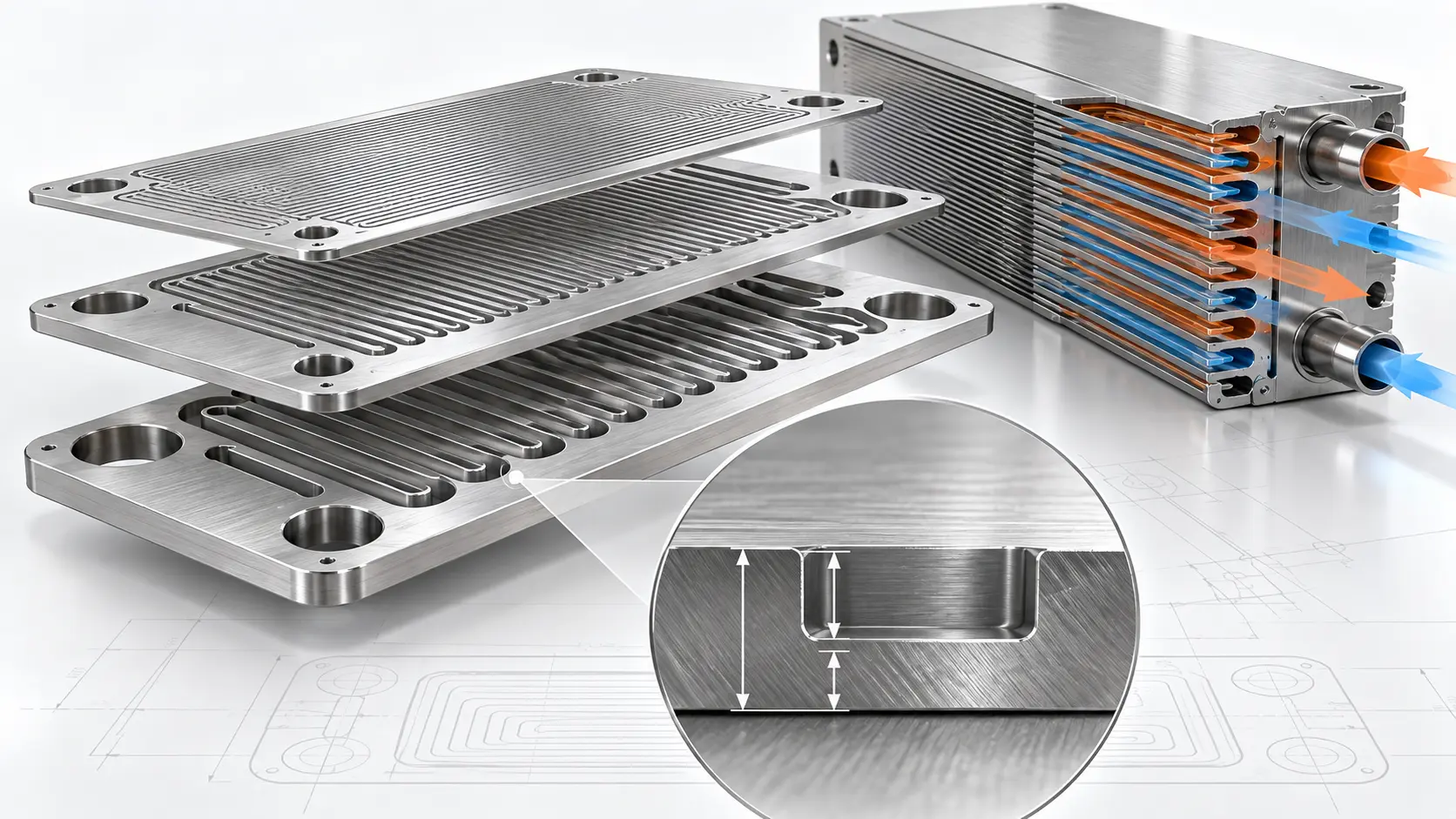

Electrolyzers and fuel cells rely on thin, engineered plates that do more than provide structure.
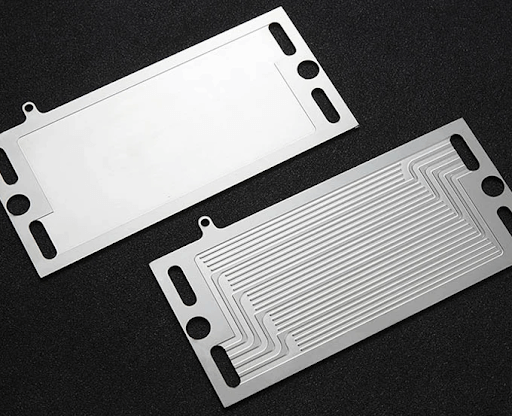
The bipolar plate manufacturing process produces bipolar plates that play a key role in a fuel cell stack. Bipolar plates guide gases, conduct electricity, and help control heat.
One fuel cell system may use thousands of bipolar plates. Because of this, even small production changes can affect performance, service life, and total cost.
Making bipolar plates is not simple. Each plate must have accurate dimensions and work in a harsh environment. For PEM fuel cell bipolar plates, DOE technical targets include cost, gas leakage, corrosion, electrical conductivity, surface resistance, strength, and forming ability.
These targets show that bipolar plate quality is not only about shape. It also depends on how well the plate performs in real fuel cell conditions.
This guide explains the complete bipolar plate manufacturing process for metallic bipolar plates, graphite bipolar plates, and composite bipolar plates. It also compares four metallic forming methods: stamping, hydroforming, deep drawing/spinning, and photochemical etching.
Bipolar Plate Manufacturing Process
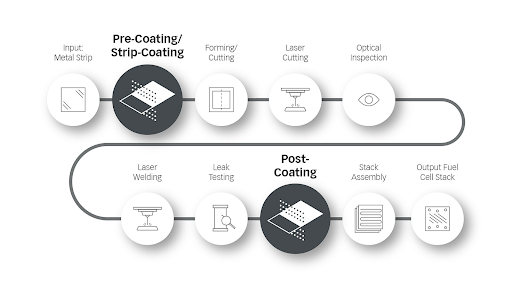
The bipolar plate manufacturing process turns raw metal into special parts for fuel cells and electrolyzers. It includes several steps, such as material preparation, forming, surface treatment, and inspection. The steps involved are discussed below in more detail.
1. Material Selection
The process begins with identifying the raw material to utilize. Bipolar plates can be grouped into three major material families: metal, graphite, and composite. Choosing the right bipolar plate material requires comparing conductivity, corrosion resistance, mechanical strength, plate thickness, manufacturing method, and project cost. Each material family has a different process route and cost logic. The raw material should match the application needs. Engineers may choose a material for higher conductivity, better corrosion resistance, or lower weight.
- Stainless steel is the common choice as a construction material. Metal bipolar plates are often used in automotive and high-power fuel cell systems. Metals are strong, transfer heat well, and can be made into thin sheets. Stainless steel 316L is a common choice. It is easy to form, resists corrosion, and helps control production cost. Stainless steel provides a balance between strength and conductivity.
- Titanium and specialty alloys are also used for bipolar plates in highly corrosive environments. They offer better corrosion resistance, but the raw material and processing costs are higher.
The choice in the base construction material will establish the performance baseline for all of the plates in the stack.
2. Coating Methods
Coatings can improve corrosion resistance and help maintain low interfacial contact resistance, but bipolar plate coating performance also depends on surface cleanliness, flow-channel quality, edge condition, and pre-coating preparation. This means electricity can pass more easily between the bipolar plate and nearby stack parts.
For metallic bipolar plates, the coating must protect the base metal without reducing electrical conductivity.
Suggested source: https://www.energy.gov/cmei/fuels/doe-technical-targets-polymer-electrolyte-membrane-fuel-cell-components
There are two well-established ways to add coatings to bipolar plates:
Pre-coated Material Rolls
In this method, the metal strip is coated before forming, stamping, etching, or welding. The coated strip is usually processed in a roll-to-roll coating system.
Common pre-coating methods include roll-to-roll PVD coating, carbon-based coating, DLC coating, and conductive polymer coating. DLC means diamond-like carbon. Some suppliers also treat the coil surface before forming. They may use electrochemical surface treatment or apply a thin metal coating to the coil material.
Pre-coating supports high productivity and lower coating cost per part. However, the coating must withstand later forming, embossing, or joining steps without cracking, peeling, or losing conductivity.
Post-coated Bipolar Plates
In this method, the coating is applied after the bipolar plate has been fully formed. This means the flow channels, ports, edges, and joining areas are already completed before coating.
Common post-coating methods include PVD sputtering, DLC coating, electroplating, electroless plating, CVD or PECVD carbon coating, spray coating, dip coating, and conductive polymer composite coating. For high-performance fuel cell stacks, post-coating is often used after forming. It can provide better surface coverage on flow fields, channel areas, and cut edges.
Post-coating can provide more complete protection for the finished geometry. However, it usually has higher process complexity, higher cost, and stricter requirements for coating uniformity inside flow channels.
The choice between pre-coating and post-coating depends on the bipolar plate material, channel design, production volume, cost target, and durability requirements.
The pre- or post-coating method will depend on the costs, design, or durability requirements of the bipolar plates.

3. Defining Geometry
Flow field geometry can also be adjusted for the individual design of the cell. This will be an iterative process and will depend on;
- Patterns of gas distribution,
- Cooling requirements,
- Stack integration with membranes, seals, and diffusion layers.
Geometry is the most critical aspect associated with bipolar plates, as it can affect power density.
4. The Forming Process
For metallic bipolar plates, flow channel forming is the core manufacturing step. The right method depends on flow field complexity, sheet thickness, tolerance, prototype speed, and production volume.
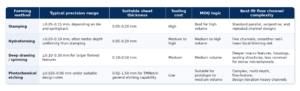
Photochemical Etching for Complex and Prototype Bipolar Plates
Photochemical etching uses photoresist imaging and controlled chemical removal to form channels and features on thin metal sheets. Since it does not require hard tooling, engineers can adjust the flow field design through digital tooling instead of making a new die.
This makes etching suitable for R&D plates, low-volume production, complex flow fields, and multi-depth designs. The process can support stainless steel, titanium, and nickel alloy bipolar plates with fine channels, manifold features, and controlled partial-depth areas.
Based on TMNetch production capability data, suitable designs can reach ±0.05 mm precision, and urgent prototypes may be completed in as fast as 6 hours after manufacturable drawings are confirmed.
Photochemical etching supports more flexible plate designs. It can create multi-depth features and sealing grooves for laser welding. It also works with different coatings on each side of the plate. For example, one side may use platinum coating, while the other side uses MMO coating. MMO means mixed metal oxide. This is useful when each plate surface has different electrochemical or contact requirements.
Stamping for High-Volume Metallic Bipolar Plates
Stamping uses matched dies and mechanical force to form flow channels in thin metal sheets. It is suitable for stable designs and high-volume metallic bipolar plate production.
Its key advantage is fast cycle time after die qualification. However, tooling cost is high, and design changes may require die modification or a new die. Stamping can also cause forming stress, local thinning, springback, and burrs, so material selection, die design, lubrication, blank holding force, and inspection must be well controlled.
Hydroforming for Fine Channels and Depth Control
Hydroforming uses fluid pressure to press thin metal sheets into a die cavity. Compared with rigid stamping, it applies pressure more evenly and can improve dimensional accuracy for fine microchannels.
This process works well for thin stainless steel plates. It is also useful when the flow field needs smoother channels and better depth uniformity. However, it has some limits. The equipment cost is higher, pressure control is more complex, and the cycle time is longer than simple stamping.
Deep Drawing and Spinning for Deeper Formed Features
Deep drawing and spinning are less common for dense PEMFC microchannel arrays. They are more suitable for deeper macro features, circular or shell-like geometries, or special sealing and manifold structures.
Deep drawing can achieve greater forming depth but may cause wrinkling, thinning, or tearing. Spinning is mainly used for axisymmetric parts, so its use in standard rectangular bipolar plates is limited. Procurement teams should consider these methods only when the design requires deeper features that stamping, hydroforming, or etching cannot produce efficiently.
Choosing the right forming method is a balancing act of cost and performance requirements.
For a deeper side-by-side analysis of each method, including cost, production volume, design flexibility, and material compatibility, read our full guide on bipolar plate manufacturing process comparison. It can help engineering and procurement teams choose the most suitable process before starting prototype or mass production.
5. Cutting and welding
Once the plates have been formed, they must now be cut and connected:
- Laser cutting creates burr-less edges – critical for function once in operation for extended periods of time.
- Laser welding connects multiple plates with very fine tolerances to ensure that the stacks are free of leaks, and reliability is guaranteed.
- Straighten, clean, and seal
There are additional steps to ensure the final product is at its best:
- Straightening is the process of removing any warpage or stresses placed on the substrate during forming.
- Cleaning is how the plates will perform with regard to chemical and electrical stability.
- Sealing – usually with screen printing, injection molding, or dispensing will complete the plates for assembly into stacks.
6. Leak Testing
The plates are leak tested – from differential testing to helium leak detection, every possible metric to ensure reliability in function will occur.
The metal plate manufacturing process allows for simply manufactured parts, but bipolar plate manufacturing allows for tighter tolerances and very specific treatments of the end use. Overall, these steps help to produce components that contribute to a clean energy system with performance and longevity.
Importance of Bipolar Plates
Bipolar plates account for almost half of a fuel cell stack’s cost and up to 80 % of its weight. When you’re designing a bipolar plate, obviously, you can’t just focus on the weight; they’re doing more than occupying space between cells—they’re providing important functions such as:
- Gas management: distributing hydrogen and oxygen evenly over each of the electrodes, transporting water out of the stack, and moderating the stack temperature.
- Electrical continuity: conducting current from cell to cell in an effective manner to generate power.
- Structural support and sealing: holding the membrane-electrode assemblies together and sealing the stack from contaminants.
These functions mean that even small changes that improve the design or manufacture a bipolar plate can increase power density, decrease losses, improve the lifetime of the system, so every design or engineering decision, from materials to channel patterns, is very important.
TMNetch Bipolar Plates
TMNetch is a specialized manufacturing company that uses advanced techniques to make high-performing bipolar plates. TMNetch’s bipolar plate manufacturing process extends beyond basic fabrication. They have 100+ engineers and chemists focused on developing etching technology with tighter tolerances and finer detail. Here are the notable benefits:
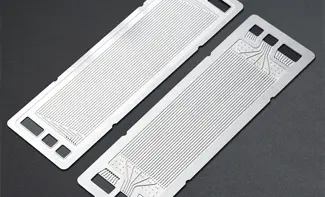
- Custom Etching with Multi-Depth Channel Design
TMNetch is able to photochemically etch flow channels and surface designs of varying depths, such as 0.6 mm and 0.4 mm on one side, as well as 0.5 mm on the other side, allowing for precise control of fluid and gas distribution.
- Unique Coating Abilities
The plate can have one side plated with platinum and the other side has an MMO (mixed metal oxide) coating. This dual-coating enhances performance and corrosion resistance.
- Laser-Welded Seal for Leaking-Free Assembly
TMNetch laser welds sealing grooves that are thin, smooth, and flush. This is important for reliable leak-free stacks.
- Fast Prototyping with Consistent Precision
Need designs tested quickly? TMNetch can supply prototypes within 6 hours and maintain tolerances of ± 0.05 mm.
- Qualified Personnel and Global Presence
Their custom bipolar plates are shipped with full documentation and COC support internationally with no problem for export/import.
FAQs About Bipolar Plate Manufacturing Process
How to make a bipolar plate?
Bipolar plates are made using techniques such as photochemical etching, forming, coating, and sealing. The bipolar plate manufacturing processes established the flow fields, enabled corrosion protection, and completed preparation for stacking.
What are bipolar plates made of?
The most widely used materials for bipolar plates include stainless steel, titanium, graphite, and composites. Metal bipolar plates are often chosen based on strength and conductivity, while other coatings are chosen to enhance durability for demanding PEM or alkaline applications.
What manufacturing processes are used for plates?
Bipolar plates manufactured from metal faced a variety of choices in processing methods that could include photochemical etching, stamping, hydroforming, or deep drawing. In contrast, photochemical etching offers precision and flexibility.
How does a bipolar plate work?
A bipolar plate separates and connects adjacent fuel cells while separating the gases. The distribution of the hydrogen and oxygen is achieved through flow channels in the plates. There are coatings that prevent corrosion and ensure conductivity. The bipolar plates help maintain stack efficiency by directing current and controlling heat and water.
Conclusion
The bipolar plate manufacturing process depends on material choice, forming method, coating design, joining method, and quality control. Metallic plates provide the best path toward thin, compact, high-power-density stacks, but they require precise forming, corrosion-resistant conductive coatings, and reliable welding. Graphite plates offer strong chemical stability but are thicker and more brittle. Composite plates provide a middle path, but long-term reliability still requires careful validation.
For R&D teams, the best first step is usually a manufacturable prototype process that allows design changes without expensive tooling. For mass production teams, the focus shifts to die life, cycle time, coating consistency, welding yield, and leak test automation.
A strong bipolar plate supplier should not only make the plate shape. It should understand how channel geometry, coating, sealing, and inspection affect the final PEM fuel cell stack.