
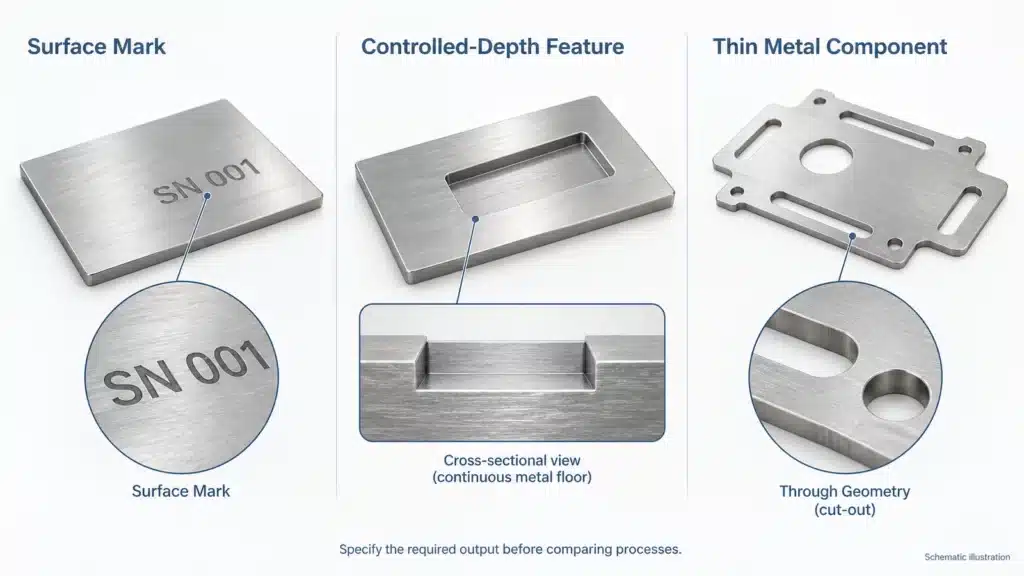
Choose between chemical etching and laser etching by defining the result: a surface mark, a controlled-depth feature, or a thin metal part. Compare the processes for the same task, material, finish, and acceptance criteria. A drawing with through-holes or an outside profile needs a manufacturing assessment, separate from a surface-marking assessment.
Some projects need both geometry and identification. Others need only a fixed pattern on an existing surface.
This guide focuses on industrial metals. It explains chemical surface etching, photochemical part manufacture, and laser marking or engraving. A clear specification also makes quotations for chemical etching services easier to compare.
Chemical Etching vs Laser Etching: Quick Comparison
Start with the required output. This prevents a common mistake: comparing the accuracy of a manufactured component with the appearance of a logo.
| Your required result | Processes to evaluate | What to specify | Acceptance priority |
|---|---|---|---|
| Text, a logo, or a code on an existing metal surface | Chemical surface etching and suitable laser marking | Content, size, location, alloy, and final finish | Legibility, placement, surface condition, and required durability |
| A recess with a specified depth | Suitable chemical etching and laser engraving | Geometry, depth, material, and permitted surface change | Depth, dimensions, edge condition, and functional impact |
| A thin profile, through-hole, slot, or functional pattern | Photochemical etching and relevant manufacturing routes | Drawing, thickness, smallest features, and tolerances | Part geometry, edge quality, and consistency |
| Part geometry plus identification | An appropriate single route or combined operations | Component drawing, identification requirements, and process order | Both requirements met in the final delivery condition |
Do not select a process from its name alone. Ask what happens to the metal and what the supplier will inspect.
Laser Marking, Etching, and Engraving: What Do the Terms Mean?
Chemical Etching and Photochemical Etching
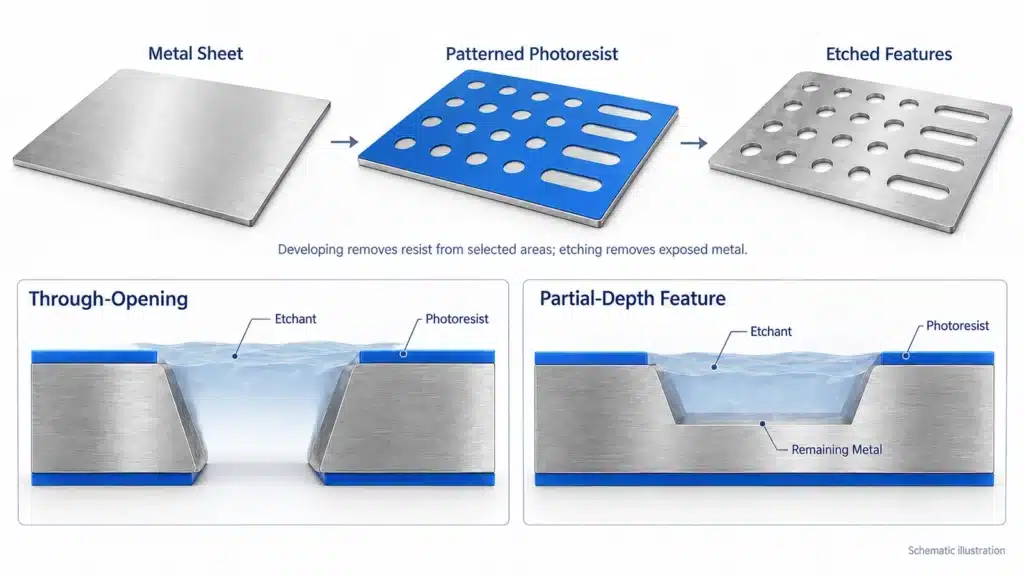
Chemical etching removes exposed metal through a chemical reaction. A protective pattern controls where removal occurs.
Photochemical etching uses a light-sensitive coating, called photoresist, to define that pattern. The industry also uses the terms photo etching and photochemical machining for this manufacturing approach.
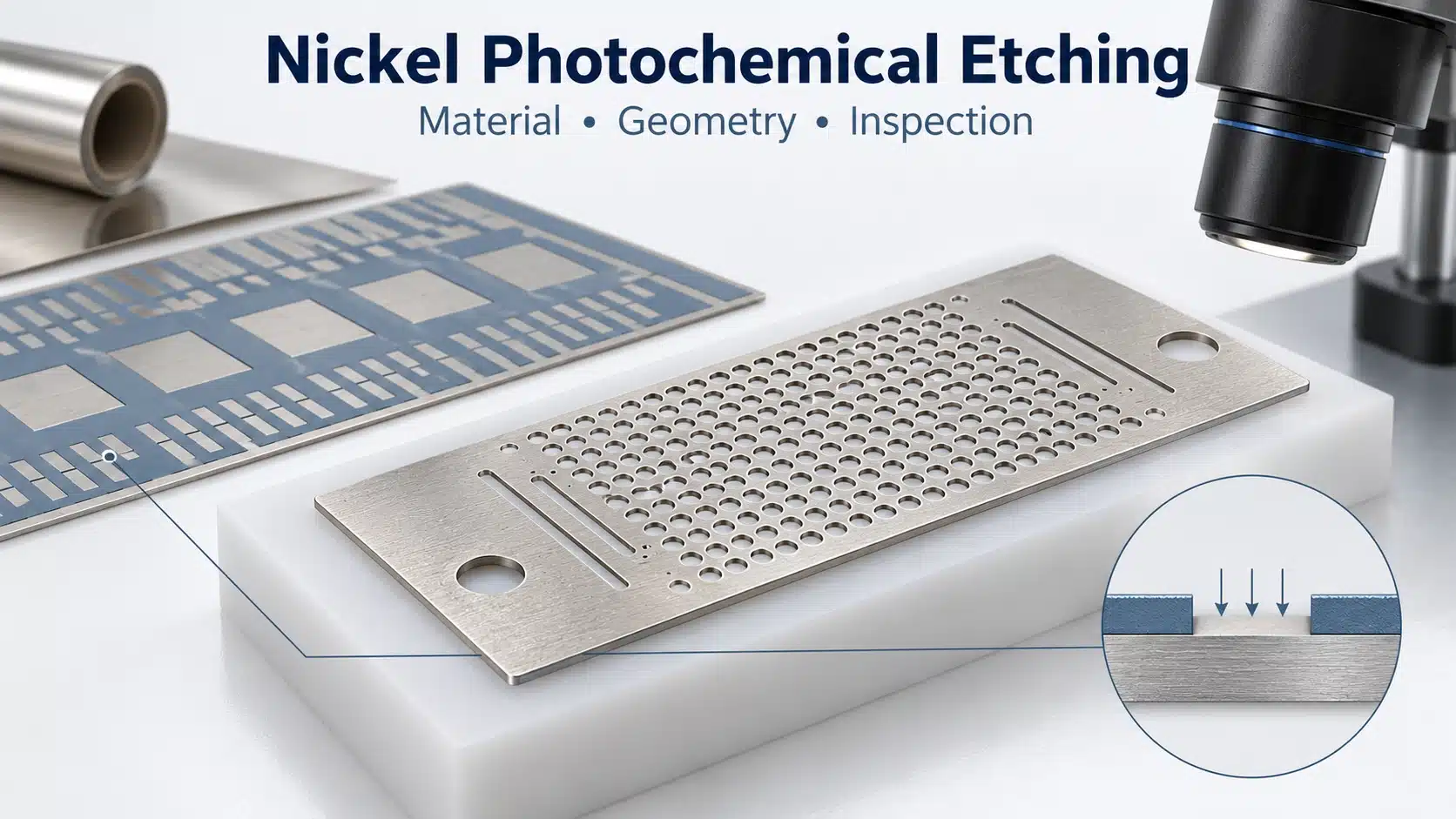
The pattern may define surface lettering, partial-depth features, or the geometry of a thin metal part. Chemical etching is therefore relevant to both surface designs and component manufacture. Our photochemical etching overview explains the process.
Laser Marking as the Broader Category
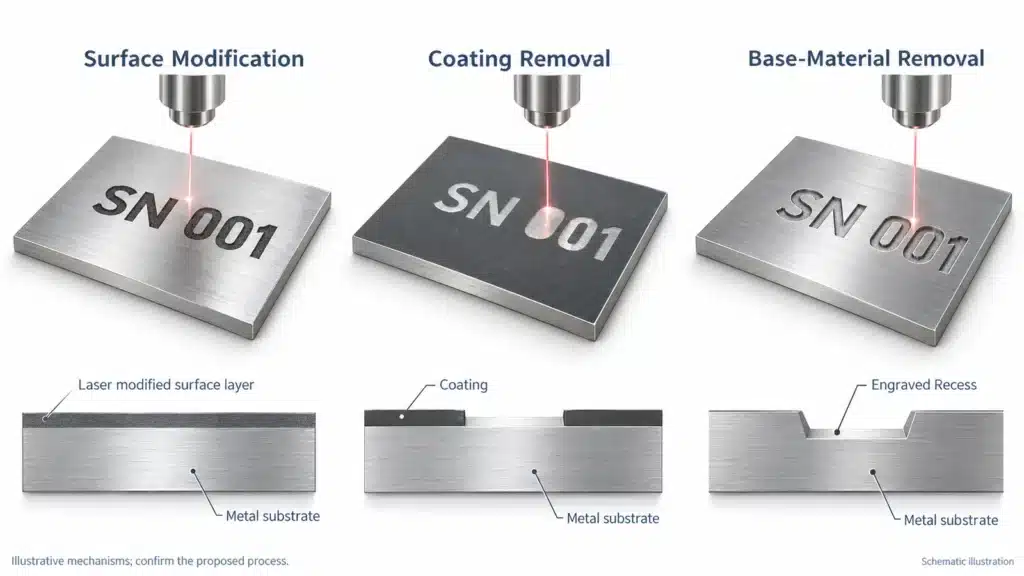
Laser marking describes a group of processes that create information on a surface. The result may come from changing the surface, removing a coating, or removing base material. A request for “laser marking” should therefore name the required result, rather than assume one fixed mechanism.
What “Laser Etching” Means in This Guide
Suppliers do not always use laser etching in the same way, laser etching refers to a specified surface-marking or shallow-texturing task. Ask whether the proposed process changes contrast, changes surface texture, or removes material. Specify the result instead of relying on an assumed universal depth limit.
Laser Engraving and Material Removal
Laser engraving removes material to form a depression. Greater depth may require repeated processing. Depth capability needs confirmation for the actual material, geometry, equipment, and surface requirements.
Compare Chemical Etching and Laser Processing for the Same Surface Task
Fixed Designs, Variable Data, and Mark Location
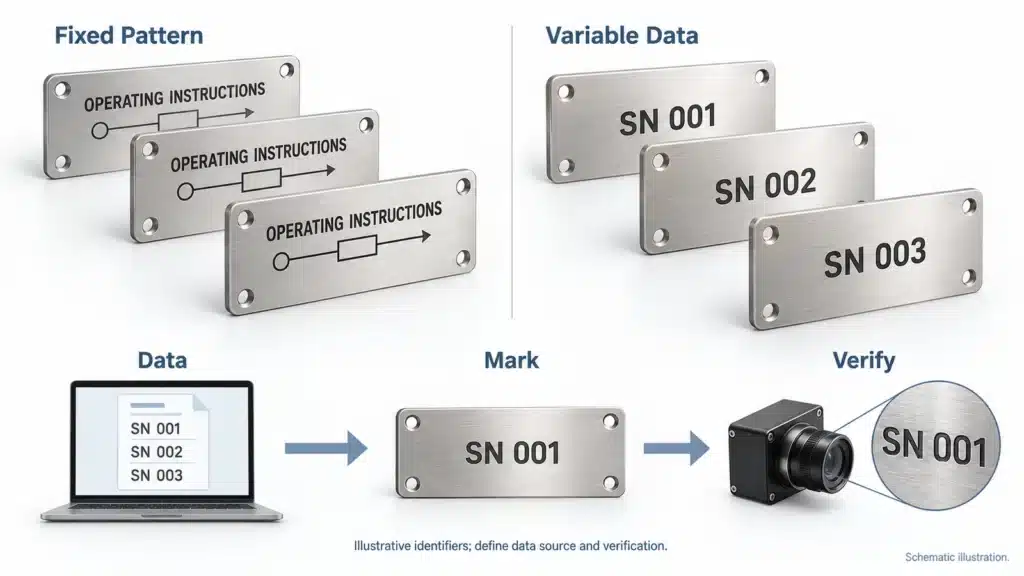
First, identify whether every part carries the same image. A fixed instruction panel and a unique serial number create different production requirements.
For a repeated chemically etched pattern, review how the mask or artwork will be prepared and reused. For changing identifiers, a digitally updated laser process is a candidate to evaluate. Confirm that the proposed system can change, position, and verify the data for each part.
Neither a readable sample nor the ability to mark a number proves that a complete traceability workflow exists. Define who supplies the data and how the process prevents duplicate or incorrect identifiers.
Also specify the mark’s location, orientation, and permitted area. Curved surfaces, restricted access, and locating features belong in the quotation.
Surface Contrast or a Defined Engraving Depth?
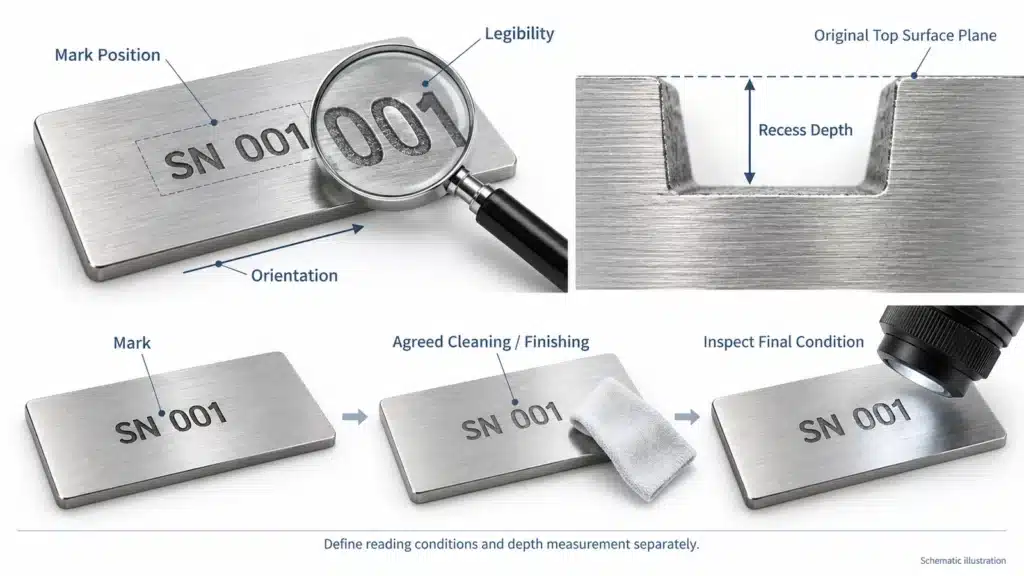
Decide whether the requirement is visible information or a measured recess. A dark, readable character does not establish engraving depth.
When comparing chemical etching vs laser engraving, keep the design, material, target depth, and final finish consistent. Ask each supplier to explain how those requirements will be measured.
Identify any contact, sealing, or bonding surfaces where alteration is restricted. State the allowed surface condition rather than asking for “high precision” without a measurement.
Readability, Durability, and Sample Approval
Approve the mark after the agreed finishing and cleaning sequence. For machine-readable codes, use the specified reading or verification conditions.
NASA’s laser marking and engraving specification, for example, links approval to representative material, finish, mark dimensions, and legibility. Its requirements apply within the specification’s stated project scope.
Consider an industrial nameplate with fixed operating instructions and a changing serial number. Compare proposals using the same character size, finish, and legibility requirement. Then check how the changing number will be produced and verified.
For chemically etched metal labels, include any specified filling or protective finish in the approval. For either route, define the cleaning, abrasion, or service exposure the project requires.
“Permanent” should describe a validated result under stated conditions, rather than replace a durability requirement.
When You Need Metal Part Geometry or Both Geometry and Identification
Profiles, Through-Features, and Partial-Depth Features
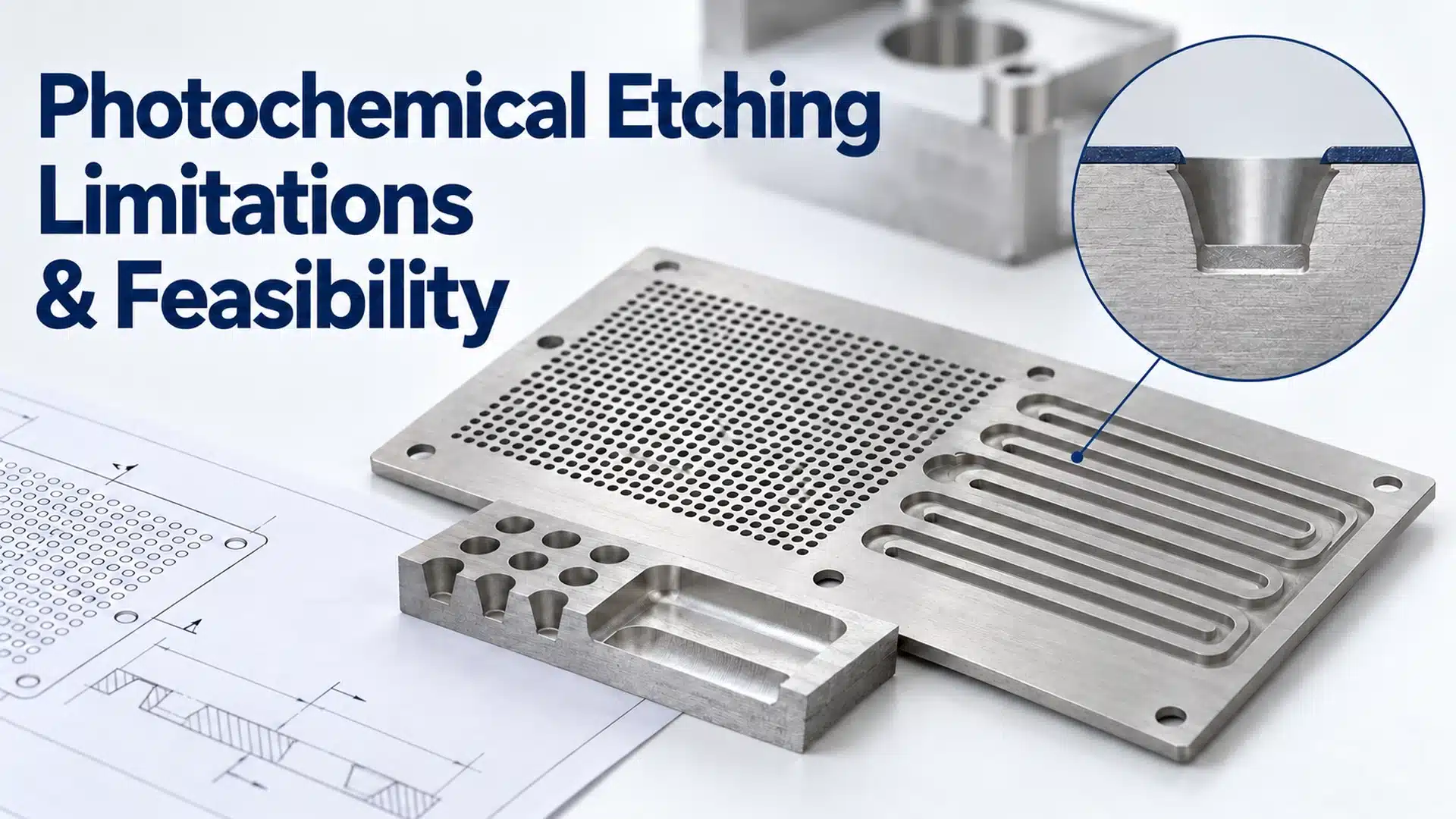
A thin shield, filter, or custom metal component has geometry that must fit its application. Specify the material grade, thickness, holes, slots, feature positions, and any partial-depth areas.
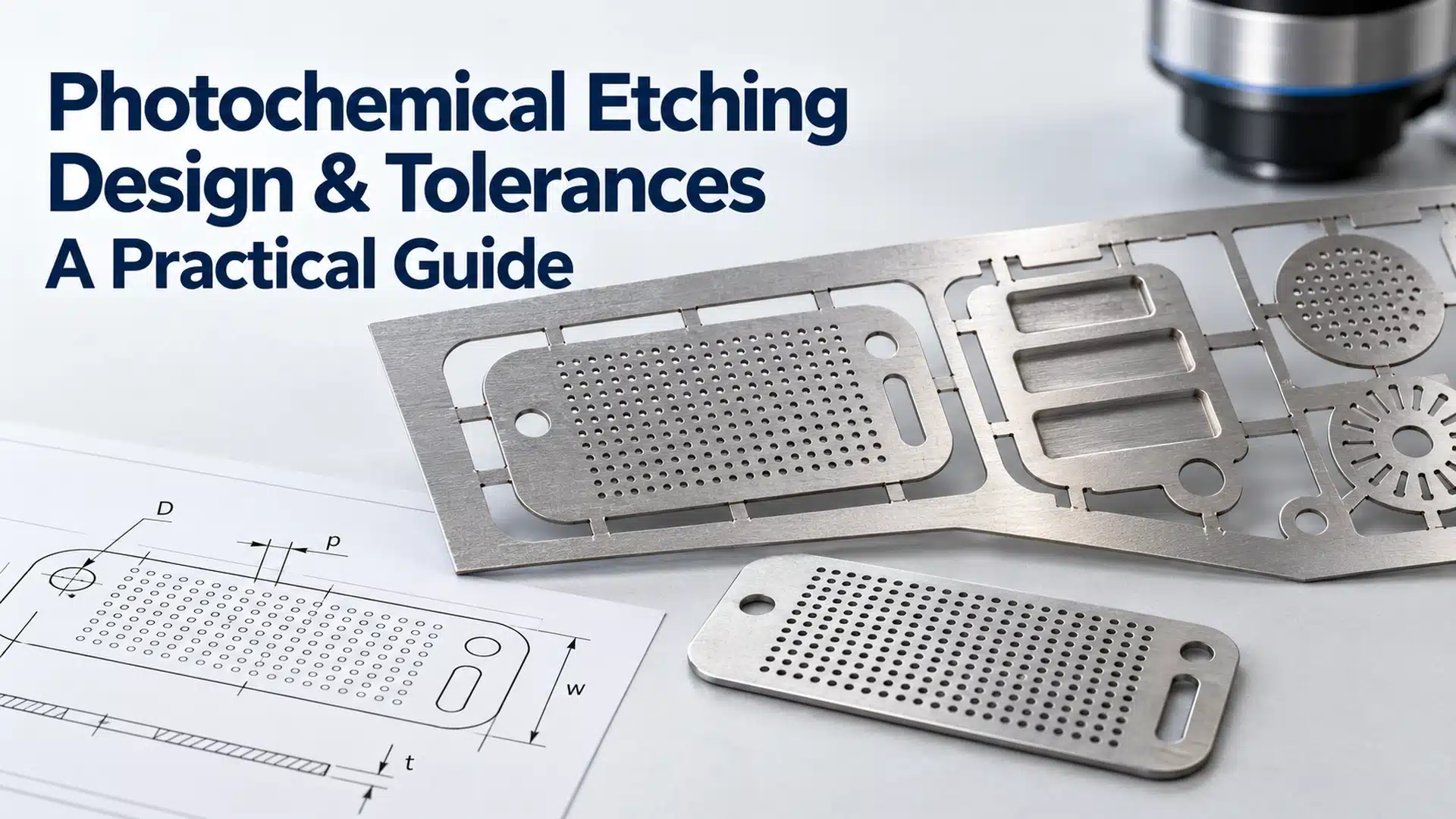
Identify the smallest openings and the narrow metal bridges between them. Mark critical assembly features separately from noncritical edges. Ask the supplier to assess the complete feature pattern before committing to a tolerance.
For partial-depth areas, state both the target depth and how it will be checked. Surface information and functional recesses may require different inspection methods.
Metal chemical etching is one route to evaluate for suitable thin components. A clear drawing makes that assessment more useful than a general request for an intricate part.
Laser cutting belongs to the geometry-manufacturing comparison when the task is to produce a through-profile or opening. Review the relevant chemical etching vs laser cutting comparison for that decision.
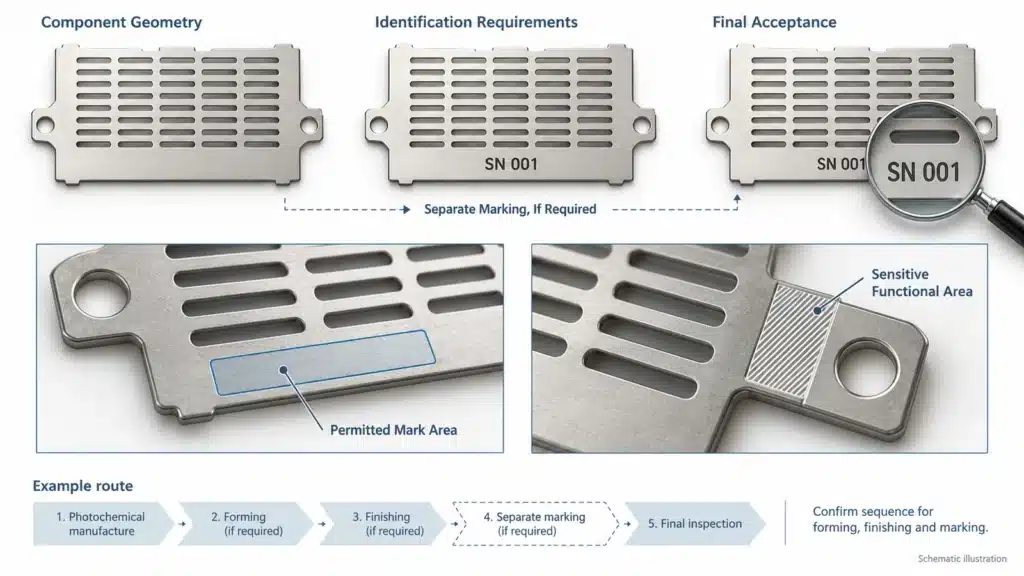
Combining Etched Geometry with Identification
Define geometry and identification as separate requirements, even when one route may produce both.
A fixed identifier may be evaluated within an appropriate chemical etching design. A separate laser marking operation may be useful when identification requirements call for another approach. Confirm the proposed route rather than automatically adding an extra process.
Agree on the sequence of forming, finishing, marking, and inspection. A mark approved before a later coating or surface operation may not represent the final result.
Place both requirements on the drawing or linked specification. Name who approves the finished component and its identification.
Production Time and Cost: Compare the Complete Job
Setup, Processing, and Inspection Time
Separate one-time preparation from repeated production work. Chemical processing may require artwork and pattern preparation; laser processing may require programming and fixtures.
Then compare loading, processing, cleaning, finishing, inspection, and handling. A short marking cycle does not establish the time needed to deliver an accepted batch.
For a repeated surface design, include the number of parts handled per operation. For unique identifiers, include data changes and verification. For deeper features, ask how the required removal affects processing time.
During prototyping, compare the lead time for an approved result. During production, compare sustained throughput for the actual part mix and inspection plan.
Neither batch size alone nor the word “laser” determines the faster route. Ask suppliers to explain the workflow behind their delivery estimate.
Cost per Accepted Part or Accepted Mark
Align the specifications before comparing quotations. A price for manufacturing a complete contact does not cover the same output as a price for adding identification to one.
Use the same quantity, material, finish, inspection, packaging, and delivery requirements. Include preparation, processing, post-treatment, rejects, and transport.
Keep equipment investment separate from outsourced delivery cost. For an in-house route, include staffing, maintenance, support systems, and expected utilization. For outsourcing, confirm what the quoted scope includes.
A repeated design, efficient sheet layout, and an agreed finishing route make chemical etching worth quoting as a cost-effective alternative. Check cost per accepted unit against a comparable quotation before choosing the route.
Our photochemical etching cost guide explains the inputs needed for a manufacturing cost review.
Material and Finish Requirements
Specify the Alloy and Final Surface Condition
Give the supplier the alloy grade and relevant material condition. For a thin component, include thickness; for surface work, identify the surface that will actually be processed.
State whether the workpiece is bare, plated, coated, polished, or otherwise finished. Include any treatment planned after etching or marking.
Ask for approval evidence that matches this condition. A result demonstrated on untreated stock does not confirm the result after a different finish.
Material suitability also includes the feature design and required surface outcome. Avoid applying one published capability value to every grade and geometry.
Aluminum Example: Use the Material-Specific Guide
An aluminum housing that needs a serial number has a different task from a thin aluminum component with openings. Start by identifying which output is required.
For surface identification, provide the alloy, final finish, mark content, location, and reading conditions. For part manufacture, provide thickness, geometry, critical dimensions, and downstream operations.
If both are needed, agree on the full sequence and approve the final condition. Do not choose from the word “aluminum” alone.
Our laser etching aluminum vs chemical etching guide develops that material-specific assessment.
FAQs About Chemical Etching and Laser Etching
Is Laser Etching the Same as Photo Etching?
No. Photo etching uses an imaged resist pattern and chemical metal removal. Laser etching refers to laser surface processing, with its exact meaning varying between suppliers.
Both may be considered for some surface tasks. Specify the intended result before comparing them, especially when the project involves a functional metal component.
Is Chemical Etching More Precise Than Laser Etching?
There is no useful universal answer. Define whether precision means a part dimension, recess depth, mark position, or readable code.
Compare evidence for the same workpiece and acceptance conditions. A supplier’s general accuracy claim does not establish performance for your drawing or final surface.
Is Laser Etching the Same as Laser Cutting?
No. Surface marking or texturing creates a feature on an existing workpiece. Laser cutting creates a through-cut profile or opening.
If your task requires that geometry, use a manufacturing-route assessment rather than a marking comparison. For a defined cutting project, provide the drawing and material requirements to the laser cutting service team.
Can Chemical Etching and Laser Processing Be Combined?
Yes, where the two operations address defined project requirements. Chemical etching may produce geometry, while a suitable laser operation adds identification.
Confirm the processing order, surface condition, mark location, and final inspection. Also confirm the actual supplier scope before assuming every step is available within one facility.
Share Your Drawing or Marking Specification
For a chemically etched component or surface design, share your requirements with TMNetch’s chemical etching team:
- Drawing or marking artwork;
- Material grade, thickness or workpiece condition, and final finish;
- Critical geometry, tolerances, or mark location and depth;
- Quantity and required delivery date;
- Inspection and acceptance requirements.
Identify any requested laser operation as marking, engraving, or cutting. This lets the project review address the correct task and confirm the appropriate manufacturing and service scope.