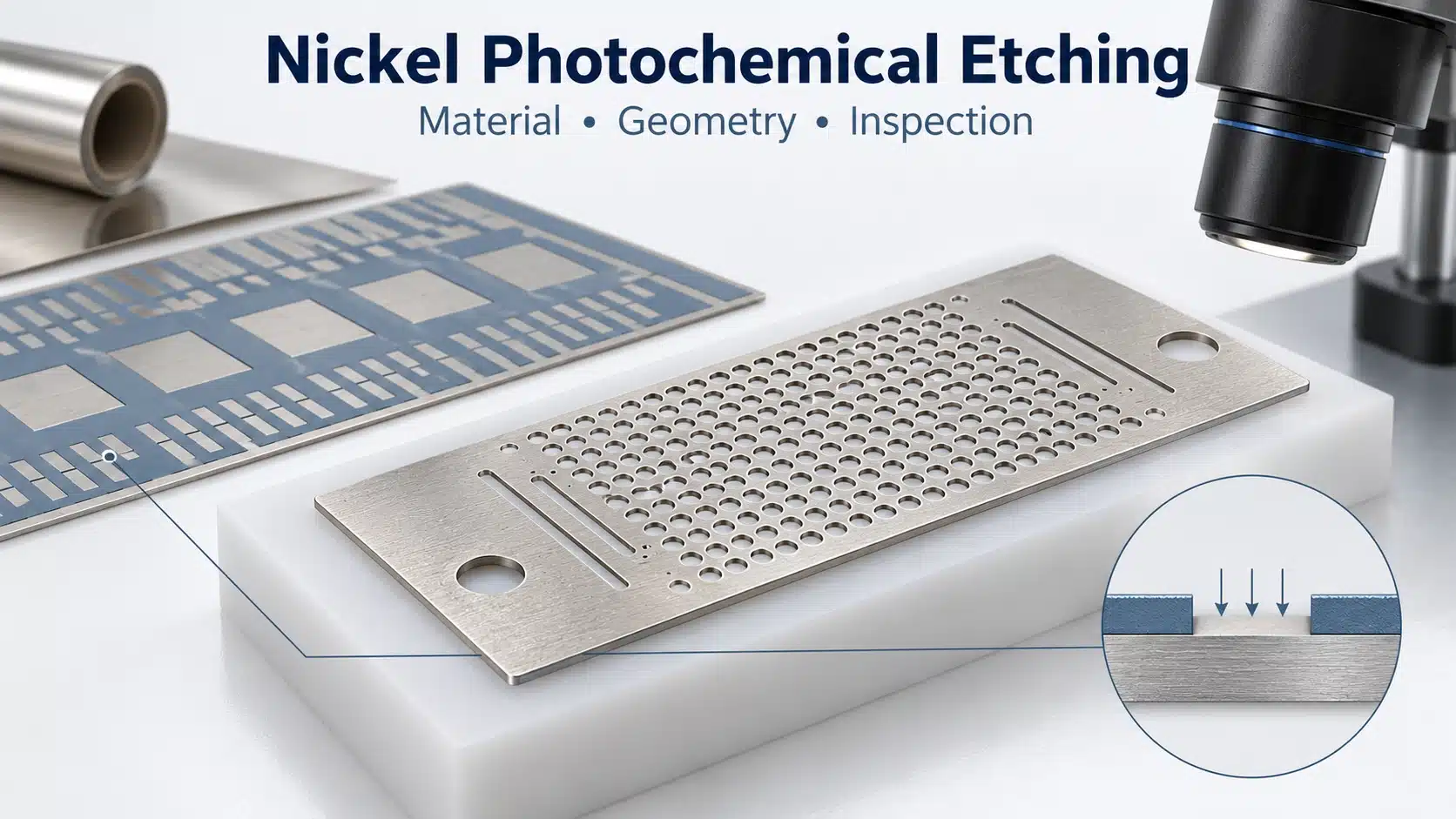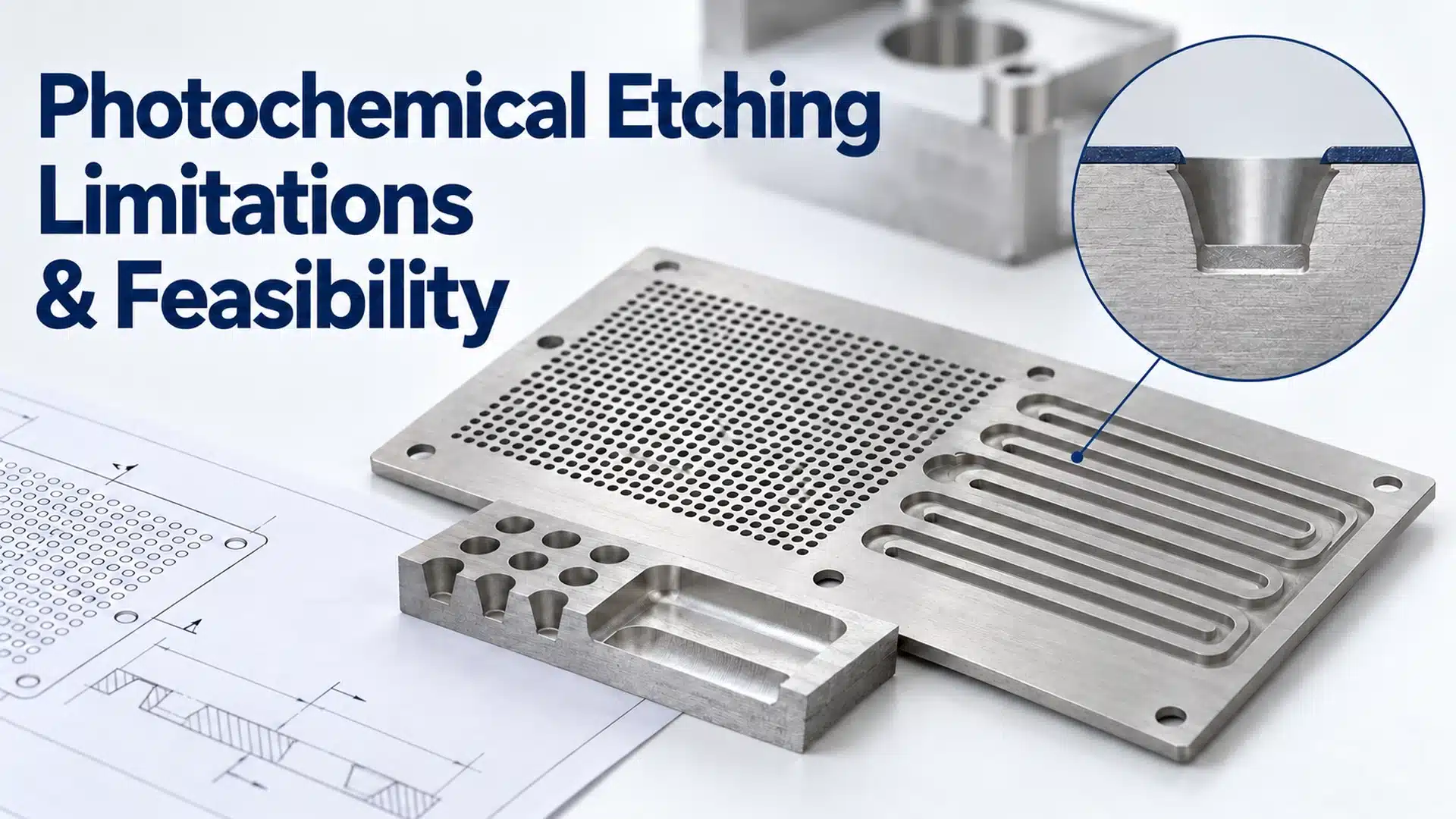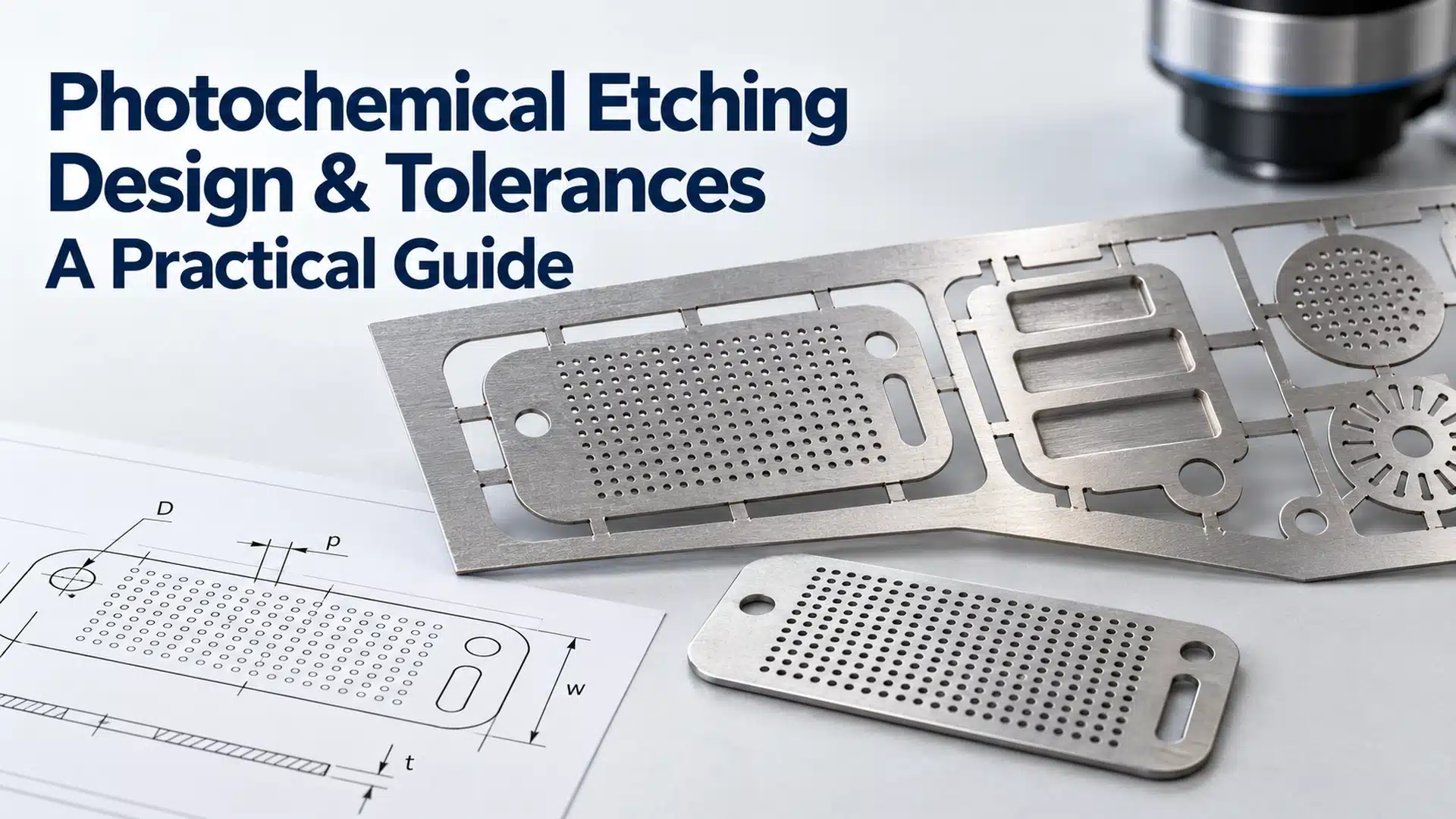

Nickel photochemical etching produces patterned components by removing selected areas of metal from sheet or foil. The first project decision is identifying the material: commercially pure nickel, a specific nickel-base alloy or another alloy containing nickel. Review its supplied condition, surface and critical features before agreeing tolerances or approving samples.
This guide explains what to confirm at each stage, from the material certificate to finished-part inspection.
Key Takeaways
- Identify the exact grade; pure nickel, nickel-base alloys and nickel silver belong to different material groups.
- Specify material condition, thickness and incoming surface together.
- Review critical features and final functional requirements alongside the etching process.
- Confirm tolerance, finishing and delivery requirements for the actual project.
What Is Nickel Photochemical Etching?
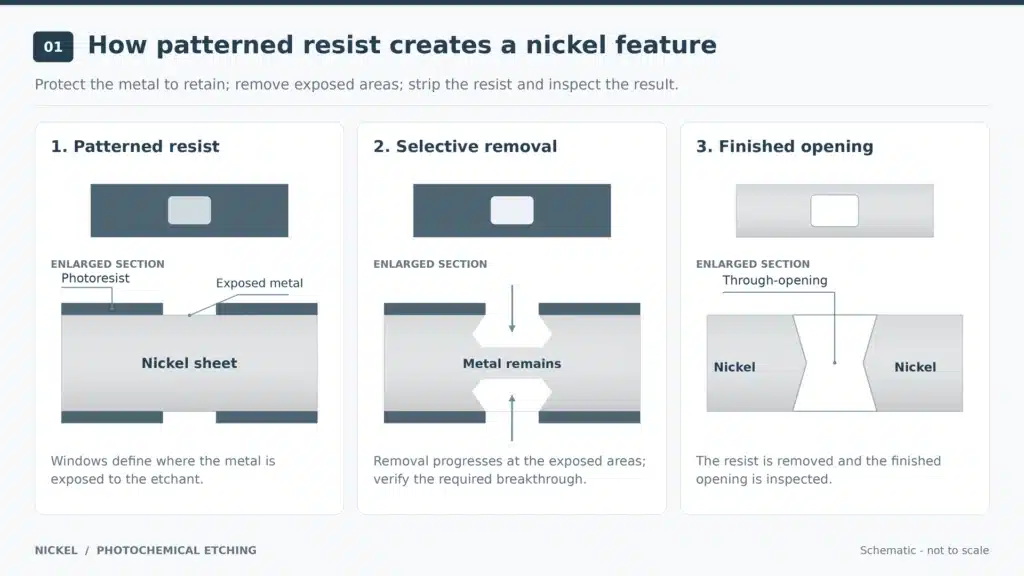
In photochemical machining, or PCM, a patterned photoresist protects the metal that must remain while an etchant removes exposed areas. For nickel sheet and foil, this creates openings, slots, profiles and, where qualified, partial-depth features.
The pattern comes from artwork rather than a hard stamping die. This supports design revisions and repeated features across a sheet. However, producing the geometry is only one part of meeting the drawing; material identity, surface condition and final inspection still need approval.
When requesting nickel chemical etching services, provide the material certificate with the drawing so feasibility is assessed against the intended stock.
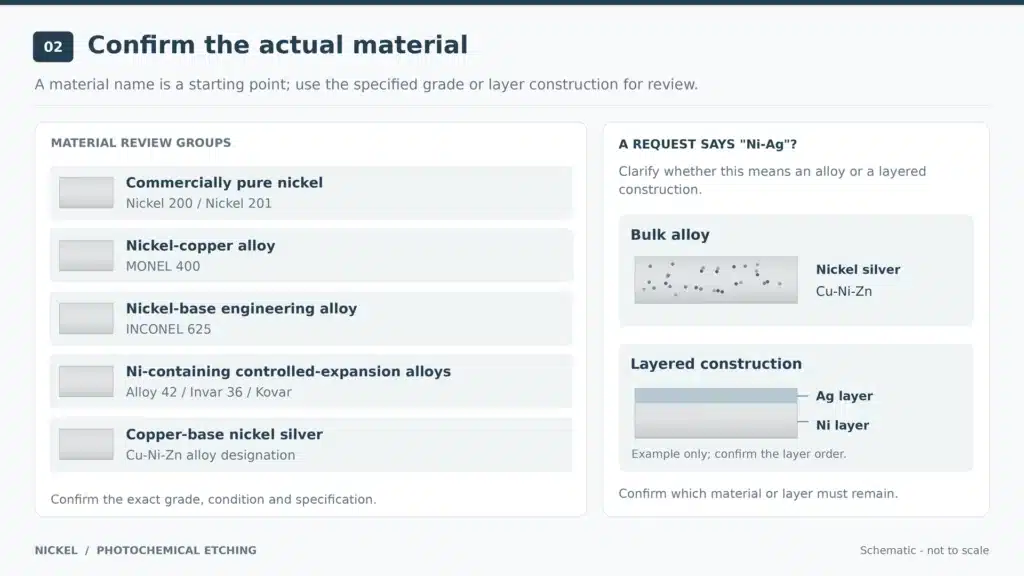
Pure Nickel, Nickel Alloys and Nickel Silver: Confirm the Material
Start with the exact grade and material specification, not the general term “nickel.” Materials that contain nickel can differ substantially in composition, mechanical behavior, thermal characteristics, corrosion resistance and manufacturing response.
| Material group | Examples | What the drawing review must establish |
|---|---|---|
| Commercially pure nickel | Nickel 200, Nickel 201 | Exact grade, supplied condition, thickness and functional requirements |
| Nickel–copper alloy | MONEL 400 | Specified alloy and condition rather than assuming the material behaves like commercially pure nickel |
| Nickel-base engineering alloy | INCONEL 625 | Complete grade, material condition, surface requirements and project-specific manufacturing requirements |
| Controlled-expansion alloys containing nickel | Alloy 42, Invar 36, Kovar | Exact alloy designation and the required thermal, dimensional and mechanical properties |
| Copper-base nickel silver | Copper–nickel–zinc alloys | Copper-alloy designation, composition, material condition and intended application |
Nickel 200 and Nickel 201 are commercially pure nickel grades, but Nickel 201 has a lower carbon content. Grade selection should be based on service requirements rather than assumed etching performance.
MONEL 400 and INCONEL 625 are nickel alloys, not pure nickel. Alloy 42, Invar 36 and Kovar are controlled-expansion alloys, while nickel silver is a copper–nickel–zinc alloy. Each requires its own material specification.
For photochemical etching, first confirm the exact alloy, thickness and supplied condition. Then validate feature size, tolerance and surface requirements against the selected material and part geometry.
What Does Ni-Ag Mean in a Nickel Etching Request?
For a request described as Ni-Ag chemical etching, confirm the actual material before selecting a process. Nickel silver is a copper–nickel–zinc alloy family, despite its name. It is distinct from commercially pure nickel.
Ask for the copper-alloy designation or a material certificate. If the request instead concerns a layered nickel/silver construction, obtain the layer sequence and identify which layer must be removed or retained. Resolve that distinction before quoting thickness, chemistry or inspection: a bulk alloy and a layered construction require different project information.
Material Condition and Surface Checks Before Etching
The same grade can arrive in different conditions. For example, Nickel 200 mechanical properties differ between annealed and cold-worked material. Annealing softens nickel, while cold working can increase its strength through deformation.
Record the supplied condition and any required hardness or mechanical properties. If the part will later be formed, identify that operation before approving the stock.
Then define the incoming surface: bare, coated, plated or previously processed. List visible contamination, scratches or other conditions requiring assessment. For a coating or layered material, specify whether it must remain through etching and cleaning.
Use one submission package: grade + specification + condition + stock form + thickness + surface + final function. Retain heat or lot identification where traceability is required.
If a sample is produced from different stock, record the difference. Approve only the characteristics it demonstrates, then resolve any remaining material or surface questions on representative samples.
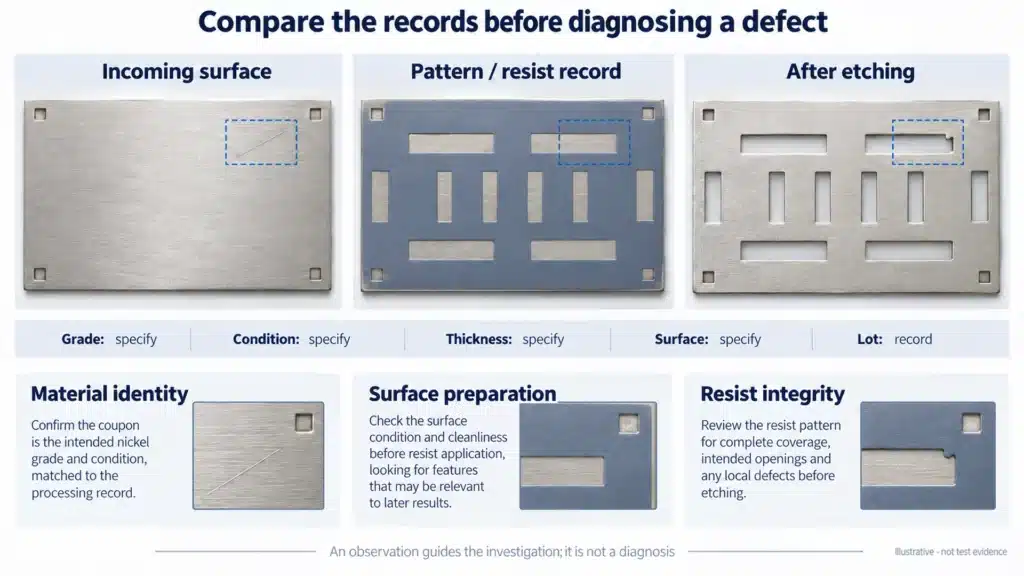
Keep incoming-surface photographs when appearance or local defects matter. If a later sample shows pits, staining or incomplete features, compare their locations with those photographs and the pattern records before changing chemistry. Check material identity, surface preparation and resist integrity as separate evidence paths. The observation should guide the investigation, not become a diagnosis by itself.
Nickel Etching Process: Critical Controls
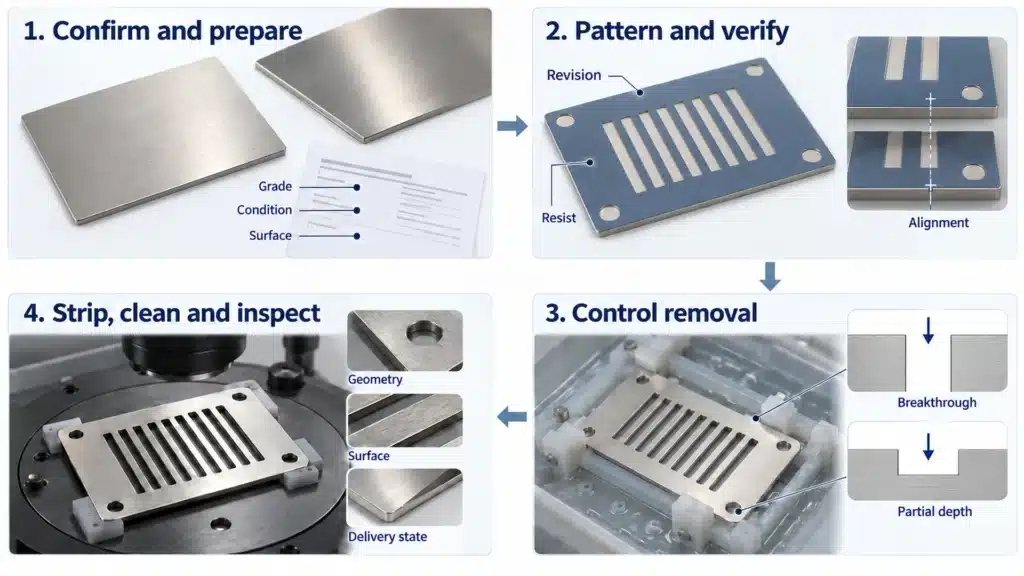
The standard PCM sequence combines material preparation, resist patterning, etching, stripping and inspection. For a nickel project, use these checkpoints:
- Confirm and prepare the stock. Match the material to the approved specification and establish a surface suitable for the resist system.
- Apply and verify the pattern. Check the artwork revision, resist integrity and intended openings. Review alignment where both faces carry a pattern.
- Control metal removal. Use the qualified route for the specified material and geometry. Verify the required breakthrough or partial depth.
- Strip, clean and inspect. Check the etched features and prepare the part for any agreed finishing or separation steps.
For detailed production stages, see the chemical etching process controls.
How Should a Nickel Etchant Be Selected?
Nickel can be etched with different chemical systems depending on the alloy, material form and manufacturing process. The correct etchant must also be compatible with the masking material and any surfaces that must remain protected.
For sheet-component manufacturing, confirm the exact alloy, thickness, surface condition, masking system and required removal depth before selecting the process. Etching performance should then be validated against the required dimensions, edge quality and surface condition.
A chemical system that works for one nickel grade or thin-film application should not automatically be assumed suitable for every nickel alloy or multilayer assembly.
Tolerances and Features to Review on a Nickel Drawing
Begin with the dimensions that control assembly or performance. Mark locating holes, slots, minimum webs and relationships between repeated features. A web is the strip of metal remaining between openings.
Etching removes metal laterally as well as through its thickness. This lateral removal, called undercut, affects the edge profile. Review an aperture, its neighboring web and sheet thickness together.
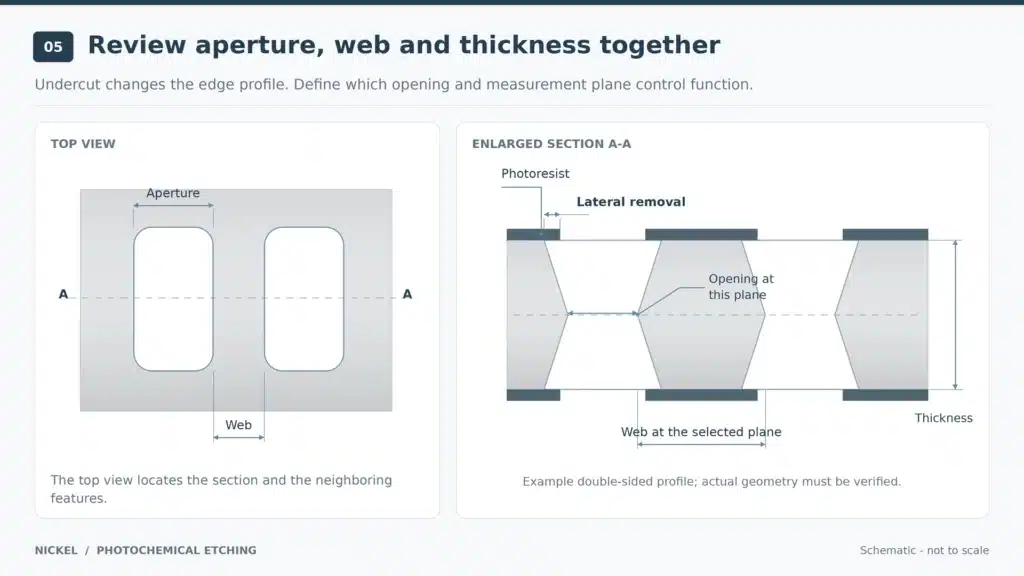
Specify where a critical width is measured and which reference features locate it. If function depends on the opening through the full thickness, make that requirement explicit rather than accepting a top-view dimension alone.
For partial-depth features, identify the etched face, depth or remaining metal, location and measurement points. Agree whether the depth or remaining thickness controls function.
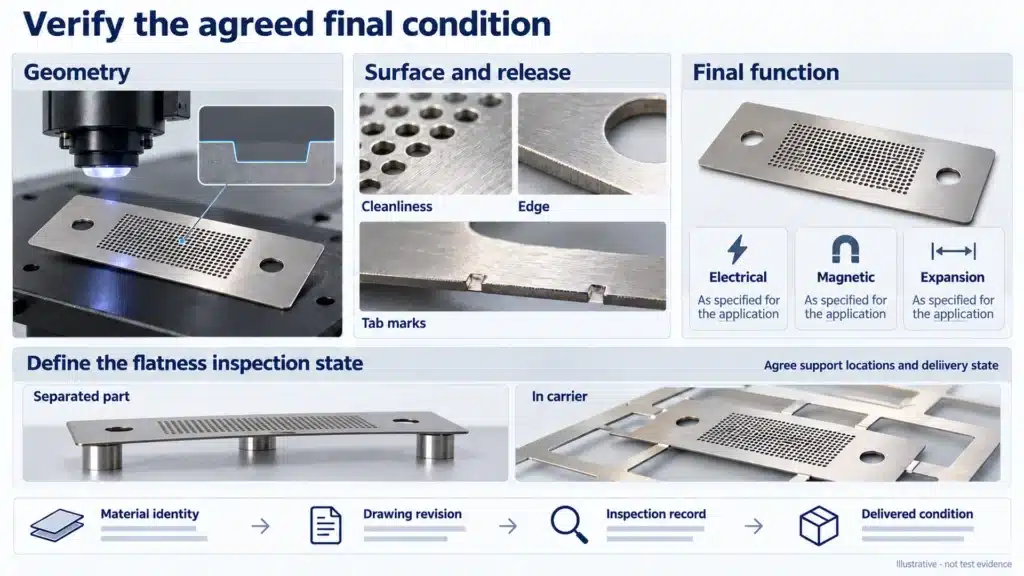
For release and handling, state whether delivery is in a carrier sheet, with retaining tabs or as separated parts. Identify permitted connection points and any restrictions on the marks left after separation.
Illustrative drawing review: A nickel shim has two locating holes, a patterned opening area and a narrow outer frame. Identify which hole positions control assembly, which openings need minimum clearance and where remaining metal width matters. Then define flatness and edge acceptance in the required delivery state.
This turns one general request for “precision nickel etching” into features the supplier can assess and inspect. Use the photochemical etching design and tolerance guide for broader drawing rules.
Tolerance confirmation should identify the material, thickness, covered dimensions and inspection state. Prototype and production schedules should also be confirmed against material availability, drawing approval, quantity, finishing and inspection scope.
Cleaning, Finishing and Final Inspection
Agree the delivered condition before approving the sample. Avoiding mechanical cutting burrs does not eliminate the need for stripping, cleaning, separation or other specified operations. The PCM workflow itself includes resist removal, cleaning and dimensional inspection.
Separate the acceptance questions:
| Check | Define before production |
|---|---|
| Geometry | Critical dimensions, measurement locations and reference features |
| Surface and residue | Cleanliness, appearance and any functional surface requirements |
| Edge and release condition | Permitted tab marks, edge profile and handling state |
| Secondary operations | Forming, plating, coating or other required work |
| Final function | Electrical, magnetic, expansion or other specified performance checks |
For a recess, a clear pattern photograph does not establish depth. Specify a suitable depth-measurement method and reference surface. For a narrow web, identify the measurement plane. If flatness controls assembly, agree how the part is supported during measurement and whether it remains attached to a carrier.
If coating or forming follows etching, identify which requirements apply before and after that operation. Retain the inspection records needed to connect the approved material, drawing revision and delivered part.
Applications Matched to the Actual Grade
Start with the component’s function, then choose and qualify the material. The examples below are review scenarios, not a list of interchangeable nickel grades or confirmed project deliveries.
| Component task | Material information needed | Features or results to verify |
|---|---|---|
| Electrical or electronic part | Exact grade, condition and contact finish | Contact geometry and required electrical performance |
| Screen or perforated foil | Grade, thickness and service environment | Clear openings, remaining webs, flatness and cleanliness |
| Shim or spacer | Grade, thickness and delivery condition | Seating thickness, locating features and edge condition |
| Controlled-expansion component | Specific alloy and thermal-history requirements | Geometry and expansion behavior in the agreed final condition |
| Part exposed to heat or chemicals | Exact alloy, medium, temperature, load and exposure duration | Required dimensions, surface and service performance |
For controlled-expansion alloys, fabrication and subsequent treatment can affect expansion behavior. Include the relevant downstream operations in the review.
For elevated-temperature service, use grade-specific property data and the actual loading and environment. A melting point is not an allowable operating-temperature specification for a finished component.
For medical applications, biological evaluation considers the device, materials, manufacturing and patient contact. Specify the intended use and contact conditions. Material selection and the ability to etch a part alone do not establish finished-device suitability.
Need precision-etched components for a medical application?
TMNetch manufactures custom metal parts for medical and diagnostic equipment, with support for material review, DFM, prototyping and production. Contact TMNetch to discuss your drawing, material and application requirements.
FAQs
Can nickel be photochemically etched?
Yes. Nickel and suitable nickel-containing alloys can be evaluated for photochemical manufacture. Confirm the exact grade, thickness, surface and geometry rather than assuming every material called nickel follows one process.
Which nickel etchant should be used?
Select a validated system for the actual material and removal task. Review resist compatibility, adjacent layers, required profile and surface acceptance; a thin-film product specification does not automatically cover bulk sheet manufacture.
Is nickel silver the same as pure nickel?
No. Nickel silver is a copper–nickel–zinc alloy family. For a Ni-Ag request, confirm the designation, composition or layer structure before discussing manufacture.
Can pure nickel and nickel alloys use the same etching process?
Do not assume they can. Review the proposed route against the particular grade, condition, surface and acceptance requirements, even when the overall production stages look similar.
Do etched nickel parts need finishing?
They require the operations needed to meet the specified delivery condition. Agree cleaning, separation, any secondary finishing and final inspection before production.
Send the Material Certificate and Drawing for Review
Prepare a review package containing:
- Exact grade, specification and material certificate.
- Supplied condition, stock form, thickness and surface.
- Drawing revision, critical features and partial-depth requirements.
- Final finish, delivery form and functional acceptance requirements.
- Sample quantity, production quantity and required inspection records.
Send these inputs to TMNetch for a nickel drawing and material review. Resolve material substitutions, surface questions and acceptance conditions before freezing the design, so the quotation and sample approval address the same finished part.
Conclusion
For nickel photochemical etching, confirm the exact grade, supplied condition, thickness and surface specification first. Distinguish pure nickel, nickel-base alloys and nickel silver, then review the process against the required geometry and final function. Agree how critical dimensions, cleanliness and required functional properties will be verified before approving production.
For nickel components with detailed openings, slots or profiles, explore TMNetch’s chemical etching services. Send your drawing, material certificate, thickness, final finish and inspection requirements for a manufacturability review.