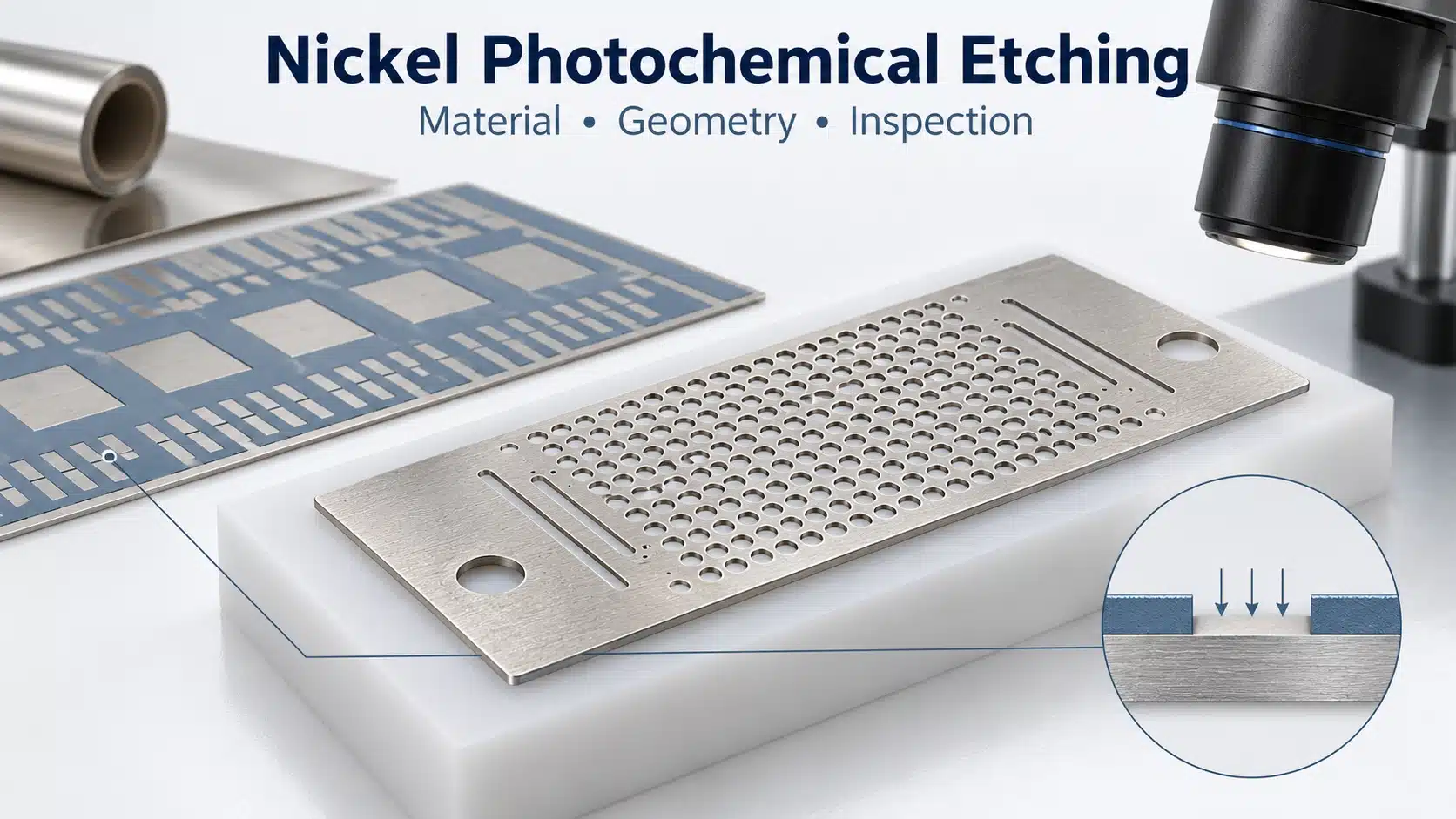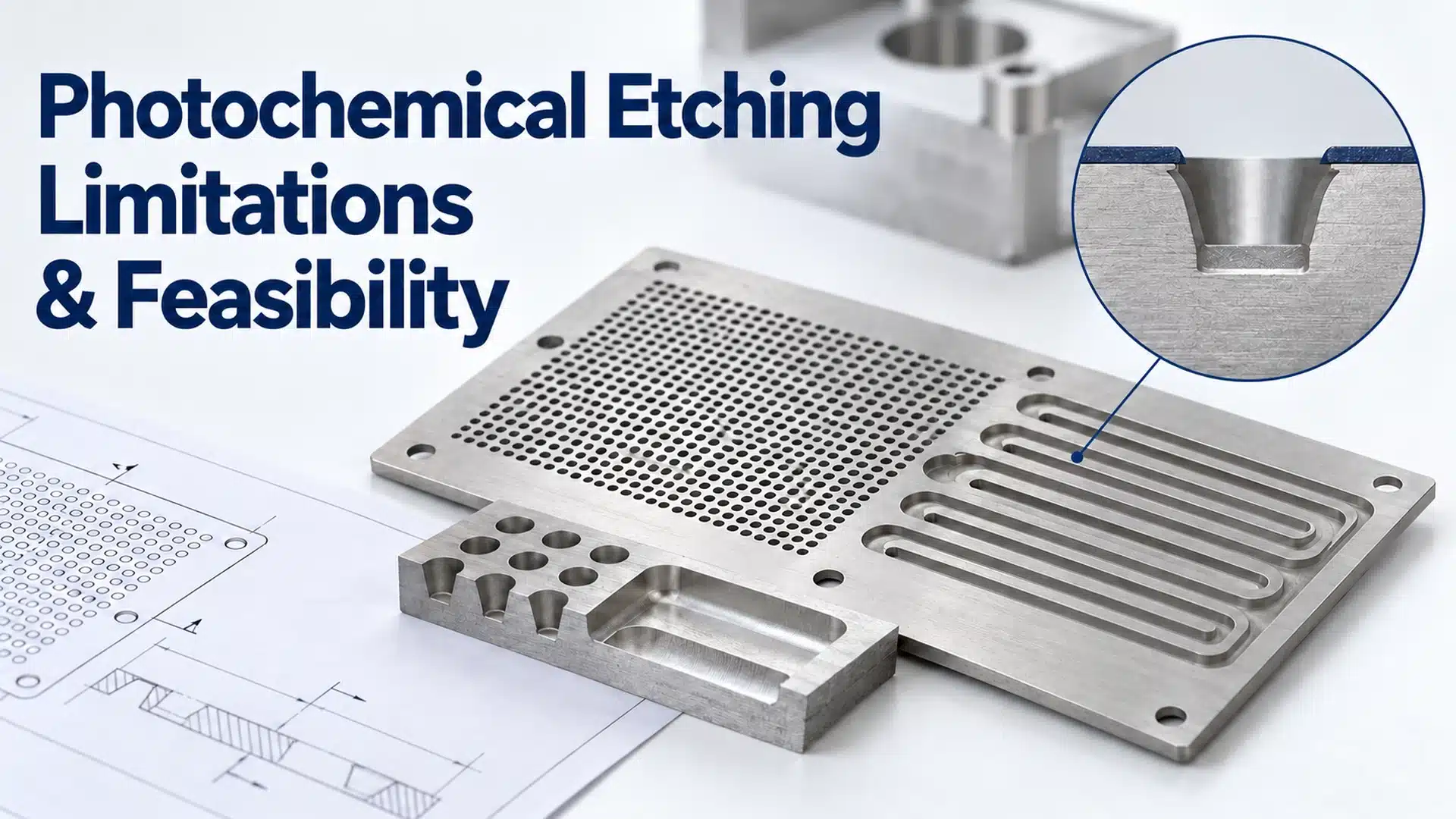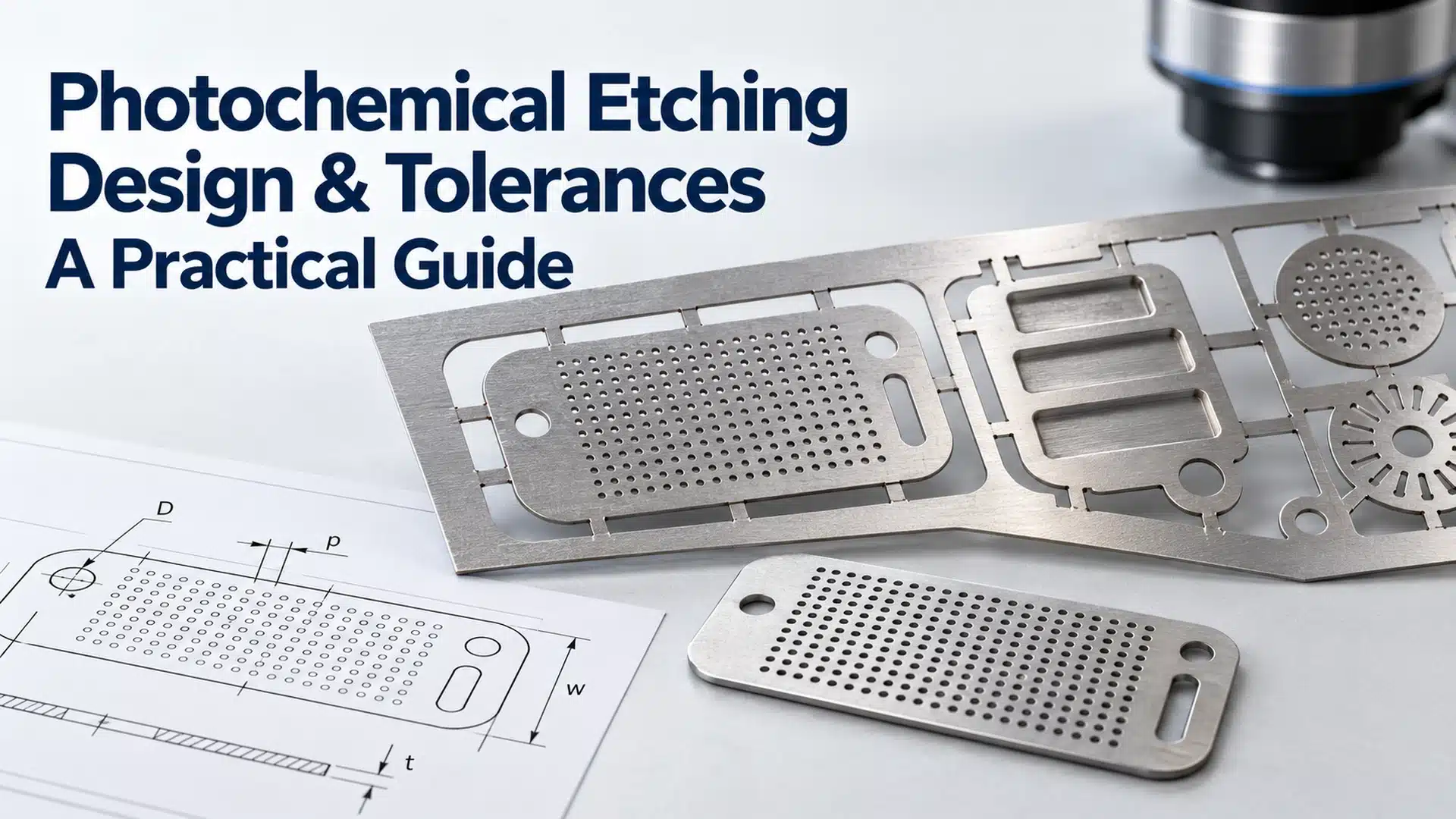

Stainless steel etching is used to produce thin metal parts with detailed openings, slots, channels, and complex profiles. It is often selected for components that may be difficult to manufacture with mechanical cutting or hard tooling.
However, the cost and quality of etched stainless steel parts depend on more than the basic process. Material grade, sheet thickness, feature size, tolerances, production volume, inspection, and secondary operations can all affect the final quotation.
This guide explains where stainless steel etching is most useful, what controls project cost, and what engineers and buyers should prepare before requesting a quotation.
What Is Stainless Steel Etching?
Stainless steel etching is a controlled metal-removal process. Selected areas of a stainless steel sheet are protected by a resist, while exposed areas are removed by an etchant.
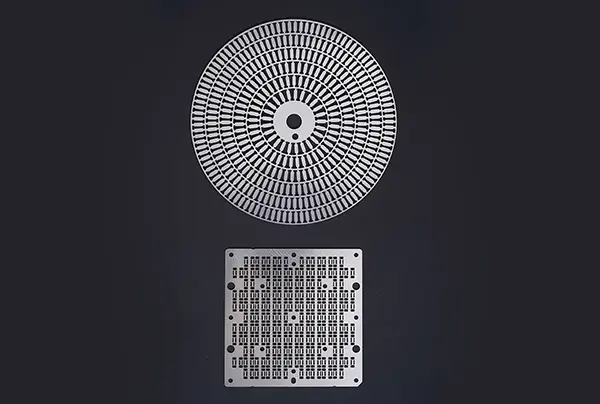
The method can create complete part profiles, holes, slots, mesh patterns, fold lines, logos, and shallow channels. Because the process does not use a cutting tool, it can produce thin and detailed parts without the mechanical force used in stamping or machining.
Industrial stainless steel etching is different from simple decorative marking. It requires controlled imaging, chemical processing, rinsing, and inspection to meet dimensional and surface-quality requirements.
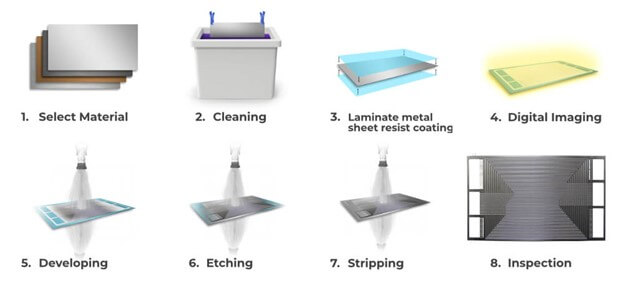
Stainless Steel Etching Process at a Glance
The industrial process normally begins with material inspection and surface cleaning. A photoresist is then applied to the stainless steel sheet. The required pattern is transferred to the resist through imaging and development.
The exposed metal is removed in a controlled etching stage. After etching, the remaining resist is stripped away. The parts are then rinsed, cleaned, and inspected. Passivation or another surface treatment may be added when required.
The process plan and achievable tolerance depend on the stainless steel grade, material thickness, part size, feature geometry, critical dimensions, and production volume.
For a detailed production sequence, see the guide to the acid etching stainless steel process.
How Stainless Steel Grade Affects Cost and Use
The term “stainless steel” covers several grades with different compositions and performance characteristics. The selected grade affects raw material cost, corrosion resistance, process control, and final application.
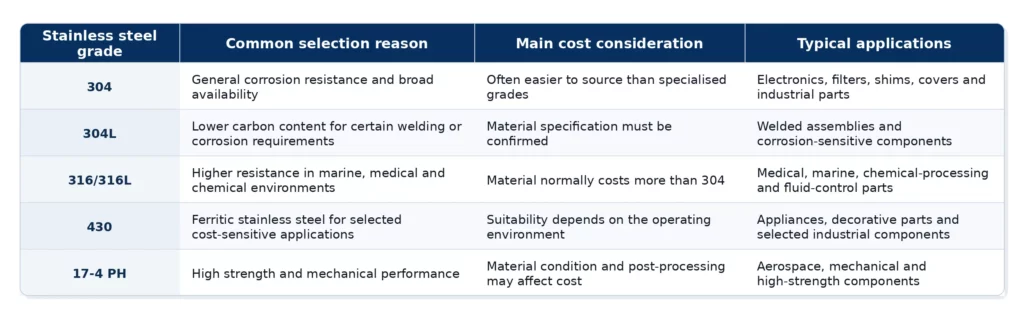
The quotation should always state the exact grade. A drawing that only says “stainless steel” may lead to delays, incorrect assumptions, or a revised price.
Material condition may also matter. Hardness, temper, surface finish, flatness, and protective film can affect handling and downstream processing.
When Is Stainless Steel Etching Cost-Effective?
Stainless steel etching can be cost-effective when the part has one or more of the following characteristics:
- Thin sheet material
- Complex two-dimensional geometry
- Many small holes or slots
- Multiple part designs in the same material and thickness
- Prototype or low-volume requirements
- Frequent design changes
- Fine internal features
- A need to avoid hard tooling
- A need to reduce mechanical stress during cutting
The process can also reduce development risk. A design change may require a new digital pattern or phototool rather than a completely new stamping die.
However, cost-effectiveness depends on the full part design and the tolerances, material limits, and process trade-offs of photochemical etching. A simple shape produced in very high volume may be more suitable for stamping. A thick part with deep features may be better suited to CNC machining or another process.
How Much Does Stainless Steel Etching Cost?
There is no standard price for every stainless steel etching project. Suppliers normally calculate cost from the drawing, material, thickness, quantity, tolerance, inspection, and finishing requirements.
The following factors have the greatest effect.
Material Grade and Thickness
Material grade affects the base cost of the sheet. Common grades such as 304 may be easier to source than specialised alloys.
Thickness also affects:
- Material consumption
- Etching time
- Feature limitations
- Undercut
- Part flatness
- Handling requirements
A thicker sheet normally requires more etching time than a thinner sheet. As material thickness increases, the minimum practical hole, slot, and web sizes also tend to increase, and tighter dimensional tolerances may become more difficult to maintain. Final limits should be confirmed through drawing review.
Part Size and Sheet Utilisation
The supplier will review how many parts can fit on one production sheet. Better sheet utilisation can reduce material waste and lower unit cost.
Sheet utilisation may be reduced by:
- Large external part dimensions
- Wide spacing requirements
- Poor nesting
- Irregular shapes
- Large edge margins
- Mixed material thicknesses
Providing a complete CAD file can help the supplier review panel layout and material usage.
Feature Density and Etch Depth
A design with many fine holes, narrow slots, half-etched channels, or closely spaced features may require tighter process control.
Cost may increase when the design includes:
- Very small apertures
- Closely spaced openings
- Multiple etch depths
- Fine lines
- Dense mesh patterns
- Tight internal corners
- Features that are small compared with material thickness
The supplier may need to apply design compensation to account for lateral metal removal during etching.
Tolerance and Inspection
Tighter tolerances require closer control of imaging, etching, inspection, and process variation. They may also increase measurement time, documentation requirements, and rejection risk.
The buyer should separate:
- Critical dimensions
- Reference dimensions
- Functional dimensions
- Non-critical external dimensions
Inspection requirements may include:
- Standard dimensional checks
- First article inspection
- Full dimensional reports
- Optical measurement
- Material certificates
- Batch traceability
- Surface inspection
- Sampling plans
Applying the same tight tolerance to every dimension may increase process-control and inspection costs without improving part function. Critical dimensions should be separated from reference and non-functional dimensions.
Prototype and Production Volume
Prototype orders may have a higher unit cost because setup, imaging, inspection, and production preparation are divided across fewer parts.
As volume increases, unit cost may decrease through:
- Better sheet utilisation
- Larger production batches
- More efficient setup
- Standardised inspection
- Reduced handling per part
Buyers should provide both the first order quantity and estimated annual volume. This allows the supplier to recommend a suitable production plan.
Secondary Operations
Etching may be only one stage of the full manufacturing process, especially when a project also requires one-stop chemical etching services such as plating, polishing, forming, cleaning, inspection, or packaging.
Additional costs may come from:
- Passivation
- Plating
- Polishing
- Deburring of secondary features
- Forming
- Heat treatment
- Welding
- Adhesive application
- Cleaning
- Special packaging
These requirements should be stated before quotation. Adding them after production planning may change the lead time and price.
Documentation and Logistics
Projects may require more than finished parts.
Additional requirements can include:
- Material traceability
- Certificates of conformity
- Inspection reports
- Export packaging
- Clean packaging
- Special labels
- International shipping
- Industry-specific documents
These items should be included in the RFQ.
Expert Tips for Reducing Stainless Steel Etching Cost
Cost reduction should not depend on lowering quality. It should come from clearer specifications and a design that matches the process.
Use a Standard Material Grade Where Possible
Special grades may increase material cost and sourcing time. Select the grade based on the real operating environment rather than using a higher grade without a functional reason.
Use Standard Material Thicknesses
A standard sheet thickness is often easier to source and process than a custom thickness. Ask the supplier whether a nearby standard thickness can meet the design requirement.
Mark Only the Critical Tolerances
Do not apply the tightest tolerance to every dimension. Mark the dimensions that control fit, flow, sealing, alignment, optical performance, or electrical contact, and use wider tolerances for non-critical features where the design allows.
Reduce Unnecessary Half-Etched Features
Half-etched channels, logos, fold lines, and recesses can be useful, but they may require additional imaging and process control.
Only include them when they serve a clear function.
Improve Panel Utilisation
Part shape and layout affect how many parts fit on one sheet. A small change to the external profile or orientation may improve material usage.
Combine Similar Parts
Parts made from the same grade and thickness may be reviewed together. This may improve production efficiency, especially during prototype development.
Validate the Design Before Volume Production
A prototype or pilot batch can identify problems before a large order is released.
Validation should confirm:
- Feature size
- Fit
- Flatness
- Edge condition
- Surface finish
- Assembly performance
Provide Complete Files
A clear RFQ reduces engineering time and prevents quotation changes.
Provide:
- 2D drawing
- CAD file
- Material grade
- Thickness
- Tolerances
- Quantity
- Annual demand
- Surface treatment
- Inspection requirements
Expert Tips for Avoiding Costly Etching Problems
Process defects increase cost through scrap, rework, inspection, and production delays.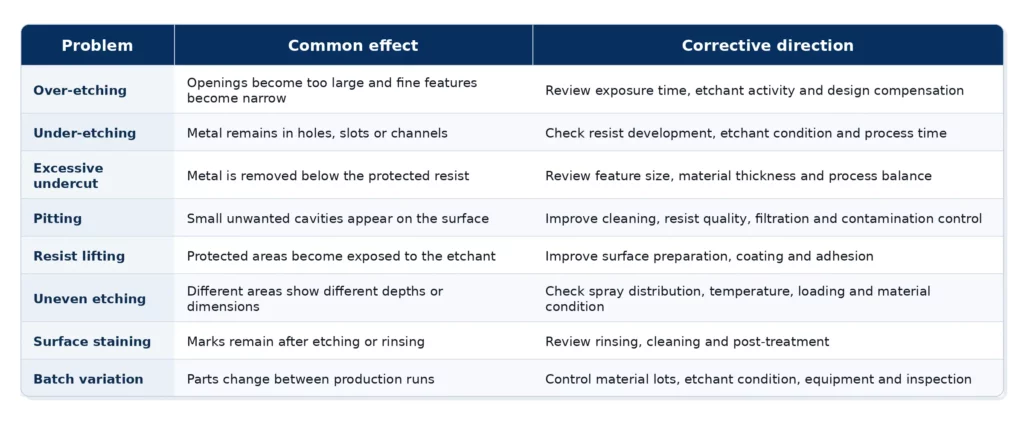
Over-Etching and Under-Etching
Over-etching removes too much metal. It may widen openings, reduce line width, or damage fine details.
Under-etching leaves unwanted metal in the part. Holes may remain partly closed, and channels may not reach the required depth.
Both problems may result from poor control of time, temperature, etchant activity, or resist development.
Pitting and Contamination
Pitting can result from surface contamination, resist defects, particles, or uneven chemical contact.
Material cleaning is critical. Oil, oxide, fingerprints, dust, and residues can reduce resist adhesion and create local defects.
Excessive Undercut
Etching removes metal downward and sideways. The sideways removal is called undercut.
Undercut becomes more important when:
- The material is thick
- The features are very narrow
- The etching time is long
- The pattern has small gaps
- The design does not include compensation
Minimum hole diameter, slot width, web width, and feature spacing should be reviewed against the stainless steel thickness and required tolerance before production. Final feasibility should be confirmed from the drawing rather than from a single general design ratio.
Batch-to-Batch Variation
Volume production requires stable control of:
- Raw material
- Surface preparation
- Resist coating
- Imaging
- Etchant condition
- Temperature
- Spray pressure
- Line speed
- Inspection method
A process that works for one prototype is not automatically stable for a large production batch.
Common Uses of Stainless Steel Etching
Stainless steel etching is most useful when a part is thin, flat, detailed, and difficult to produce with conventional tooling.
Speaker Grilles
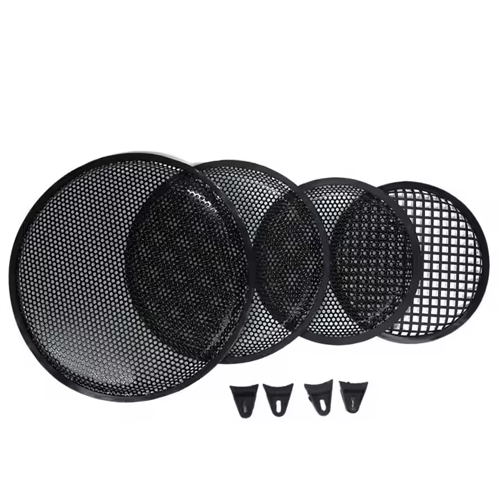
Speaker grilles may contain many small openings in a controlled pattern. Etching can create custom hole shapes and open-area ratios without producing the mechanical burrs associated with some cutting methods.
Important design factors include:
- Aperture size
- Open area
- Flatness
- Surface appearance
- Mounting features
- Coating or finishing requirements
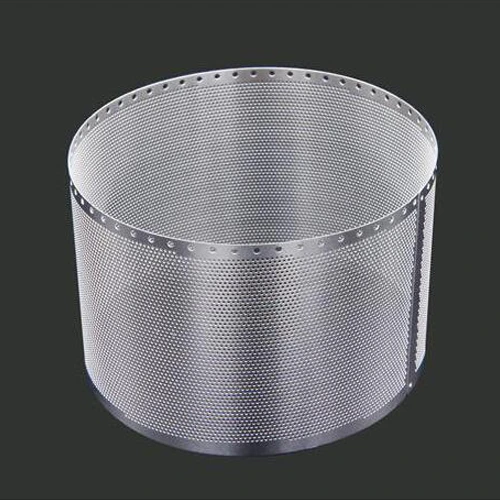
Metal Filter Meshes
Etched metal filter meshes are used when the designer needs repeatable openings, custom external shapes, or integrated mounting features.
The main cost factors include:
- Mesh aperture size
- Material thickness
- Open-area percentage
- Sheet utilisation
- Inspection method
- Single-layer or multilayer design
EMI and RFI Shielding Components
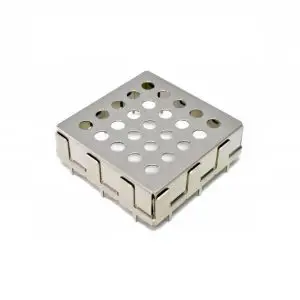
Thin stainless steel sheets can be etched into EMI and RFI shielding components such as covers, frames, vents, and mounting structures.
The design may also require:
- Fold lines
- Tabs
- Contact points
- Ventilation openings
- Plating
- Forming after etching
Encoder Disks
Encoder disks contain repeated slots or optical patterns arranged around a centre point. The main requirements may include pattern accuracy, concentricity, flatness, and clean edges.
Shims and Spacers
Etching is suitable for thin custom shims, washers, and spacers with irregular profiles or multiple openings.
Material thickness, thickness tolerance, flatness, and dimensional inspection are usually important cost factors.
Fluid-Control Plates
Stainless steel plates may contain channels, ports, flow openings, or sealing features. Some designs require through-etched openings, while others use partial-depth features.
The supplier must understand which surfaces are functional and which dimensions affect sealing or flow performance.
What Information Should You Include in an RFQ?
A complete RFQ helps the supplier assess feasibility, cost, and lead time.
Include the following information:
- CAD file: DXF, DWG, STEP, or another agreed format
- 2D drawing: Dimensions, tolerances, notes, and revision level
- Material grade: Such as 304, 316L, 430, or 17-4 PH
- Material thickness: State the nominal sheet thickness and any required thickness tolerance. Note whether the tolerance applies to the incoming material, the finished etched part, or both.
- Feature type: Through-etched, half-etched, or both
- Critical dimensions: Clearly marked on the drawing
- Flatness requirement: Especially for sealing or optical parts
- Surface finish: Mill finish, polished, passivated, plated, or another requirement
- Prototype quantity: Parts needed for testing
- Production quantity: Initial order and annual forecast
- Inspection: Reports, certificates, sampling, and measurement method
- Packaging: Standard, protective, clean, or export packaging
The supplier may also ask about the final operating environment, assembly method, and functional purpose of the part.
TMNetch Approach to Stainless Steel Etching
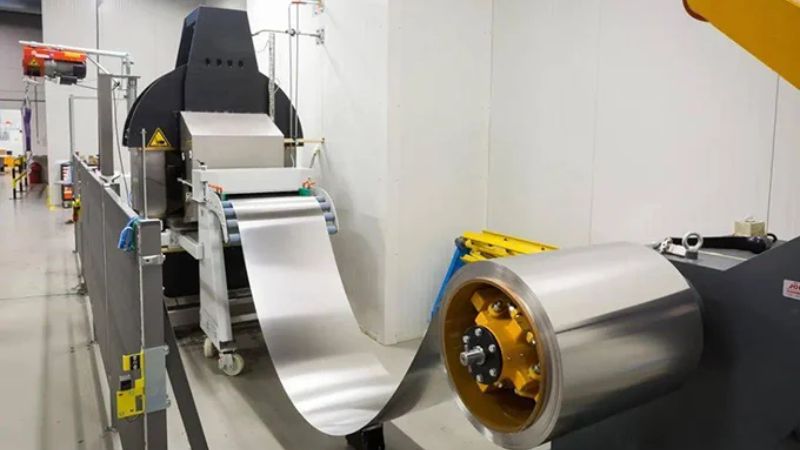
TMNetch provides precision stainless steel chemical and photochemical etching using multiple automated long-line systems. Its website lists roll-to-roll continuous exposure and etching equipment for materials up to 1,200 mm wide. Under suitable design conditions, photo etching tolerances can be as tight as ±0.025 mm on critical dimensions, while TMNetch product pages commonly list ±0.03 mm. Final tolerance depends on the material, thickness, part geometry, feature size, and inspection requirements. The production system is certified to ISO 9001:2015.
For projects that require further processing, TMNetch lists plating, polishing, forming, laser cutting, cleaning, inspection, and packaging. Project review covers material grade, thickness, geometry, tolerance, surface finish, and quantity before production planning. For a project quote, contact TMNetch and send the drawing, stainless steel grade, material thickness, required quantity, tolerance, and surface-finish requirements.
FAQs
Can Stainless Steel Be Etched?
Yes. Stainless steel can be etched through controlled chemical, photochemical, electrochemical, laser, or decorative processes.
Photochemical etching is often used for thin, flat components with detailed holes, slots, channels, and external profiles.
What Is the Best Etchant for Stainless Steel?
There is no single best etchant for every stainless steel project. Selection depends on the alloy grade, material thickness, required feature, equipment, surface requirement, and production controls.
The etchant should be selected and managed as part of the complete process.
Will Ferric Chloride Etch Stainless Steel?
Ferric chloride can etch some stainless steel grades under controlled conditions. Performance depends on grade, thickness, bath condition, temperature, exposure, and equipment.
It should not be treated as a universal option for every stainless steel part.
Can Stainless Steel Be Half-Etched?
Yes. Half-etching can create shallow channels, fold lines, identification marks, recessed areas, and other partial-depth features.
Half-etched designs require clear depth requirements and may involve additional process control.
Conclusion
Stainless steel etching is suitable for many thin and detailed components, but cost and quality depend on the complete project specification.
Material grade, thickness, feature size, tolerance, production volume, etchant control, inspection, and finishing should be reviewed together. Buyers can reduce cost and project risk by providing complete drawings, marking critical dimensions, and selecting requirements based on the real function of the part.