
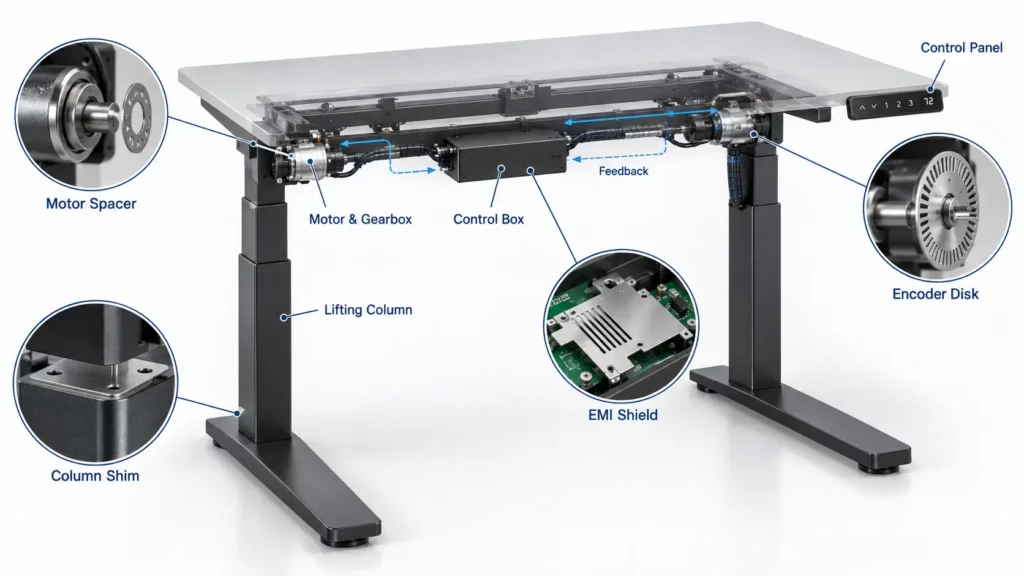
How do standing desks work? A control panel or app sends a command to the control box, which drives the motor, gearbox, spindle, and lifting columns.
For manufacturers, the actuator is only one part of the system. Interfaces, guide clearances, feedback, and shielding affect reliability.
Precision etched parts do not replace the actuator. They may control a measured static offset, support position feedback in a compatible design, or form thin shielding and retaining parts.
Key Takeaways
- Smart desks combine electric motion, control logic, feedback, and mechanical guidance.
- Etched parts may fit as shims, spacers, encoder disks, retainers, or shielding components when thin, flat geometry is required.
- A shim can correct a defined static offset. It cannot repair worn glides, bent profiles, electronic faults, overload, or lost synchronization.
What Components Make Up a Smart Standing Desk?
In this article, a smart standing desk means an electric sit-stand workstation with programmable control, safety logic, feedback, or connectivity. “Smart” describes the control layer, not guaranteed stability.
| System area | Main function | Potential etched component | Main engineering concern |
|---|---|---|---|
| Control panel and app | Sends movement commands | Usually not the main etching opportunity | User input and communication |
| Control box | Manages power, feedback, and safety logic | Thin retainers or shielding parts, where required | Wiring, EMC, sensors, and controller compatibility |
| Motor and gearbox | Produces and transfers rotary motion | Motor mounting shims, spacers, or endplay washers | Shaft axis, preload, and fastener engagement |
| Position feedback | Reports travel or relative position | Encoder disk, if the actuator uses a compatible optical design | Pattern accuracy, sensor gap, and indexing |
| Lifting column and frame | Transfers force and raises the desktop | Column mounting shims or interface spacers | Parallelism, offset, and load transfer |
| Glides and profiles | Guides telescoping movement | Not normally replaced by an etched shim | Wear, friction, clearance, and lateral play |
These are potential opportunities, not universal components. Selection depends on architecture, function, material, thickness, tolerance, and validation.
Where Can Precision Etched Metal Parts Fit?
Photochemical etching is not used to manufacture the entire desk. It is relevant to thin, flat parts that control spacing, position, signal timing, or contact.
Column Mounting Shims and Frame Interface Spacers
A column mounting shim may compensate for a measured static offset between a lifting column and the frame. It is relevant only when the drawing allows selective compensation.
The design must protect the load path. A shim can change fastener engagement, contact pressure, column position, and frame geometry. Specify it as a controlled interface component, not a general anti-wobble accessory.
For thin, flat parts with custom holes, slots, or profiles, review custom etched shims and precision metal spacers.
Motor Mounting Shims, Gearbox Spacers, and Endplay Washers
The term motor shim is often too broad for an engineering drawing. The part may be a motor-housing shim, gearbox spacer, bearing endplay washer, or shaft-positioning plate.
These parts can influence the motor axis, shaft engagement, bearing preload, gear contact, and axial endplay. They may also affect current, heat, and service life.
Before specifying one, define the mounting face, shaft axis, axial position, clamp load, adjustment range, and fastener engagement.
Encoder Disks for Compatible Position Feedback Systems
Some actuators use an encoder or another position-sensing system to estimate motor rotation or relative travel. An optical encoder disk can contain repeated slots or openings that create position pulses.
This is not a universal standing desk component. Other systems use Hall sensors, magnetic sensing, current feedback, or integrated actuator feedback. The disk must match the sensor type, resolution, indexing method, material, and sensor gap.
When an actuator calls for a thin patterned disk, manufacturers can evaluate etched encoder disks. The supplier still needs the drawing and sensing principle before confirming manufacturability.
EMI/RFI Shielding for Control Electronics
Smart desks may include control boards, Bluetooth modules, sensors, or compact motor-control electronics. If the enclosure requires electromagnetic shielding, a thin metal frame, cover, clip, or contact component may be considered.
This is an electronics-design decision, not an automatic requirement. Define the frequency range, grounding path, enclosure layout, airflow, contact pressure, and EMC test method.
For PCB-level or compact modules, see TMNetch’s EMI/RFI shielding components. Shield suitability for a standing-desk controller remains project-specific.
Where Etched Parts Are Not the Right Solution
Etched parts are not replacements for worn glides, bent profiles, unstable feet, failed sensors, thick structural brackets, main lifting columns, or deep three-dimensional parts. Use them only when a thin, flat interface or pattern is required.
How Do Standing Desks Work? From Command to Linear Motion
Command → control box → motor and transmission → spindle and nut → lifting column → frame → feedback
Control Panel, App, and User Command
The control panel or app sends a request to raise, lower, stop, lock, or move to a stored height. A memory position defines a target, not the motor torque or column load.
The interface may include a display, memory buttons, Bluetooth, reminders, or a child-lock function. None replaces mechanical alignment.
Control Box and Safety Logic
The control box distributes power to one or more motor channels. Depending on the model, it may also process position signals, motor current, error codes, tilt, and initialization status.
Typical safety logic may include soft start-stop, overload handling, travel limits, initialization, and obstruction response. LINAK describes a system combining lifting columns, a control box, and a control panel. Channel and parallel-column configurations vary by model.
An anti-collision standing desk may use current change, position change, or tilt detection. The controller can stop movement and may reverse the desk a short distance.
This response is not the same as being pinch-proof. Sensitivity can change with table size, total weight, collision location, motorized-leg count, and object hardness.
Standing Desk Motor, Gearbox, Spindle, and Nut
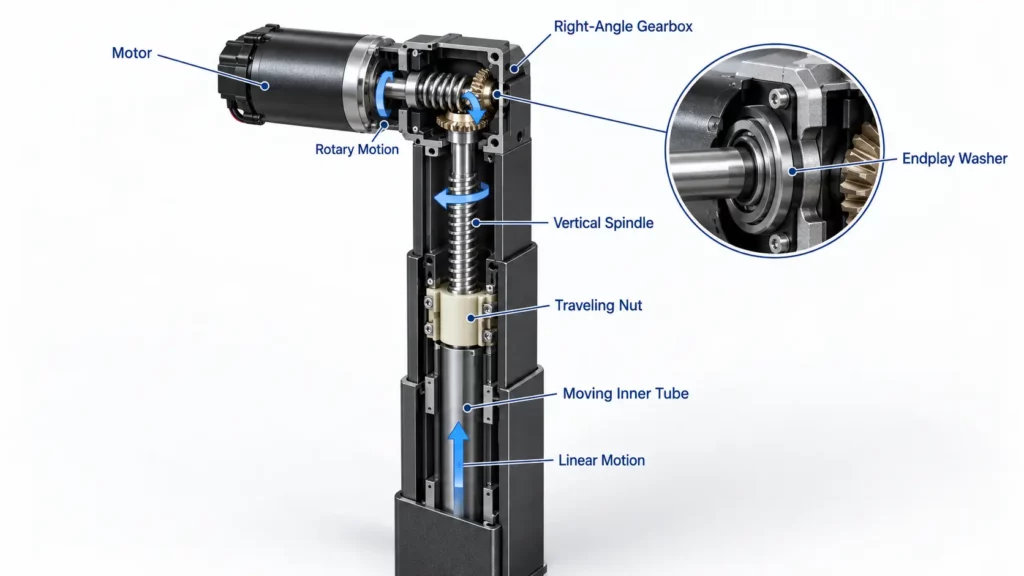
The standing desk motor creates rotary motion. The gearbox adjusts speed and torque, while the spindle and nut convert rotation into linear travel.
This chain depends on shaft engagement, bearing endplay, coupling position, backlash, lubrication, and mounting stiffness.
That is where a precision metal spacer or endplay washer may become relevant. It controls a specific dimension in the mechanical stack; it does not create more motor power.
Telescoping Profiles and Polymer Glides
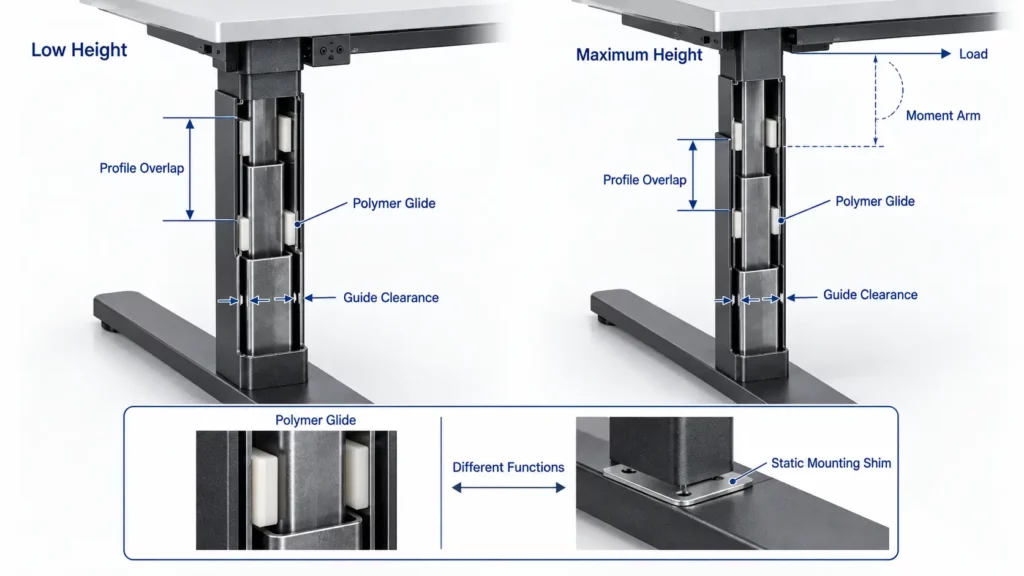
Many lifting columns use nested metal profiles. Polymer glides guide the moving sections and manage contact between them.
Clearance must support smooth travel without excessive play. Too little can increase friction and motor current; too much can increase lateral movement and noise.
These effects often become more visible at maximum height, when profile overlap may be lower and the lever arm is longer.
An etched metal shim should not replace a glide. The two parts have different material, wear, lubrication, and contact functions.
Feedback and Position Sensing
The controller needs feedback to coordinate travel and recognize abnormal conditions. A desk may use Hall sensors, motor-current monitoring, position pulses, tilt sensing, or another method.
If the actuator uses an optical encoder, the encoder disk provides a repeated pattern that the sensor reads to estimate rotation or relative position.

Single Motor vs Dual Motor Designs
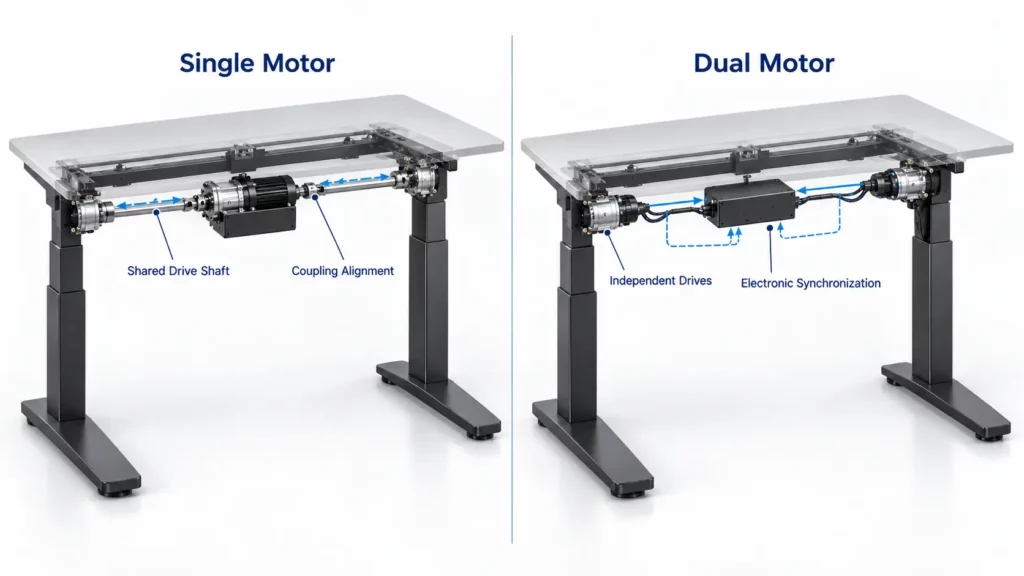
Neither architecture is automatically better. Choose according to desktop size, stroke, load, packaging, cost, service, and validation results.
| Design | Main benefit | Main risk | Possible etched-part consideration |
|---|---|---|---|
| Single motor | Fewer electronic drive channels | Shaft, coupling, and transmission alignment | Motor or gearbox interface spacers |
| Dual motor | Direct control of each column | Sensor matching and synchronization | Column mounting shims or motor interface parts |
| Three or more columns | Shares load across several columns | More wiring and synchronization points | Repeated flat interface components, where justified |
A single-motor design needs controlled drive-shaft and coupling interfaces. Backlash or wear can affect left-right movement.
A dual-motor design offers more direct control, but the controller must manage friction, load, motor speed, and sensor output. It still needs correct frame geometry.
For both designs, test symmetric and off-center loads, power loss, uneven friction, and repeated operation.
Lift Column Alignment: Five Interfaces Engineers Must Check
Lift column alignment is a group of mechanical and electronic relationships that influence movement, stability, and service life.
| Alignment layer | What can go wrong | Possible etched-part role |
|---|---|---|
| Floor and base leveling | Uneven contact or unstable feet | Usually a leveling wedge, not an etched shim |
| Column-to-frame geometry | Nonparallel or offset mounting faces | Static compensation shim |
| Internal guide clearance | Excessive friction or lateral play | Not a substitute for polymer glides |
| Motor and transmission alignment | Shaft offset or uncontrolled endplay | Spacer, washer, or mounting shim |
| Electronic synchronization | Different reported positions between columns | Cannot be fixed by a shim |
Mechanical Alignment
A tolerance stack can be expressed as:
g_actual = g_design + ΣsᵢΔᵢ + Δ_assembly + Δ_load
Here, g is a gap or clearance. The Δ terms represent part, datum, assembly, and load variation. This is not a universal design value.
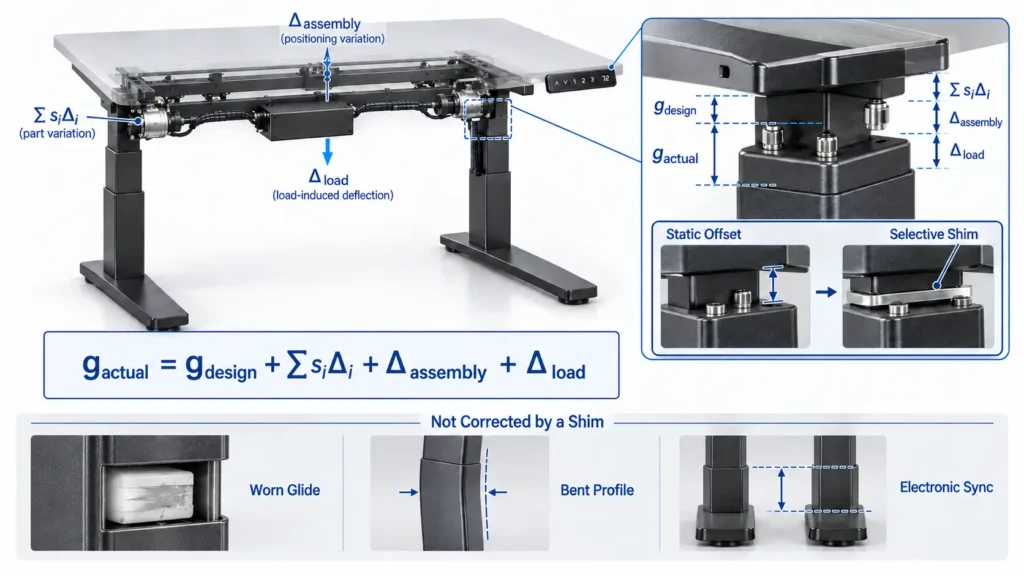
A shim changes one static term at one interface. It may help when a measured mounting surface is out of plane and compensation is allowed.
It will not remove deflection, wear, a bent profile, poor floor contact, or an electronic error. It may create a new problem if it reduces fastener engagement or changes the load path.
Before selecting one, check the floor, feet, frame squareness, fastener torque, mounting-face flatness, column parallelism, glides, drive interfaces, and load distribution.
Steelcase troubleshooting documentation also separates mechanical binding from electronic synchronization. It links binding to column parallelism, glide adjustment, and desk leveling, while treating control-box initialization as a separate action.
Electronic Synchronization
Two columns can be mechanically parallel and still become electrically out of sync. A controller may lose its reference after a power event, cable fault, back-drive, or failed initialization.
The recovery process is model-specific. If one side moves faster, check the controller, feedback, initialization, load distribution, and column friction first. A shim can alter geometry, but not sensor matching.
When Is Photochemical Etching Suitable for Desk Components?
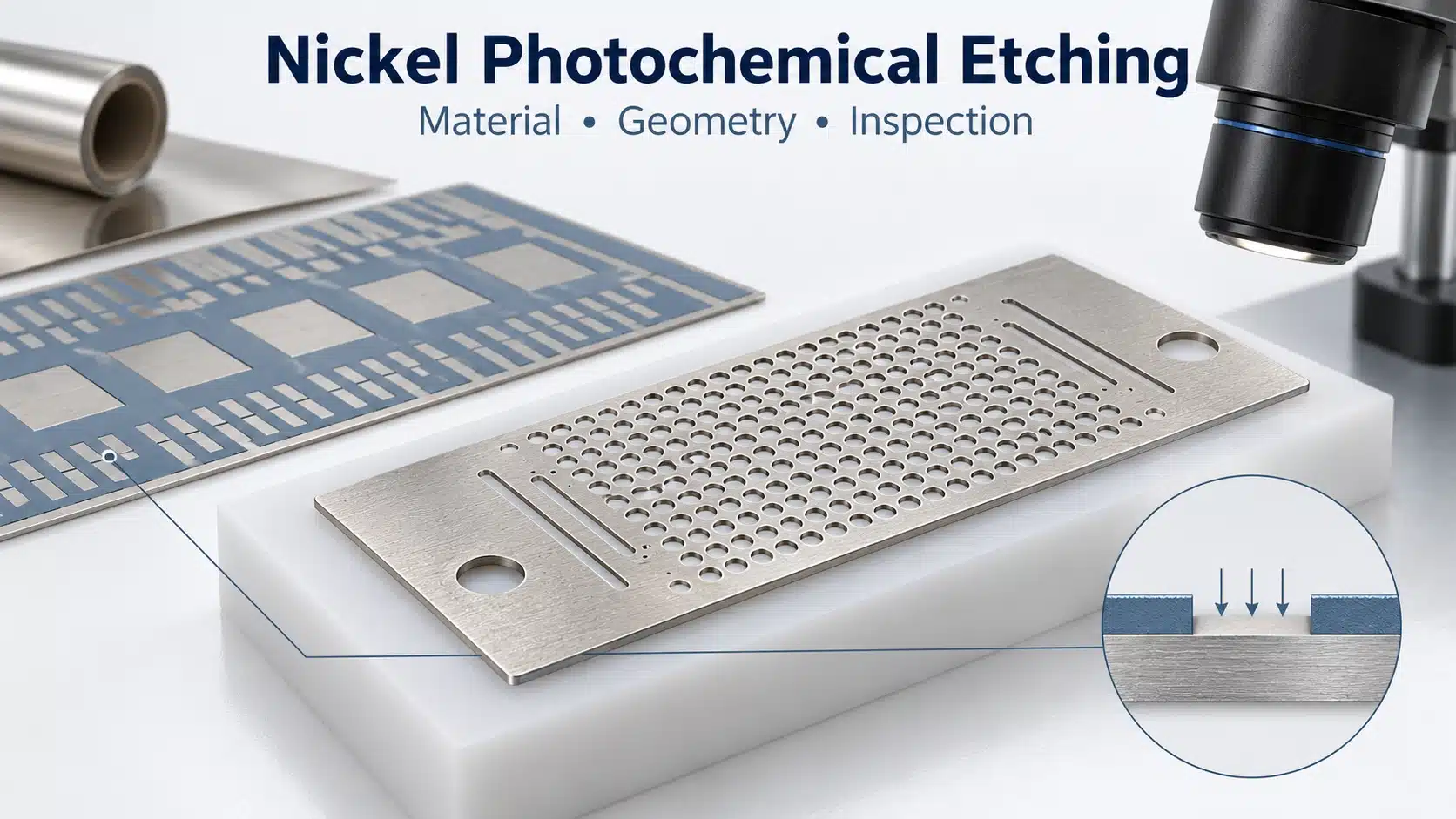
Photochemical etching, also called photo etching or photochemical machining, uses a photoresist pattern and controlled chemical removal to create flat metal profiles.
It can produce holes, slots, repeated patterns, cutouts, and selected half-etched details. It is useful when a thin, flat part has complex two-dimensional geometry.
Etching Compared with Other Methods
| Manufacturing method | Often worth evaluating when | Main consideration |
|---|---|---|
| Photochemical etching | Thin, flat, complex profiles and frequent design changes | Chemical undercut, stock thickness, inspection, and setup control |
| Stamping | High-volume parts with stable geometry and suitable forming | Die investment, forming limits, burrs, and design-change cost |
| Laser cutting | Low-volume parts or thicker material with accessible profiles | Heat input, edge condition, burr control, and cycle time |
| CNC machining | Thick parts, 3D geometry, or tight local machining features | Cycle time, fixturing, and material removal cost |
The best method depends on geometry, material, thickness, tolerance, quantity, surface requirements, and production schedule. “Precision” alone is not enough to select a process.
Suitable Part Characteristics
Continue evaluating photochemical etching when the part has:
- A thin, flat form;
- Complex X-Y geometry;
- Multiple holes, slots, or repeated openings;
- Frequent design revisions;
- Prototype or short-to-medium production requirements;
- A function as a shim, spacer, washer, encoder disk, retainer, or shield.
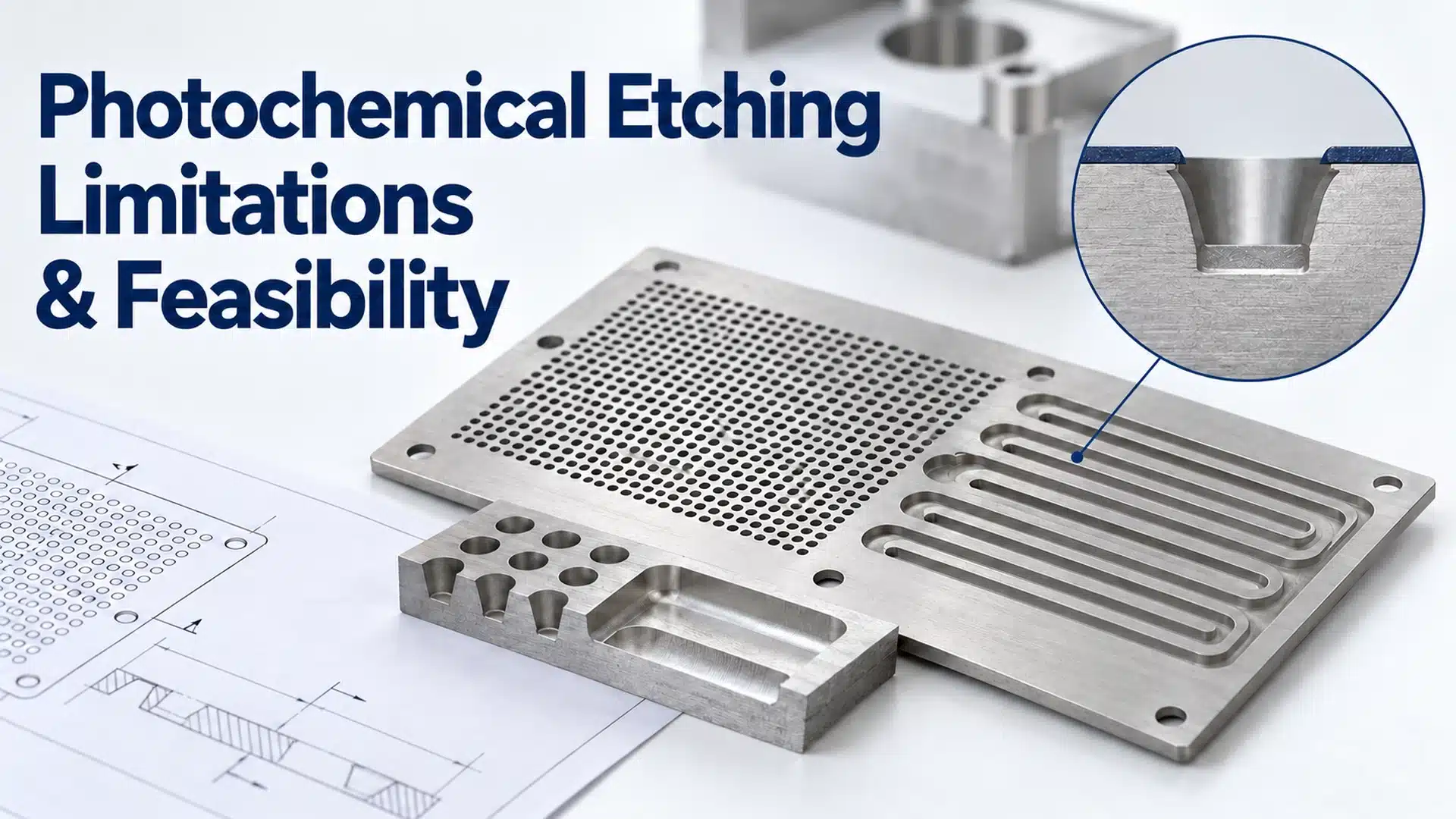
Photochemical etching still has lateral undercut, edge taper, thickness effects, and etch-time sensitivity. Concentration, temperature, process time, material, and geometry influence results.
Thickness Is Not Created by Etching
For a fully etched-through part, final thickness is governed mainly by the incoming sheet or strip. Nominal thickness, material tolerance, temper, flatness, and post-processing all matter.
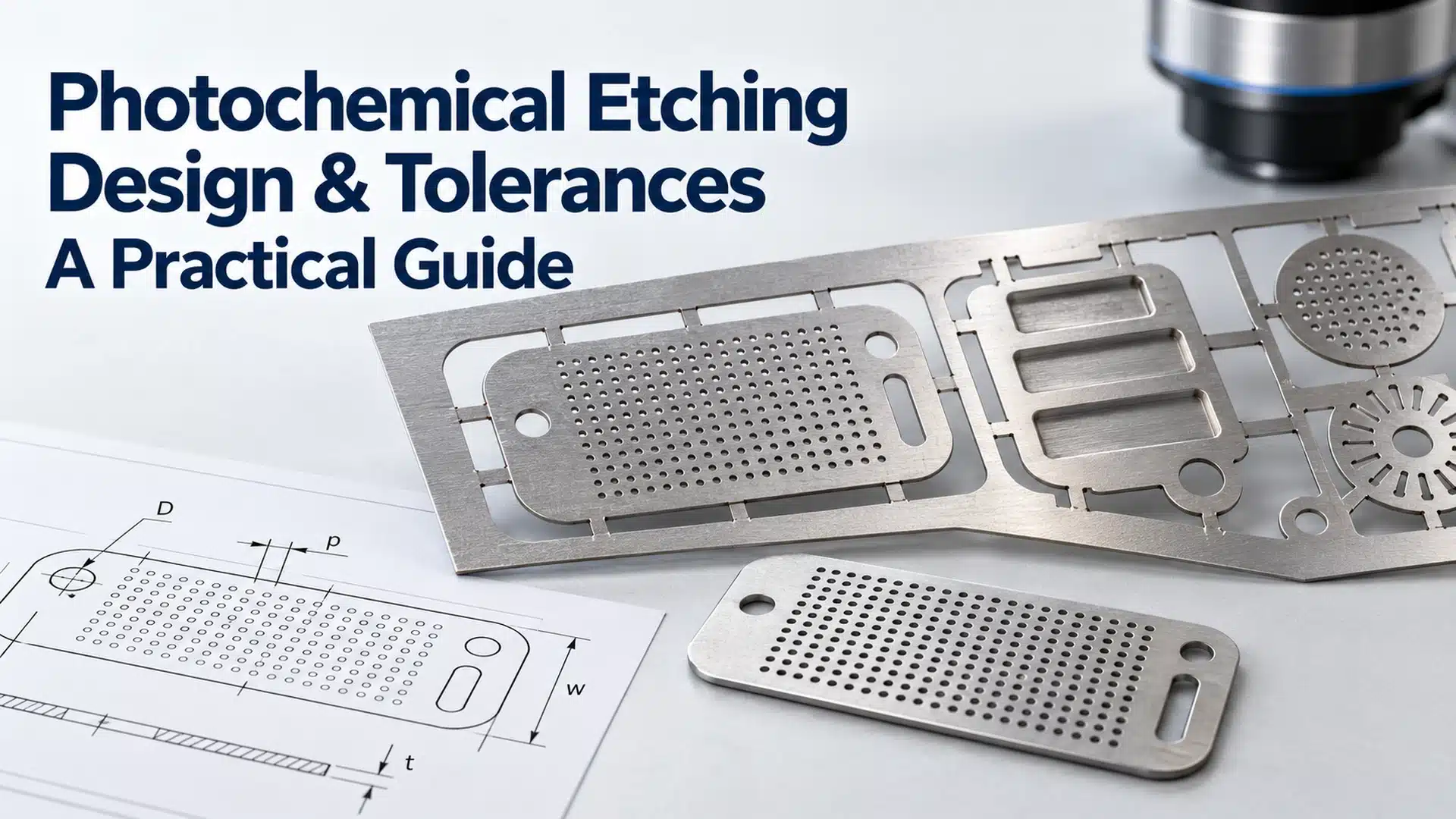
Etching defines the X-Y profile; it does not create an arbitrary final thickness. Specify the stock material, thickness tolerance, flatness, critical features, and inspection method.
Review photochemical etching design limits before assigning narrow webs, small holes, close feature spacing, or half-etched details.
Possible material families include stainless steel, cold-rolled steel, brass, copper, phosphor bronze, and selected nickel alloys. Choose according to load, corrosion, wear, temperature, contact, hardness, electrical requirements, and cost.
TMNetch lists stainless steel, copper, brass, phosphor bronze, beryllium copper, aluminum, titanium, and nickel alloys among its material options. Final suitability remains drawing-specific.
How Should OEMs Validate an Etched Part in the Desk System?
Validate each shim, spacer, encoder disk, or shield at three levels:
| Validation level | What to check | Example evidence |
|---|---|---|
| Component | Material, thickness, profile, holes, flatness, burrs, and finish | Inspection report and lot identification |
| Assembly | Fit, orientation, fastener engagement, shaft position, sensor gap, and grounding | Assembly measurement and functional check |
| System | Travel, skew, current, noise, stability, obstruction response, and endurance | Test conditions, raw data, and failure criteria |
Test unloaded and loaded conditions, symmetric and off-center loads, power interruption, and repeated cycles.
For electronic parts, include sensor output, controller errors, EMC behavior where relevant, and signal changes after assembly.

OEM Procurement Checklist for Precision Etched Parts
An RFQ should give the supplier enough information to understand both the part and its role in the desk system.
Include:
- Current 2D drawing, CAD file, or DXF with revision number;
- Functional datums, critical dimensions, assembly location, and measured interface error;
- Material grade, temper, nominal thickness, and thickness tolerance;
- Profile, hole, slot, web, flatness, and half-etch requirements;
- Surface finish, plating, bending, cleaning, and packaging requirements;
- Prototype and production quantities, inspection documents, traceability, and sampling requirements;
- Application conditions, load, temperature, vibration, contact environment, validation tests, and acceptance criteria.
For drawings, use consistent GD&T language and identify dimensions that control fit, motion, sealing, sensing, or electrical contact. ASME Y14.5 and ISO 1101 provide recognized frameworks.
Identify finished-desk standards by market and product scope. ANSI/BIFMA X5.5 addresses desk and table safety and performance. ISO 9241-5 and EN 527 cover workstation dimensions and office-table safety. UL 2999 may apply to certain commercial furnishings, so confirm the certification route.
Ask for a manufacturability review before fixing price or delivery.
Frequently Asked Questions
What parts of a smart standing desk can be made by photochemical etching?
Potential parts include thin shims, washers, spacers, encoder disks, retainers, contact parts, and selected EMI/RFI shielding components. The function must match the material and thickness.
Are etched shims standard components in standing desks?
Etched shims should not be treated as universal standing-desk components. Consider them only after defining the interface error, compensation range, and validation method.
Can a metal shim fix a wobbly standing desk?
Only in a limited case. A shim may correct a measured static offset at an approved interface. It cannot repair worn glides, bent profiles, uneven floors, loose fasteners, sensor faults, or synchronization problems.
How does a standing desk know its height?
Depending on the design, the controller may use position pulses, Hall sensing, motor-current information, tilt sensing, or another method. An encoder disk is only one possibility.
What should I send for an etched-part RFQ?
Send the interface drawing, material grade, nominal thickness, tolerance, quantity, inspection needs, application conditions, and the measured problem.
Final Thoughts
A smart standing desk coordinates the motor, lifting column, frame, feedback, and safety logic. Precision etched parts may support selected interfaces for spacing, axial position, sensing patterns, or shielding.
Define the failure, measure the interface, select the process, and validate the assembly.
TMNetch states that it has specialized in photochemical etching since 2011 and operates an ISO 9001:2015-certified facility in Dongguan, China. Its public materials list etched shims, encoder-related components, EMI/RFI shielding, and multiple metal families. Final suitability remains project-specific.
Get in Touch
If you are developing a lifting column, actuator, control module, or smart standing desk, send the interface drawing for review with the material grade, nominal thickness, tolerance, quantity, inspection requirements, and application conditions.