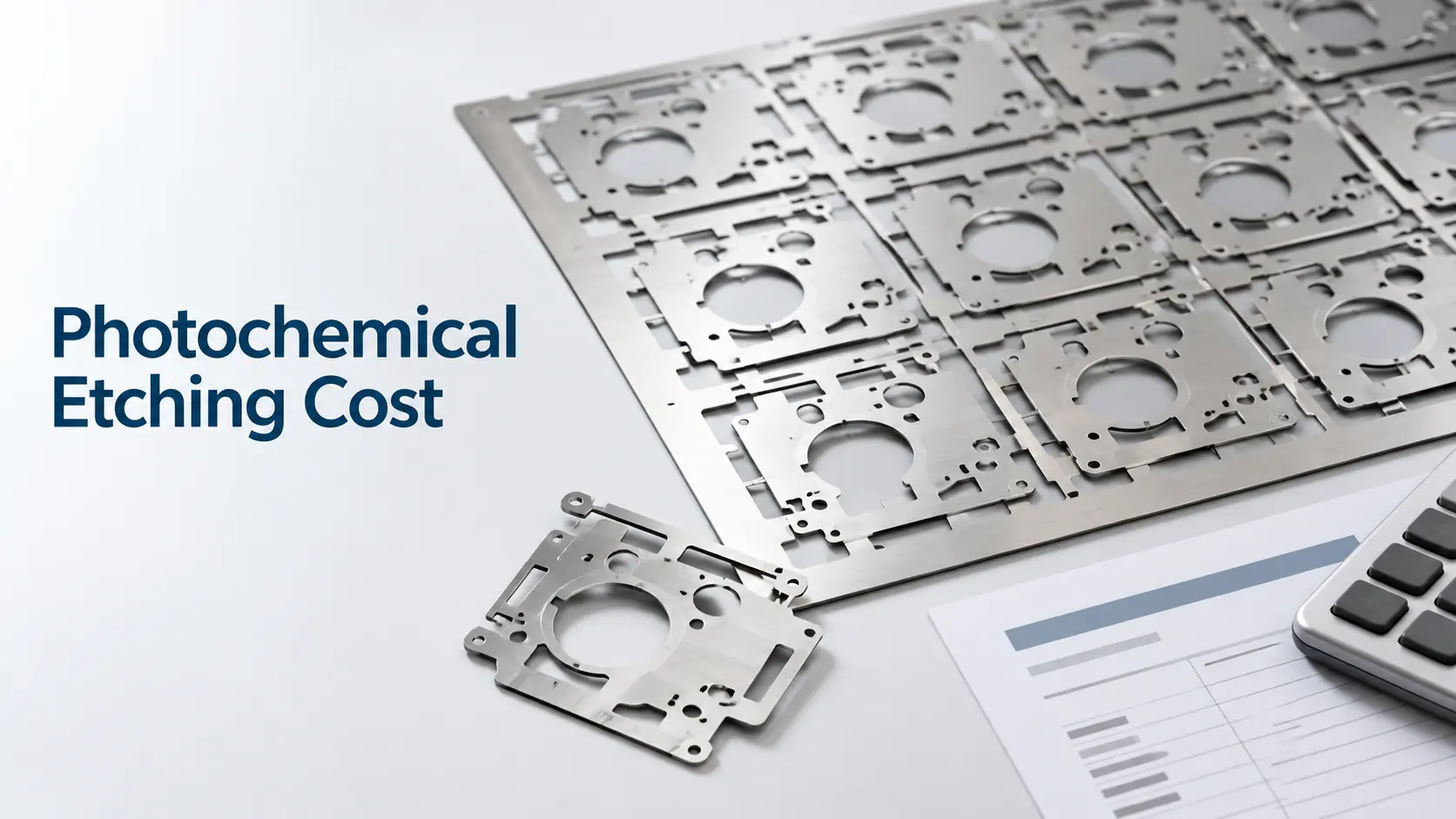

Brass photochemical etching is a precision manufacturing process used to produce thin, detailed metal components without mechanical cutting or high-temperature machining. It combines UV-sensitive photoresist, digital tooling and controlled chemical etching to remove selected areas from a brass sheet.
The process is suitable for complex profiles, fine holes, narrow slots and repeated patterns. Common products include EMI shields, electrical contacts, encoder discs, shims, washers and decorative components.
This guide explains how brass photochemical etching works, which brass grades can be processed and which design factors should be reviewed before production.
What Is Brass Photochemical Etching?
Brass photochemical etching, also called brass photo etching or photochemical machining, is a subtractive sheet metal manufacturing process.
A UV-sensitive photoresist is applied to the brass sheet. A digital pattern is transferred onto the resist through controlled exposure and development. The unprotected metal is then removed by a chemical etchant.
The process is particularly useful when a design contains many holes, complex internal profiles or fine repeating features. Unlike conventional stamping, it does not require a hardened production die for every new geometry.
Why Brass Is a Good Choice for Photochemical Etching?
Brass is one of the most popular metals used in photochemical etching. It provides a quality mix of detail control. Many industries choose brass because it performs well during the etching process. The metal responds well to chemicals, holds, and stays flat. Let’s look at three main reasons manufacturers prefer brass for etching.
1. Excellent Etchability
Brass responds well to controlled chemical etching processes. Ferric chloride is commonly used to remove exposed metal while the required part areas remain protected by photoresist.
The final etching result depends on more than the chemical type. Etchant concentration, temperature, spray pressure, conveyor speed and brass composition all affect the removal rate and edge profile.
Chemical etching removes material both vertically and laterally. This lateral removal is known as undercut. It cannot be completely eliminated, but manufacturers can control and compensate for it when preparing the phototool.
This compensation helps produce finished holes, slots and outside dimensions that match the approved drawing. Customers should normally provide final required dimensions rather than adjusting their drawings for undercut.
2. Dimensional Stability
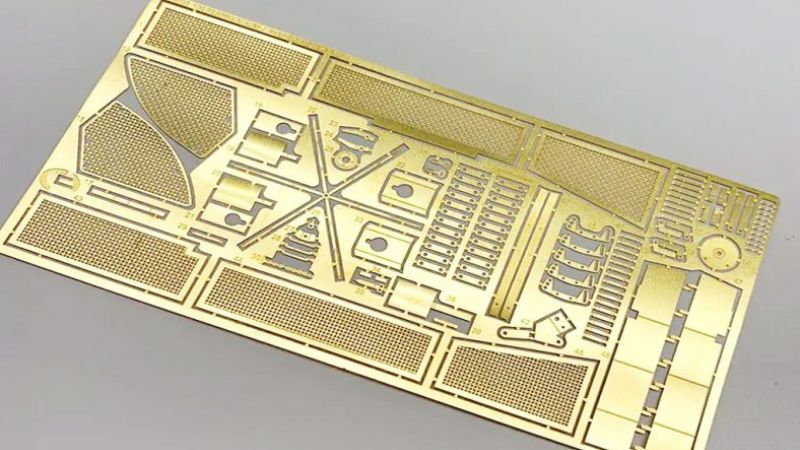
Photochemical etching does not apply the punching or cutting force used in stamping and mechanical machining. This reduces the risk of introducing mechanical stress into thin brass sheets.
The process can therefore help maintain flatness when producing detailed flat components. This is important for EMI shields, electrical contacts, encoder discs and precision shims that must fit closely with other parts.
However, brass does not remain perfectly flat under every condition. Material temper, residual stress, part size and feature distribution can all affect the final flatness.
Large open areas or uneven feature patterns may make a thin part more flexible. Secondary operations such as forming, polishing and plating may influence final shape, dimensions and surface condition. Projects requiring several operations should be reviewed as a complete etching and secondary-processing workflow during the design-for-manufacturability stage.
3. Smooth Surface Finish
Photochemical etching does not create the conventional shearing burrs found on punched or mechanically cut edges. This can reduce the need for separate deburring operations.
The process produces a characteristic etched edge rather than a perfectly vertical machined wall. Edge shape depends on material thickness, etching direction and process control.
The original brass surface outside the etched areas is generally preserved because it remains protected by photoresist. Surface appearance can still be affected by material condition, cleaning quality and post-etch handling.
When the final part requires soldering, bonding or plating, the surface requirements should be defined before production. Tin, nickel, silver and other deposited finishes may affect dimensions, conductivity, corrosion resistance and appearance. If the brass part requires a deposited surface layer, define the finish and thickness before production and review the available custom metal plating services.
Common Brass Grades for Photochemical Etching
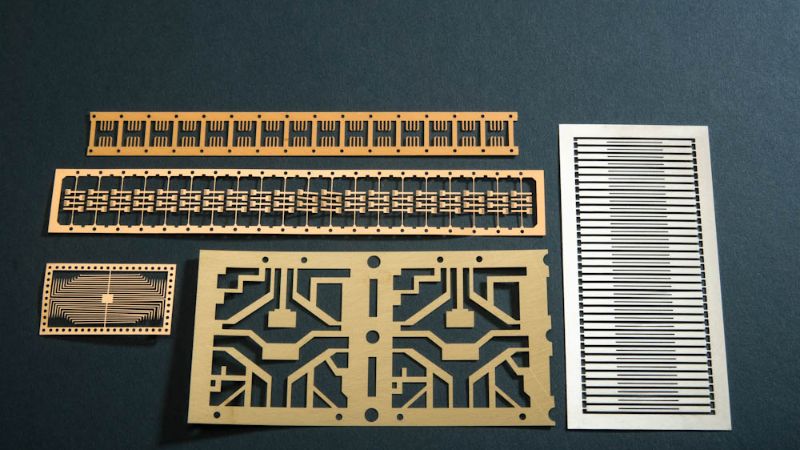
The best brass grade depends on conductivity, strength, forming requirements, corrosion resistance, and appearance. TMNetch’s copper and brass etching capabilities cover several copper alloys, but final feasibility must be confirmed against the exact grade, temper, thickness, and drawing.
C260 Cartridge Brass
C260 is widely used for formed and stamped components. It provides good ductility and can be considered when an etched part requires later bending or forming.
Typical applications include:
- Electrical contacts
- Connector components
- EMI and RFI shields
- Decorative metal parts
- Thin springs and clips
- Precision shims
C230 Red Brass
C230 contains a higher proportion of copper than many common yellow brasses. It has a reddish appearance and is often selected for decorative, architectural and corrosion-resistant components.
Typical applications include:
- Decorative panels
- Nameplates
- Identification parts
- Architectural details
- Electrical components
C280 Muntz Metal
C280 has a higher zinc content than C260 and is commonly considered for applications that require strength and cost control.
Its suitability for very fine etched features, tight tolerances or secondary forming should be reviewed with the manufacturer before the material is finalized.
Other Brass Grades
Other brass alloys may also be processed, but they should not automatically be treated as direct substitutes.
The following details should be provided during quotation:
- Brass grade or material standard
- Sheet thickness
- Temper or hardness
- Surface condition
- Critical dimensions
- Required plating or finishing
- Forming requirements
- Annual production volume
Brass Grade Comparison
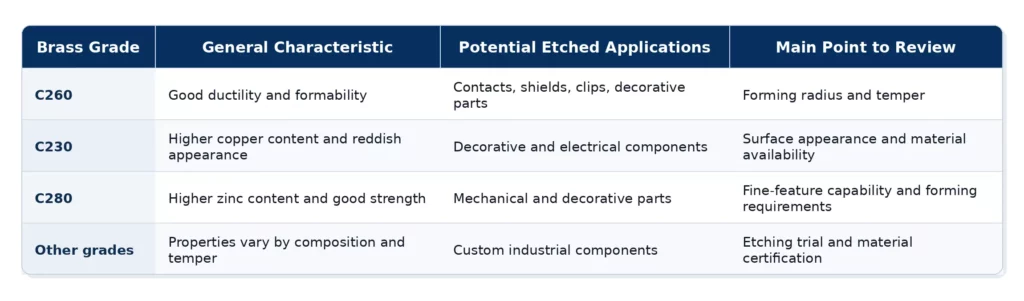
How does Brass Photochemical Etching Work?
The industrial photo etching process normally includes material review, surface cleaning, photoresist application, imaging, development, chemical etching, resist stripping, and dimensional inspection.
Each stage affects the final dimensions. Process control is therefore more important than simply leaving the metal in an etchant for a fixed period.
Step 1: Material and Drawing Review
The process begins with a review of the customer drawing and material specification.
The manufacturer checks:
- Brass grade
- Sheet thickness
- Part dimensions
- Minimum holes and slots
- Critical tolerances
- Half-etched features
- Attachment tabs
- Plating and forming requirements
Potential manufacturing risks should be identified before the phototool is prepared.
Step 2: Brass Sheet Cleaning
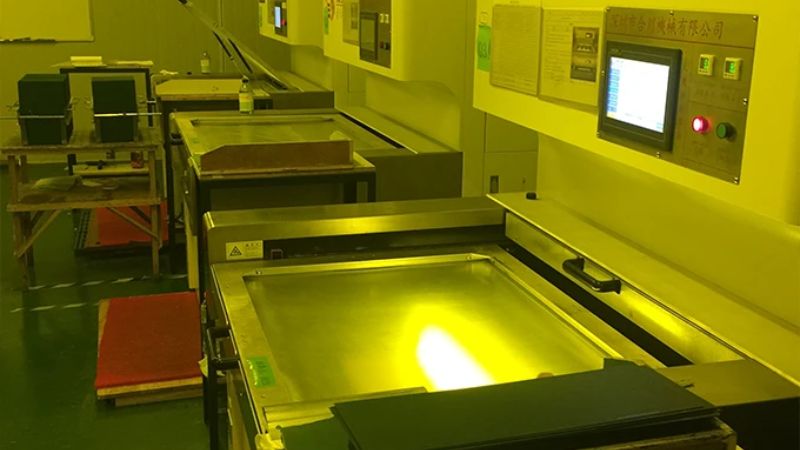
Oil, oxidation, dust and surface residue can prevent the photoresist from bonding correctly.
The brass sheet is therefore cleaned and prepared to create a uniform active surface. Inconsistent cleaning can cause poor resist adhesion, incomplete features or irregular etching.
The cleaned sheet should not be contaminated before photoresist application.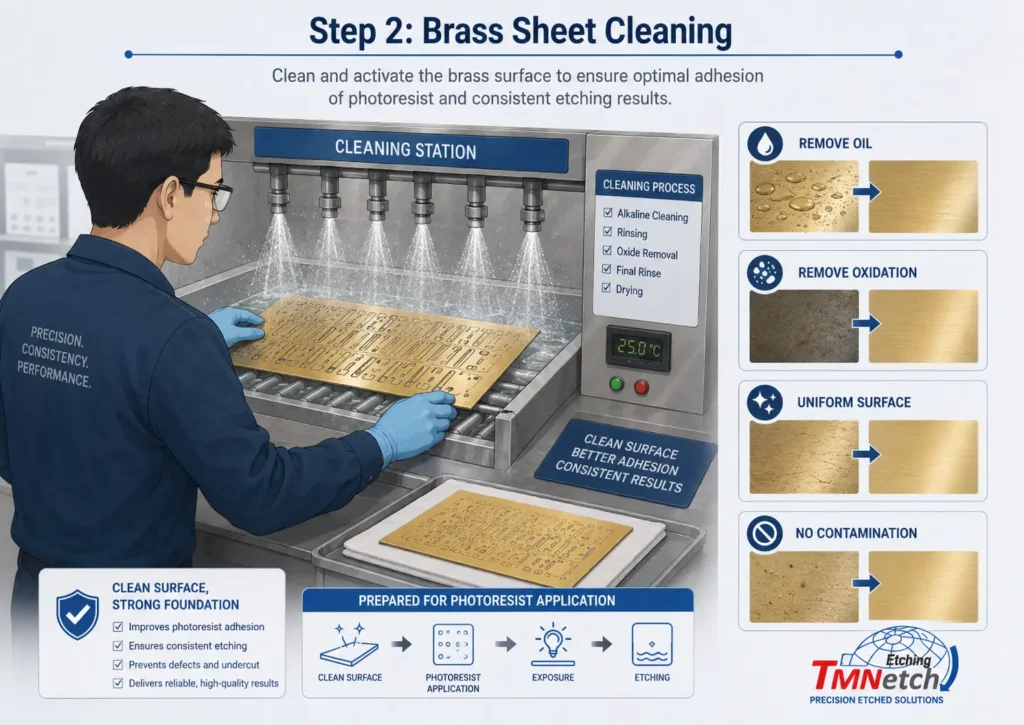
Step 3: Photoresist Application
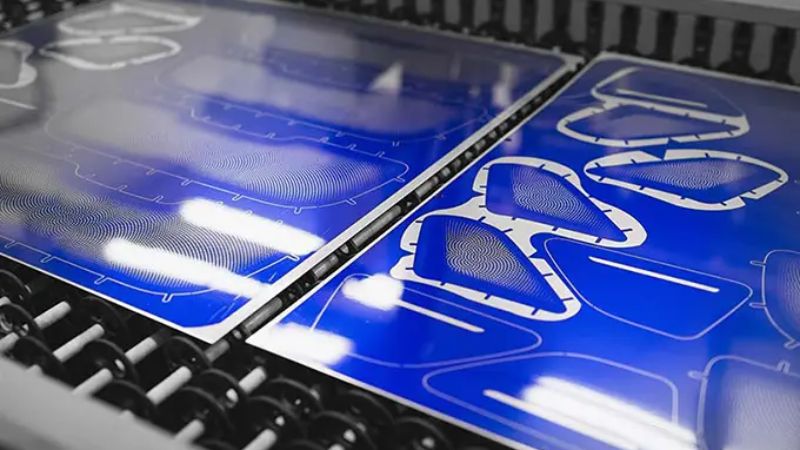
A UV-sensitive photoresist is applied to one or both sides of the brass sheet.
Dry-film photoresist is commonly laminated with controlled heat and pressure. The coating must remain uniform and free from bubbles, wrinkles and particles.
Double-sided coating is normally used when the part must be etched through the full sheet thickness from both sides.
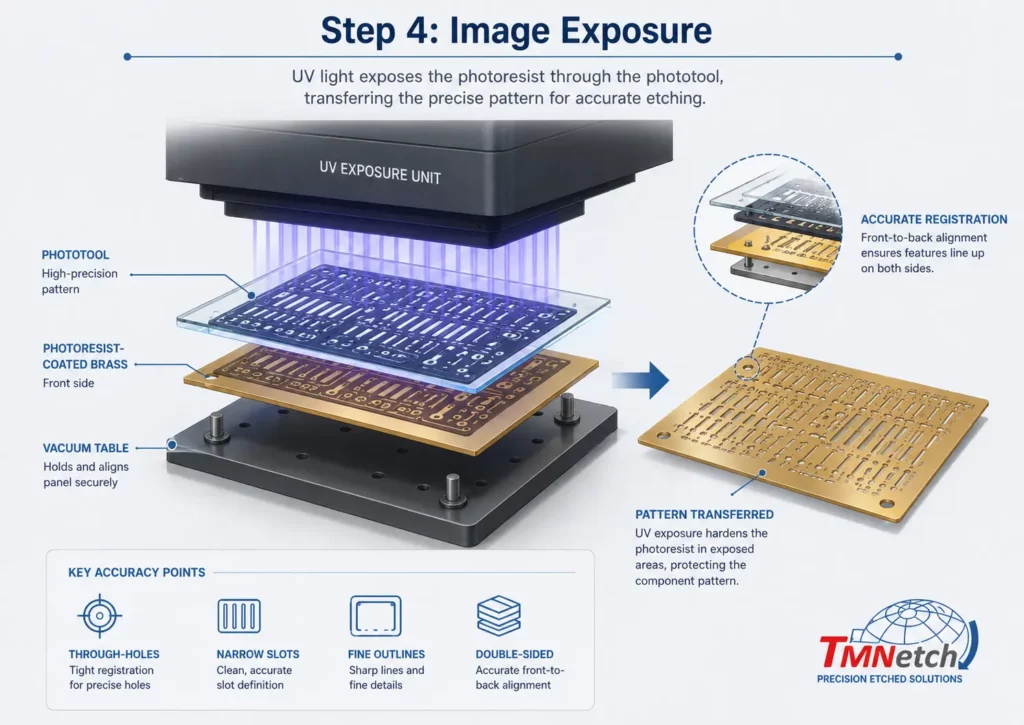
Step 4: Image Exposure
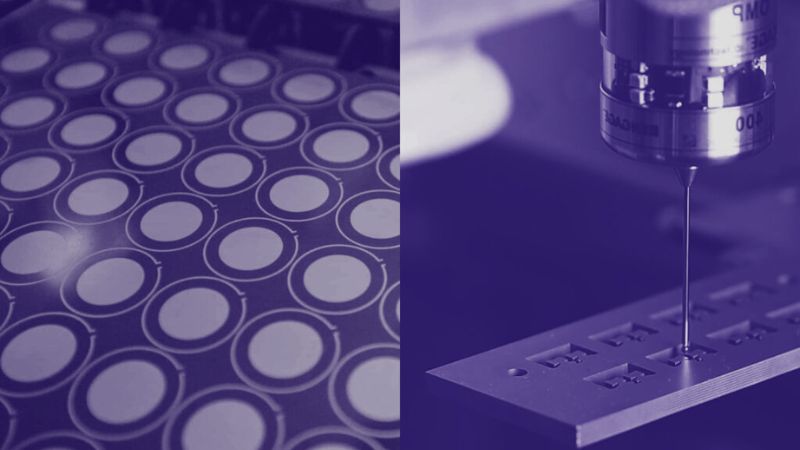
The coated sheet is aligned with a phototool or digital imaging system. UV light hardens the areas of resist that must protect the final component.
Accurate front-to-back alignment is important for:
- Through-holes
- Narrow slots
- Fine outlines
- Double-sided details
- Controlled edge profiles
Incorrect exposure or registration can change feature dimensions and produce uneven edges.
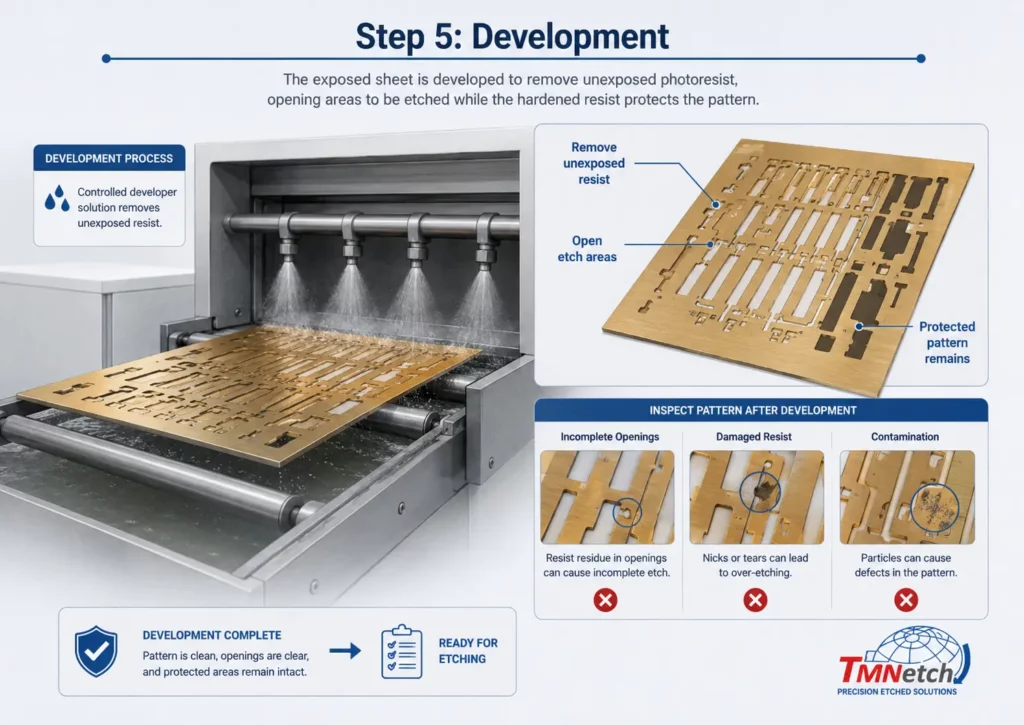
Step 5: Development
The developed sheet passes through a controlled solution that removes the unexposed photoresist.
This reveals the brass areas that must be dissolved during etching. The protected areas remain covered by the hardened resist.
After development, the pattern should be inspected for incomplete openings, damaged resist or contamination.
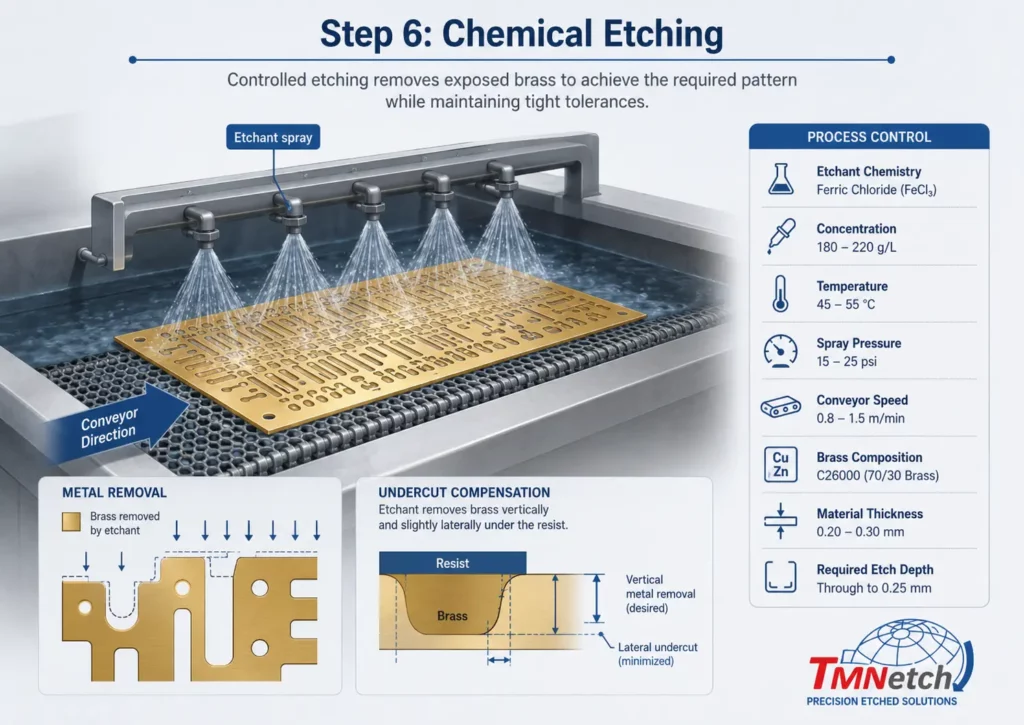
Step 6: Chemical Etching
The prepared brass sheet enters the etching line. Etchant is sprayed onto the exposed areas while the sheet moves through the machine.
Important control factors include:
- Etchant chemistry
- Etchant concentration
- Temperature
- Spray pressure
- Conveyor speed
- Brass composition
- Material thickness
- Required etch depth
As the etchant removes metal vertically, it also removes a limited amount of metal laterally beneath the resist. This effect is called undercut and must be considered during phototool compensation.
Step 7: Resist Stripping and Cleaning
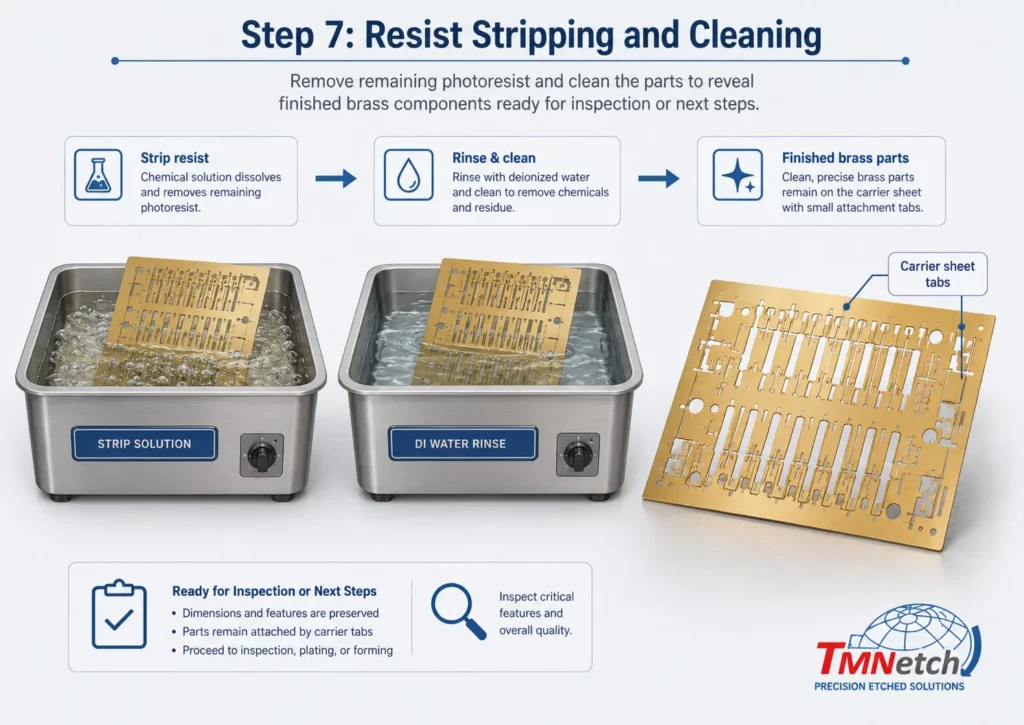
After etching, the remaining photoresist is removed. The sheet is then rinsed and cleaned to expose the finished brass components.
Parts may remain attached to a carrier sheet by small tabs until inspection or secondary processing is complete.
Step 8: Dimensional Inspection
The finished components are checked against the approved drawing.
Inspection may include:
- Overall dimensions
- Hole and slot dimensions
- Feature position
- Edge condition
- Flatness
- Surface condition
- Half-etch depth
- Plating or finishing requirements
Critical dimensions should be clearly identified on the drawing so that the inspection plan can focus on the features that affect assembly and function.
Brass Photochemical Etching Design Guidelines
Photochemical etching can produce complex brass components, but it is not dimensionally unlimited. The drawing should be reviewed according to material thickness, feature type and tolerance requirements.
The following rules are general DFM principles. Final values must be confirmed for the selected brass grade and sheet thickness.
Minimum Hole and Slot Size
The minimum practical hole or slot size normally increases as the brass sheet becomes thicker.
Very small openings are more difficult to etch completely because the etchant must remove metal through the full thickness while controlling lateral undercut.
For each critical hole or slot, specify:
- Finished opening size
- Positional tolerance
- Whether the opening is functional
- Mating component dimensions
- Acceptable edge profile
Do not apply a single minimum-hole value to every material thickness.
Minimum Land and Bridge Width
The land is the strip of metal between two adjacent openings.
If the land is too narrow, etching from both sides may weaken or remove it. Minimum land width should therefore be reviewed in relation to sheet thickness, feature length and surrounding geometry.
Long narrow bridges may also require additional handling support.
Inside and Outside Corners
Perfectly sharp internal corners are difficult to maintain because etchant attacks the exposed metal from several directions.
Small radii can improve dimensional consistency and reduce local over-etching. Outside corners may also become slightly rounded during processing.
The drawing should distinguish between visually preferred corners and functionally critical corners.
Undercut and Etch Compensation
During etching, metal is removed both through the sheet and sideways beneath the resist edge.
This lateral removal is known as undercut. The phototool is normally compensated so that the finished feature matches the customer drawing after etching.
Undercut is affected by:
- Material thickness
- Alloy composition
- Etchant condition
- Etch time
- Spray distribution
- Feature orientation and density
Customers should provide finished dimensions rather than attempting to calculate phototool compensation themselves.
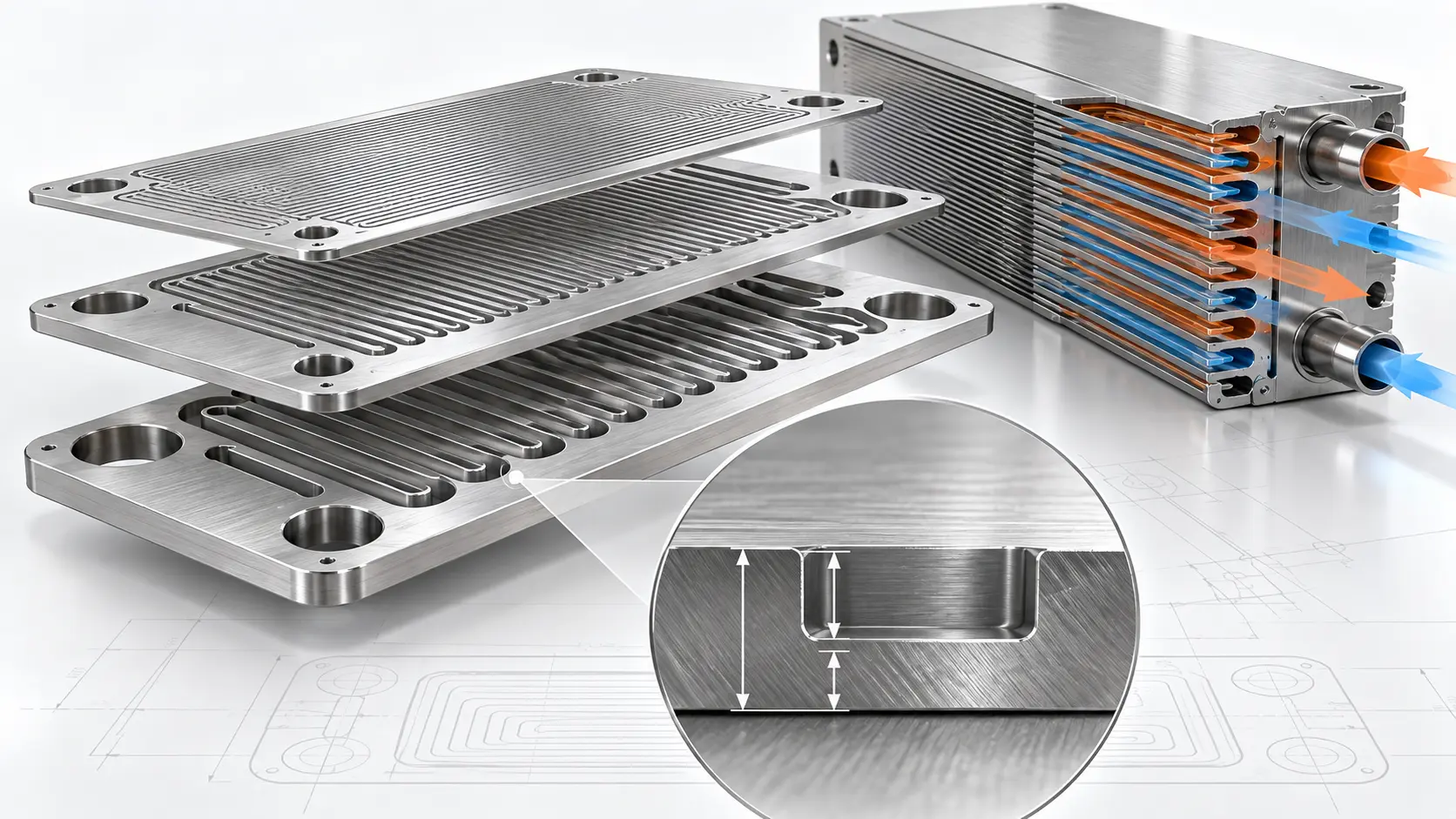
Half-Etched Features
Partial or half etching can be used to create:
- Bend lines
- Recessed areas
- Identification marks
- Logos
- Step features
- Assembly locations
Half-etched depth is generally less precise than a full through-etched outline. The drawing should state whether the depth is functional or only used as a visual or forming aid.
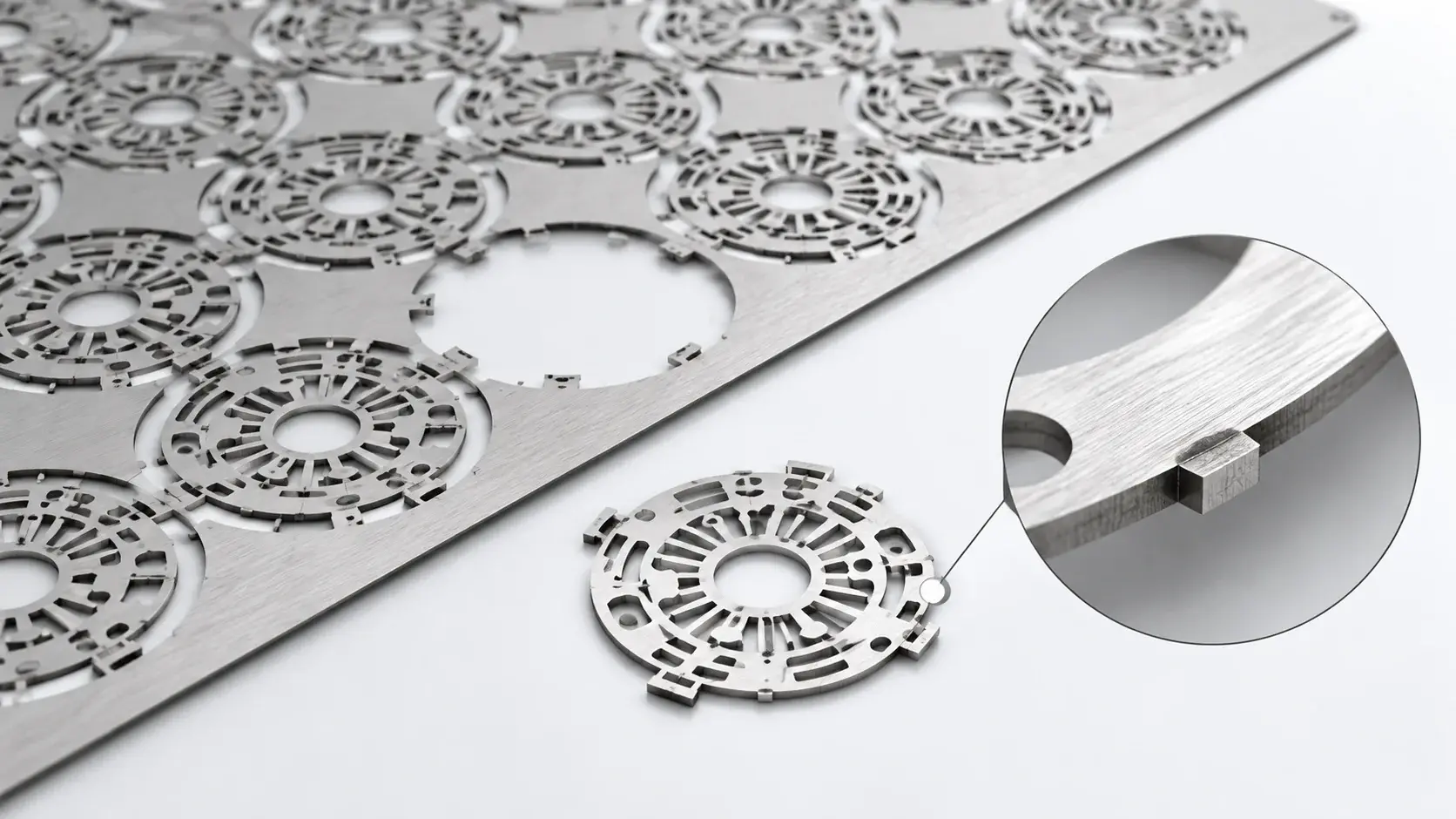
Attachment Tabs
Small tabs can hold multiple components inside the production sheet.
Tab position should avoid:
- Functional sealing edges
- Electrical contact surfaces
- Visible cosmetic edges
- Tight assembly locations
- Areas that require later forming
The drawing should also state whether parts may be supplied in sheets or must be separated before delivery.
Single-Sided and Double-Sided Etching
Double-sided etching is commonly used to cut through a brass sheet more evenly.
Single-sided or asymmetric etching may be selected for recessed details, markings or special edge profiles. These features require accurate front-to-back registration and a clear depth specification.
Tolerances and Cost
Not every dimension requires the tightest available tolerance.
Overly tight tolerances can increase:
- Engineering review time
- Process control requirements
- Inspection time
- Sampling requirements
- Scrap risk
- Overall production cost
Separate critical dimensions from reference or non-functional dimensions. This helps the manufacturer focus process control where it has the greatest effect on product performance.
Common Applications of Photo-Etched Brass Parts
Brass combines electrical conductivity, formability, surface appearance and compatibility with several finishing processes. These properties support a wide range of industrial applications.
EMI and RFI Shielding Components
Photo etching can produce custom EMI and RFI shielding components, including brass shielding cans, covers, frames and ventilation patterns, without conventional stamping dies.
Brass shields may also be formed or plated after etching. The design review should include bend lines, grounding points, soldering requirements and final surface treatment.
Electrical Contacts and Connector Components
Brass is used for terminals, contact elements, connector parts and conductive spring components.
Material grade and temper are especially important when the part must flex, carry current or undergo repeated insertion cycles.
Precision Shims, Washers and Spacers
Chemical etching is suitable for custom metal shims, washers and spacers made from brass and other alloys, especially when the design contains custom profiles, slots or multiple internal openings.
The process is particularly useful for prototypes, low-to-medium volumes or designs that would require complex conventional tooling.
Encoder Discs and Optical Components
Etched brass can be used for encoder discs, timing discs and light-control components with repeated slots or openings.
For these applications, feature position, pitch consistency, concentricity and flatness may be more important than the tolerance of one individual slot.
Decorative and Identification Parts
Brass is also used for custom metal engraving and decorative components, including:
- Nameplates
- Logos
- Decorative grilles
- Model components
- Architectural details
- Identification plates
Surface appearance should be defined before production. Natural brass, polished brass and plated brass may require different process routes.
Fine Screens and Perforated Components
Photochemical etching can produce custom metal mesh filters and screens with dense hole arrays without punching each opening separately.
When designing a brass screen, review:
- Open-area percentage
- Hole shape
- Land width
- Sheet thickness
- Flatness
- Required flow or filtration performance
FAQs
What chemical is used for industrial brass etching?
Ferric chloride and other copper-alloy-compatible etchants may be used in industrial brass etching. The exact chemistry depends on the brass grade, production equipment and required feature quality.
Industrial production also controls etchant concentration, temperature, spray pressure and exposure time. The process should not be treated as a simple acid-soaking operation.
How thick can photo-etched brass be?
The practical thickness range depends on the brass grade, part dimensions, feature sizes and required tolerances.
Thicker sheets require more material removal and normally need larger minimum holes, slots and land widths. Submit the drawing and material specification for a project-specific capability review.
Can brass be etched without burrs?
Photochemical etching does not create the conventional cutting burrs associated with mechanical shearing. However, parts may still have attachment tabs or a characteristic etched edge profile.
The tab location and edge requirements should be defined during the DFM review.
Final Thoughts
Brass photochemical etching is a practical option for producing thin and complex components without conventional cutting burrs or mechanical cutting stress. It works well for parts with fine holes, narrow slots and repeated patterns.
The process is commonly considered for EMI shields, electrical contacts, shims, washers, encoder discs and decorative brass components. It is also useful when a project is still in the prototype stage or may require future design changes.
Successful production depends on more than following the seven basic steps. Engineers must review the brass grade, thickness, minimum feature sizes, undercut, tolerances and secondary operations as one complete manufacturing system.
Avoid assigning tight tolerances to every dimension unless they are functionally necessary. Mark critical features clearly and provide final finished dimensions rather than making your own phototool compensation.
Plating, forming, polishing and packaging requirements should be shared at the quotation stage. Use this chemical etching buyer’s checklist to prepare the drawing, material, tolerance, inspection and secondary-processing information required for supplier evaluation.
Get In Touch
TMNetch provides custom brass etching services for precision components made from C260, C230, C280, and other copper alloys, subject to material and drawing review. Send the brass grade, temper, thickness, quantity, critical dimensions and finishing requirements for an engineering assessment.
For a faster technical review, please provide:
- A dimensioned DXF, DWG, STEP or PDF drawing
- Brass grade and material thickness
- Material temper when applicable
- Critical dimensions and tolerances
- Required quantity and annual demand
- Plating, forming or polishing requirements
- Inspection and packaging requirements
Share your drawing and project requirements with TMNetch for a project-specific DFM review and quotation.