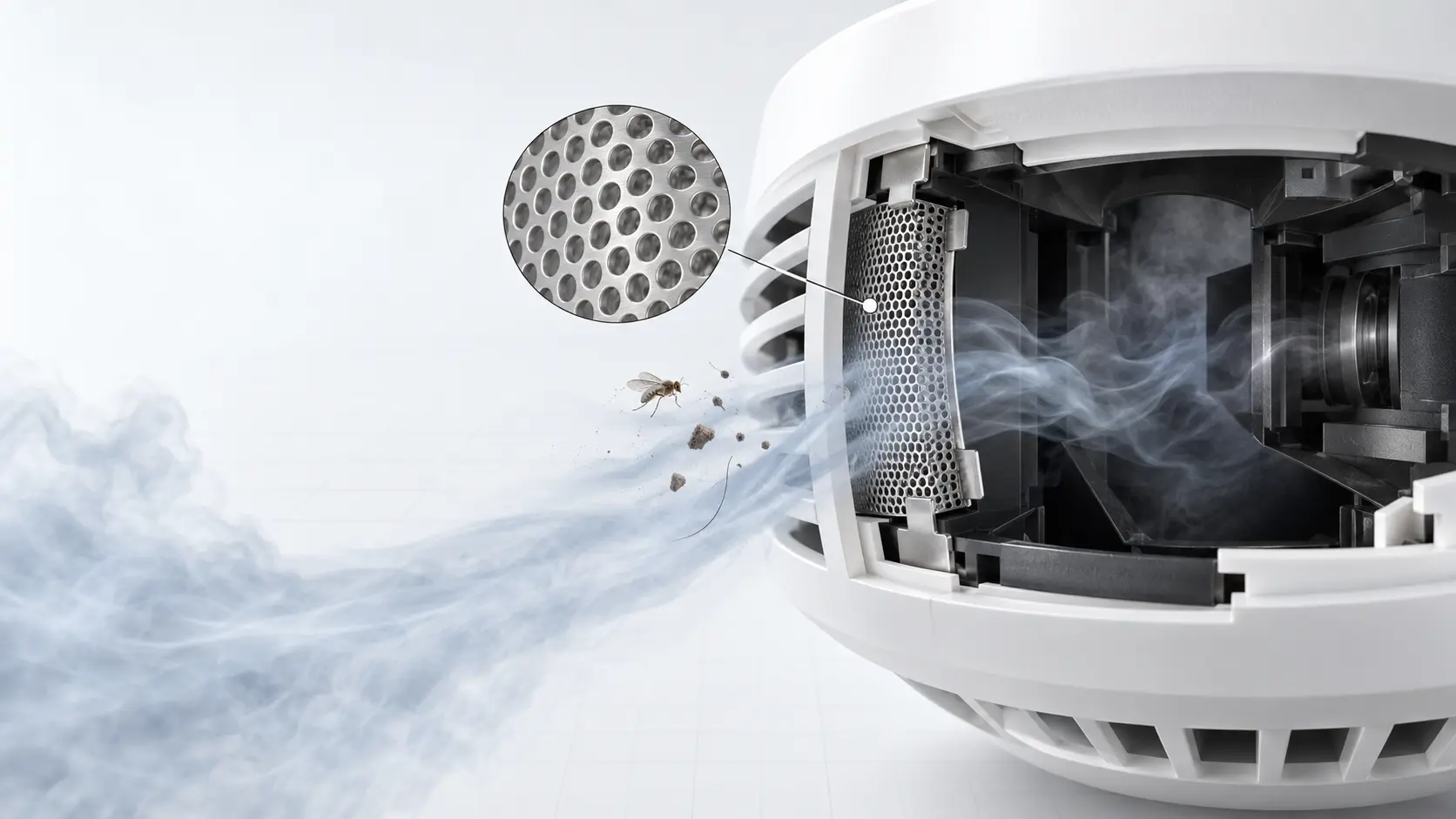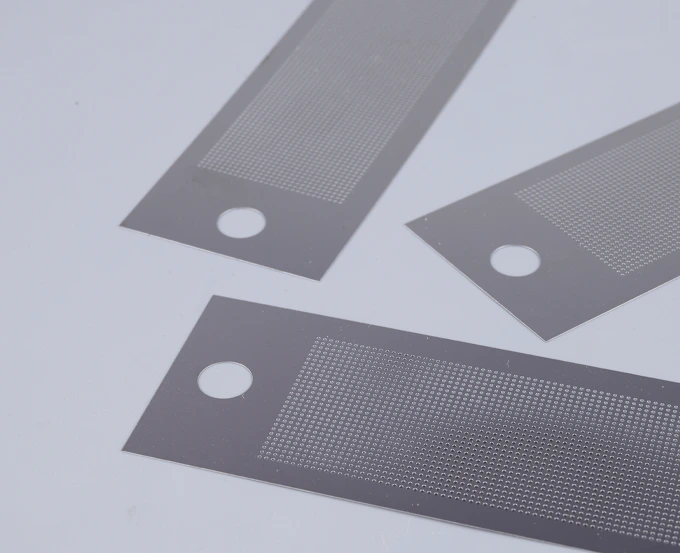

Stainless Steel Etching is a precision manufacturing process that removes selected areas of stainless steel to create fine patterns, holes, slots, channels, or complete metal part profiles. In industrial production, the most common methods are stainless steel chemical etching and stainless steel photo etching. These methods use a photoresist mask to protect the required areas while controlled etchants remove exposed metal.
For buyers, stainless steel etching is useful when the part is thin, flat, complex, and needs clean edges with minimal mechanical distortion. Buyers evaluating a live drawing can review TMNetch’s stainless steel etching service before requesting a manufacturing review. Etched stainless steel parts are widely used in electronics, automotive, medical, aerospace, energy, filtration, and precision assembly applications.
What Is Stainless Steel Etching?
Stainless Steel Etching is a controlled process for selectively removing stainless steel from a sheet or foil. The goal is to create functional features such as holes, slots, mesh openings, channels, text, cavities, or complete part outlines.
In industrial use, etching stainless steel is not only a surface decoration method. It can also be used to manufacture precision stainless steel components. These parts may support shielding, filtering, spacing, sensing, sound transmission, heat transfer, or fluid control.
TMNetch describes its stainless steel etching process as a way to create patterns, cavities, and features through controlled chemical reactions, without mechanical cutting or stamping. The same page also describes the result as burr-free and stress-free precision components.
Industrial Etching vs Decorative Etching
Industrial Stainless Steel Etching focuses on functional parts. These parts must meet drawing requirements, tolerance targets, edge quality needs, and inspection standards.
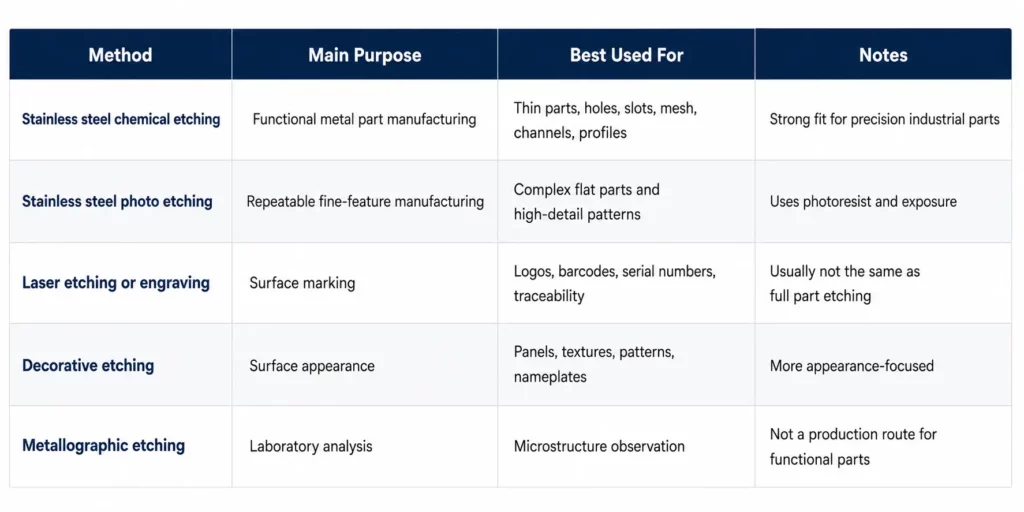
Decorative stainless steel etching focuses more on appearance. It may create logos, textures, patterns, nameplates, or architectural surfaces.
Laser etching stainless steel is also common, but it often serves a different purpose. Laser marking and engraving are widely used for serial numbers, barcodes, logos, and traceability marks on stainless steel surfaces.
This article focuses mainly on industrial stainless steel chemical etching for precision functional parts.
How Does Stainless Steel Etching Work?
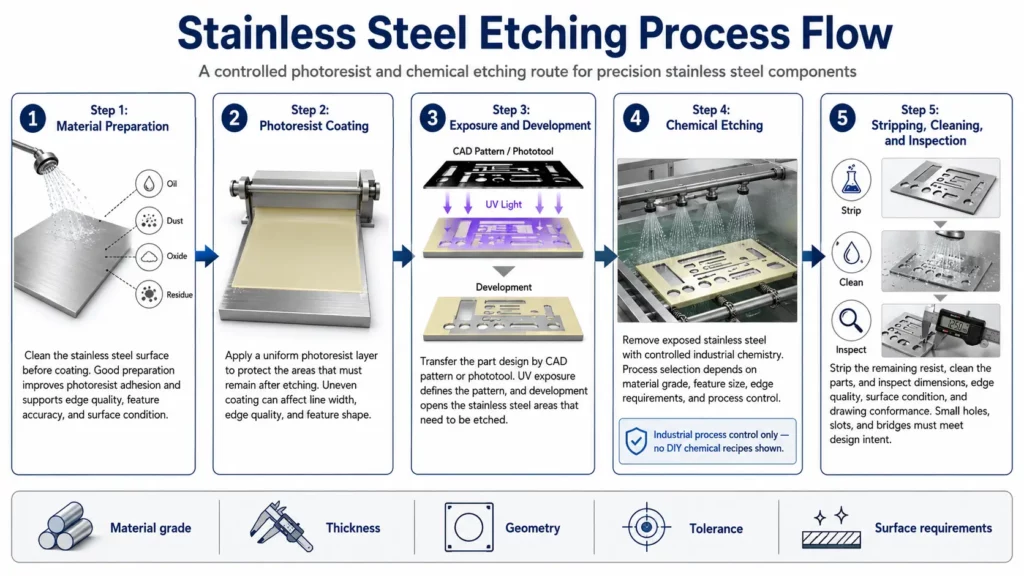
The stainless steel etching process usually follows a controlled photo etching route that combines photoresist imaging with chemical metal removal. The exact process depends on material grade, thickness, geometry, tolerance, and surface requirements. The exact process depends on material grade, thickness, geometry, tolerance, and surface requirements.
Step 1: Material Preparation
The process starts with stainless steel sheet or foil. The surface must be cleaned before coating.
Oil, dust, oxide, and residue can affect photoresist adhesion. Poor surface preparation can lead to uneven edges, incomplete features, or weak pattern transfer.
In our production experience, stainless steel etching quality starts before the etchant touches the metal. Material cleaning, surface preparation, photoresist adhesion, exposure accuracy, and etchant control all affect the final edge quality, feature size, and surface condition.
Step 2: Photoresist Coating
A light-sensitive photoresist is applied to the stainless steel surface. This resist protects the areas that must remain after etching.
The resist layer must be uniform. If the coating is uneven, the etched part may have unstable line width, poor edge quality, or inconsistent feature shapes.
Step 3: Exposure and Development
A CAD pattern or phototool transfers the part design onto the coated sheet. UV exposure hardens or changes the photoresist in the selected areas.
After development, the areas that need to be etched are opened. The protected areas remain covered by resist.
Step 4: Chemical Etching
The exposed stainless steel is removed with controlled chemistry. The protected areas remain in place.
Chemical etching stainless steel may use ferric chloride or other industrial etchants, depending on the grade, feature size, edge requirement, and process control. The article does not cover DIY acid handling or chemical recipes.
Step 5: Stripping, Cleaning, and Inspection
After etching, the remaining photoresist is stripped. The parts are cleaned and inspected.
Inspection may include dimensional checks, edge quality review, surface condition review, and drawing comparison. For precision stainless steel etching, this step is critical because small holes, slots, and bridges must meet the design intent.
Main Types and Methods of Stainless Steel Etching
Stainless Steel Etching can refer to several different methods. Buyers should understand the difference before choosing a process.
Stainless Steel Chemical Etching
Stainless steel chemical etching uses controlled chemistry to remove selected metal areas. It is useful for thin sheet parts that need fine holes, tight patterns, clean edges, or complex profiles.
This method does not rely on mechanical cutting force. That makes it useful for parts where burrs, deformation, or stress may create assembly or performance problems.
Stainless Steel Photo Etching / Photochemical Etching
Stainless steel photo etching, also called stainless steel photochemical etching, combines photoresist imaging with chemical etching. Buyers comparing it with laser cutting, CNC machining, or stamping can review this photochemical etching process and manufacturing comparison. ASM describes photochemical machining as a metal-etching process that uses photoresist to define where the metal will be etched. ASM also lists key process stages such as phototool preparation, metal selection, workpiece preparation, photoresist masking, etching, stripping, and inspection.
TMNetch’s photo etching page describes photo etching as a chemical manufacturing process for accurate metal components. It also states that the process is stress-free and burr-free because chemicals selectively remove metal without physical force touching the part.
Laser Etching or Laser Engraving Stainless Steel
Laser etching stainless steel is often used for permanent surface marking. It can create text, logos, barcodes, serial numbers, safety marks, and traceability codes.
This is useful for identification. However, laser etch stainless steel is not always the same as manufacturing a thin functional part. If the buyer needs holes, slots, channels, mesh openings, or a full etched profile, stainless steel chemical etching may be more relevant.
Decorative Stainless Steel Etching
Decorative etching is used for visible surface patterns. It may be applied to panels, nameplates, signs, appliances, architectural surfaces, or branded parts.
It can be useful, but the quality criteria are often different from industrial precision parts. Appearance, texture, and pattern consistency may matter more than tolerance or functional geometry.
Metallographic Etching
Metallographic etching is a laboratory method used to reveal microstructure for microscopic examination. ASTM E407 covers chemical solutions and procedures used for etching metals and alloys for microscopic examination.
This is different from stainless steel etching service for industrial part production.
Which Stainless Steel Grades Can Be Etched?
Many stainless steel grades can be etched, but the result depends on the grade, thickness, geometry, surface condition, and tolerance requirement.
Stainless steels are commonly grouped into families such as austenitic, ferritic, martensitic, and duplex. These families differ in corrosion resistance, strength, ductility, magnetic behavior, and typical applications. worldstainless describes austenitic stainless steels as containing significant chromium and enough nickel or manganese to stabilize the austenitic structure, with AISI 304 as a common example.
300 Series Stainless Steel
300 series grades, such as 304 and 316L, are common choices for precision etched stainless steel parts. They are often selected for corrosion resistance, formability, and broad industrial use.
304 is common in electronics, filters, general industrial parts, and precision components. 316L is often selected when corrosion resistance is more important, such as in medical, marine, filtration, or demanding industrial environments.
400 Series Stainless Steel
400 series grades, such as 430, may be selected when buyers need cost control, formability, or magnetic behavior. They may be used in decorative, appliance, automotive, or functional industrial parts.
The right material choice depends on the application, not only the etching process. Buyers should review corrosion environment, spring behavior, magnetism, surface finish, finishing needs, and cost.
TMNetch’s stainless steel etching page lists 301/304, 316, 430, and specialty grades for stainless steel etching projects. It also lists stainless steel thickness capability from 0.03 mm to 3.0 mm.
Benefits of Stainless Steel Chemical Etching
Stainless steel chemical etching is useful because it solves several common problems in thin metal part manufacturing.
Burr-Free Edges
Chemical etching does not shear the metal with a cutting tool. This helps reduce mechanical burrs.
Burr-free edges matter for filters, screens, contacts, shims, medical parts, shielding parts, and sealing surfaces. A burr can affect assembly, fit, flow, electrical contact, or safety.
No Mechanical Stress
In stainless steel chemical etching projects, the metal is removed through controlled chemistry rather than punching or cutting force. This helps reduce mechanical stress and distortion.
This is important for thin parts, flatness-sensitive parts, spring parts, shims, and components with narrow bridges.
No Heat-Affected Zone
Chemical etching is not a heat-based cutting method. It can help avoid heat-affected zones that may occur in some thermal processes.
This benefit is useful for thin stainless steel, fine patterns, cosmetic surfaces, and parts that need stable material behavior.
Complex Features Without Hard Tooling
Photo etching can form many holes, slots, and openings at the same time. This is useful for mesh, speaker grilles, filter screens, sensor parts, and repeated arrays.
It also supports faster design changes than hard tooling routes. If a hole pattern, slot layout, or profile needs revision during development, digital tooling can be easier to adjust.
In stainless steel chemical etching projects, we usually review part thickness, stainless steel grade, feature density, hole or slot size, bridge width, tolerance, and surface requirements before confirming whether etching is the right manufacturing route.
Industrial Uses of Stainless Steel Etching
Stainless Steel Etching is used across many industries because stainless steel offers strength, corrosion resistance, and stable performance.
Electronics
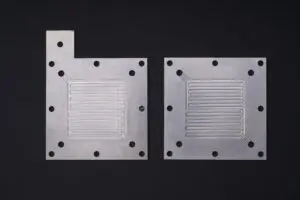
In electronics, etched stainless steel parts can be used for EMI/RFI shielding, board-level shielding, connector contacts, sensor parts, and lead-frame components.
TMNetch’s EMI/RFI shielding page states that chemical etching supports design flexibility, burr-free components, custom markings, and enhanced surface properties through electroplating.
Automotive
Automotive applications may include photo-etched speaker grilles, sensor parts, decorative trim, fuel system components, EV battery parts, and power electronics parts.
Photo etched speaker grilles can use fine holes, detailed patterns, and consistent openings. TMNetch’s speaker grilles page lists stainless steel as one of the suitable materials and highlights fine holes, detailed patterns, and flawless edges.
Medical
Medical applications may include surgical blades, filters, screens, device parts, springs, and fine stainless steel components.
For medical projects, buyers usually need strong control over material grade, edge condition, cleanliness, and documentation.
Aerospace
Aerospace applications may include precision metal shims, washers, and spacers, as well as filters, screens, sensor parts, shielding strips, and heat exchanger plates.
Thin etched parts can help reduce weight while maintaining accurate features. TMNetch’s metal shims, washers, and spacers page highlights flat, stress-free parts, burr-free edges, tight thickness control, and stainless steel material options.
Energy and Fuel Cells
Energy applications may include etched bipolar plates, flow field plates, thermal plates, heat transfer parts, and other hydrogen-system components.
Stainless steel can be useful when the part needs corrosion resistance, mechanical stability, and fine etched channels or openings.
Filtration and Fluid Control
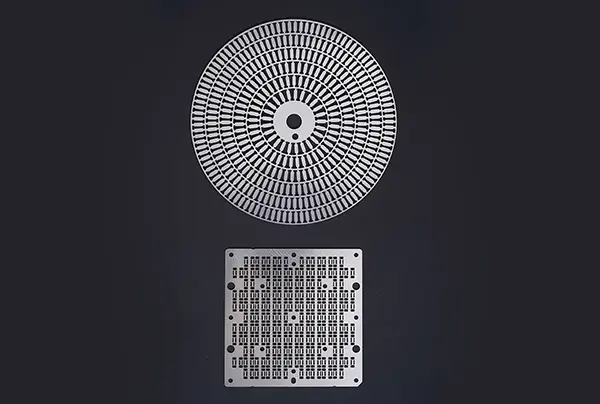
Filtration applications include metal mesh filters and screens, sieves, micro-hole arrays, flow restrictors, and fluid-control plates.
TMNetch’s metal mesh filter and screens page states that photochemical etching can provide clean edges, zero burrs, tight tolerances, design flexibility, and support for stainless steel and other alloys.
When Should Buyers Choose Stainless Steel Etching?
Stainless Steel Etching is strongest when the part is thin, flat, complex, and feature-dense. It is not always the best process for thick 3D parts or deep-formed parts.
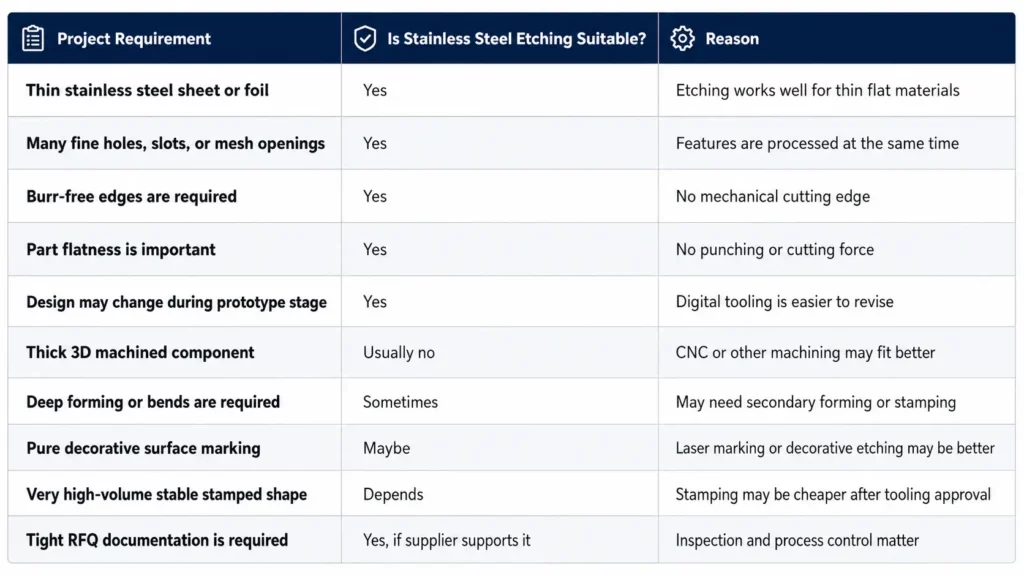
If the drawing contains many small openings, narrow slots, micro holes, or repeated patterns, precision stainless steel etching is worth reviewing early. If the part needs deep forming, heavy load-bearing structure, or thick 3D machining, another process may fit better.
How TMNetch Supports Stainless Steel Etching Projects
TMNetch provides stainless steel etching service for precision metal parts that require controlled patterns, cavities, holes, channels, and burr-free features.
Based on TMNetch stainless steel etching capability data, TMNetch can support stainless steel parts from 0.03 mm to 3.0 mm. TMNetch supports half-etch, full-etch, and double-depth features. For parts that also need plating, forming, polishing, cleaning, or inspection, review its one-stop chemical etching services.
For broader chemical etching capability, TMNetch lists prototypes ready in 6 hours, five fully automated 39-meter lines, accuracy as tight as ±0.025 mm, part sizes up to 600 × 1500 mm, and rigorous inspections on its chemical etching page.
For buyers, the next step is a drawing review. Send the drawing, stainless steel grade, material thickness, tolerance, minimum feature size, surface requirement, annual volume, and application environment. TMNetch can then review whether stainless steel chemical etching is suitable for the part.
FAQ About Stainless Steel Etching
What is Stainless Steel Etching?
Stainless Steel Etching is a precision process that removes selected areas of stainless steel to create holes, slots, channels, patterns, or complete part profiles.
How does stainless steel chemical etching work?
Stainless steel chemical etching uses a photoresist mask to protect the required areas. The exposed stainless steel is chemically removed, then the part is stripped, cleaned, and inspected.
Is laser etching stainless steel the same as chemical etching?
No. Laser etching stainless steel is often used for marking, logos, barcodes, serial numbers, and traceability. Chemical etching stainless steel is more relevant for thin functional parts with holes, slots, mesh, channels, or complete profiles.
What is acid etching stainless steel?
Acid etching stainless steel is a broad term for removing or texturing stainless steel with acidic chemistry. In industrial precision parts, the process should be controlled by professional equipment, process parameters, inspection, and safety systems.
Which stainless steel grades can be etched?
Common grades include 301, 304, 316L, 430, and specialty grades. The final result depends on grade, thickness, geometry, tolerance, surface condition, and supplier capability.
Does stainless steel etching create burrs?
Chemical etching normally avoids mechanical burrs because no cutting tool shears the edge. Buyers should still define edge quality and inspection requirements in the drawing or RFQ.
What are etched stainless steel parts used for?
Etched stainless steel parts are used for filters, screens, EMI/RFI shielding, shims, spacers, speaker grilles, sensor parts, contacts, bipolar plates, medical parts, aerospace components, and precision industrial parts.
What should buyers provide for an RFQ?
Buyers should provide a drawing, stainless steel grade, thickness, tolerance, quantity, minimum feature size, surface requirements, finishing needs, and application information.
Conclusion
Stainless Steel Etching is a precision process for producing thin, complex, burr-free stainless steel parts. Chemical and photochemical etching are the most relevant methods for industrial component manufacturing. Laser and decorative etching are useful for marking or appearance, but they are not always the right route for functional precision parts.
For buyers, the right decision depends on grade, thickness, geometry, tolerance, feature size, edge quality, volume, and inspection needs.
To check whether your part is suitable for stainless steel etching, send your drawing and requirements to TMNetch for an engineering review.