
CNC machining is a core manufacturing method used across modern industries, with trusted supporting manufacturers through reliable, production-focused solutions. For complex components, it provides consistent accuracy coupled with tight tolerances and fast production. More than a few manufacturers are still wondering what is CNC machining and why it really matters in this day and age. Here is a guide about CNC-based machining, including information about the automated CNC-based machining process, varieties of automated machining methods, and details on how high-precision CNC machining for OEM helps meet complex industrial capacity needs.
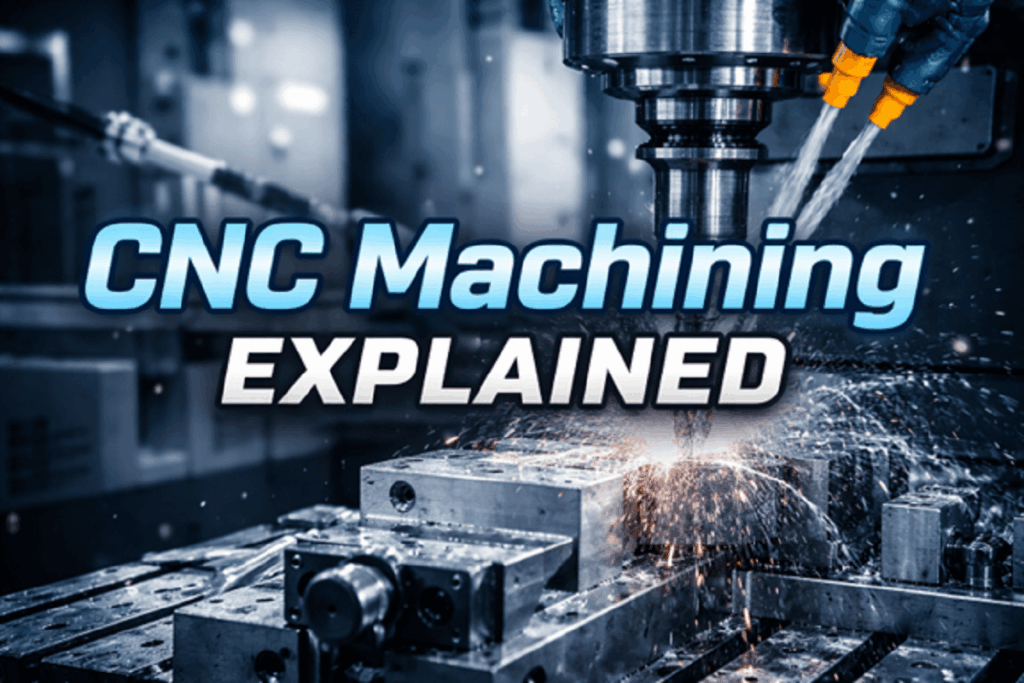
Understanding What Is CNC Machining
One of the questions that might come to the minds of manufacturers stepping into the new realm of advanced manufacturing is machining using CNC technology. This is a manufacturing process that uses programmed machines to remove material with extreme precision. By automating the machining process, the advantages of CNC machining include precision, repeatability, and minimization of human error, all of which take CNC machining above and beyond.
The CNC Machining Process Explained
CNC-based machining is highly structured in terms of workflow to ensure accuracy, consistency and repeatability. To really define how CNC-based machining works, it must be viewed through the lens of how each step links technology and automation, but most importantly, the advantages of CNC machining can take place in true manufacturing environments.
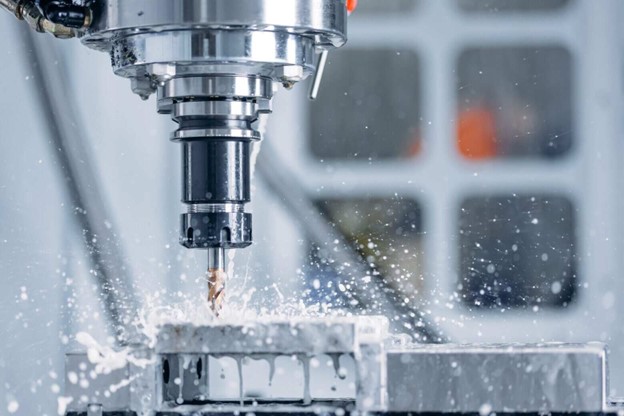
Step 1: Develop the CAD design
CNC machining starts with a CAD model that specifies dimensions, tolerances, and geometries. This step answers what is CNC machining is from a digital perspective, where design precision sets the foundation for high-quality CNC machining results.
Step2: Turn CAD to CAM Toolpath
Here, the CAM software translates the design into cutting paths in the CNC machining process. The choice between varying types of CNC machining, for example, milling or turning, is made here according to the geometry of the part and the desired production goals.
Step 3: Generate G-code instructions
CAM system transforms toolpaths into G-code, driving the machine movements. This is one of the main advantages of computer-controlled machining: accurate, repeatable control without human intervention.
Step 4: Material Selection for CNC Machining
Selecting the right material is the next most critical step in the automated CNC-based machining process. Due to strength, endurance, and reliability needs, especially high-precision CNC machining for OEM parts, metals or plastics are selected.
Step 5: Setup process on the machine and the preparation step
At this stage in computer-controlled CNC operations, the part is held in a fixture or chuck. The features of CNC machining, elimination of manual stairs for high precision, hence very low error and scrap, are best realised when the setup is done properly.
Step 6: Load cutting tools
Selecting cutting tools depending upon the material and the types of CNC machining involved. Once the tool offset is correctly transferred to the controller, the process will be stable.
Step 7: Simulate and dry run
A cycle test to validate the machining process using CNC systems is ready for full production. This step shows how it differs from manual methods by eliminating human errors through simulating a program through digital simulation.
Step 8: Execute machining operations
G-code tells the machine how to remove material. According to the selected computer-controlled CNC operations, milling(most of the time), turning, or drilling operations are performed, providing a consistent CNC machining output.
Step 9: Burr removal & surface reconditioning
Trims edges, and if required, finishes are applied after it is cut. It is critical for enhancing part quality and, in fact, represents the key advantages of CNC-based machining, delivering finished parts directly.
Step 10: Inspection and quality check
Finally, the last inspection confirms that the measurement, as well as the tolerances, are to specification. This guarantees that each part is produced to stringent quality and performance standards for high-precision CNC machining for OEM.
Different Types of CNC Machining Used in the Industry
This knowledge of the types of CNC machining allows the manufacturer to choose the correct equipment for the job according to the accuracy and speed required, as well as the compatible materials. We will describe each of the options below, covering the role and offering practical advantages for applications.
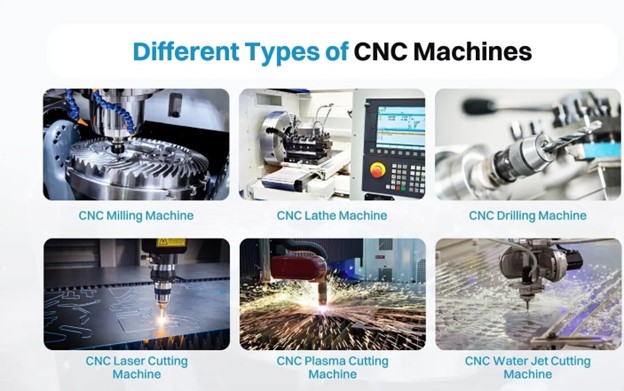
1. CNC Mills
Instead, CNC mills remove material using rotating cutters via drilling, facing, and pocketing. CNC machines are the heart of the automated CNC-based machining process and are among the most common methods to produce 3D parts.
2. CNC Lathes (Turning Centers)
CNC lathes cut parts from a rotating workpiece held in place in a fixed position by using a stationary cutting tool to produce cylindrical shapes. It’s a standard type for shafts, bushings, and round parts.
3. CNC Routers
They are like mills, but lighter duty, and used for softer materials; think wood, plastic, and foam. They offer the versatility of CNC-based machining for two-dimensional and three-dimensional cutting operations.
4. CNC Plasma Cutters
High-temperature plasma quickly cuts conductive metals. Because this type of computer-controlled CNC operation takes place only inside a plane on the XY-axis, it is perfect for quick, rough cuts on steel and aluminum sheets.
5. CNC Laser Cutters
When it comes to high-precision cutting and engraving, CNC laser cutters work using focused laser beams. They illustrate the data-driven advantages in providing clean edges and fine features.
6. CNC Waterjet Cutters
Cold cutting is done with high-pressure water, with abrasives from an industrial waterjet cutter, often CNC controlled. It is an ideal CNC machining process for materials sensitive to heat.
7. CNC Drills
CNC drills are used to automate the operation of drilling, tapping, and boring. These have often been adapted and integrated in mills, enhancing the efficiency of high-precision CNC machining for OEM manufacturing.
Choosing the appropriate varieties of automated machining methods enables manufacturers to process the machining, controlled costs, and achieve stable and consistent results on standard and high-precision CNC machining for OEM projects.
Advantages of CNC Machining for Manufacturers
CNC machining offers a slew of benefits that positions itself as a go-to option for manufacturers in need of precision, speed, and repeatability. Along with a tailored machining process using CNC systemsand production planning, these advantages directly address the needs of modern manufacturing and OEMs.
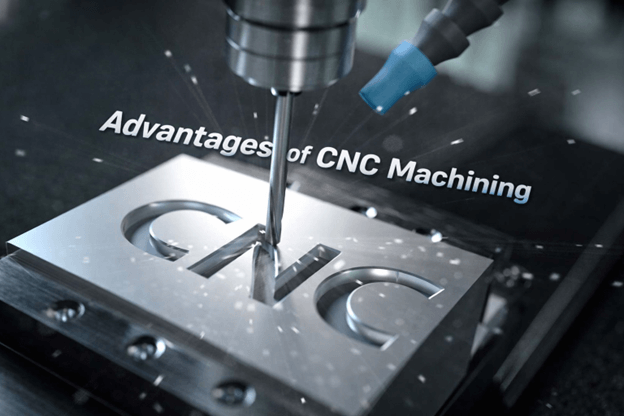
- High accuracy and tight tolerances: Another great benefit of CNC machining is the accuracy of dimensions. CNC-based machining is consistent in achieving the same accuracy with every run.
- Consistency across production volumes: It provides consistency of quality throughout the entire process. This is especially pertinent for the OEM parts.
- Flexible production using different methods: This ability to handle complex designs and changing requirements is another aspect of how multiple varieties of automated machining methods.
- Increased production speed and reduced lead times: One of the key features of effective CNC-based machining is the automation of the various steps involved, which makes it arguably the greatest time saver of the entire process.
- Price-building and lowering of material waste: Optimized toolpaths reduce scrap. These CNC machining benefits aid in cost control for high-precision computer-controlled machining for OEM work.
In conclusion, the benefits of CNC machining are conducive to reproducible production, consistent quality, and smooth processes. With the proper types of CNC machining and a managed CNC machining process, the result can be guaranteed for reliable manufacturing of general-purpose or OEM purposes.
FAQs
Q1. What Are the Applications for CNC Machining?
This process is used in the aerospace, automotive, medical, and electronics sectors to produce prototypes with high-dimensional precision and low production costs. CNC machining enables precision, replicability, and scalable production.
Q2. Which types of materials can be used in the CNC machining process?
It is clear that the CNC machining process supports anything from aluminum to plastic and composites, from all types of metals, such as aluminum and steel, to plastic and composite. The selection of all the materials is based mainly on strength and tolerance, as well as the application.
Q3. How does high-precision CNC machining for OEM help manufacturers?
Even in large pieces, OEM CNC machining with high precision allows for the same level of quality consistency. This lowers defects, increases accuracy with assembly, and is compliant with manufacturers’ and stringent standards of the industry.
Conclusion
Our modern world still relies on computer-controlled CNC operations as a core manufacturing technology. This enables it to be accurate, efficient, and versatile for a wide range of applications. This guide positions real production value from what is CNC machining is to the vertical machining process using CNC systems and categories of CNC-based machining. However, the computational advantages of CNC machining are why CNC is perfect for scalable manufacturing. By providing high-precision computer-controlled machining for OEM requirements, TMNetch enables manufacturers to take advantage of reliable results, excellent quality, and successful production runs in the long term.